The Sit Boy
Chaos in Vegas (Part I)
At 7:47 a.m., Dixon was running.
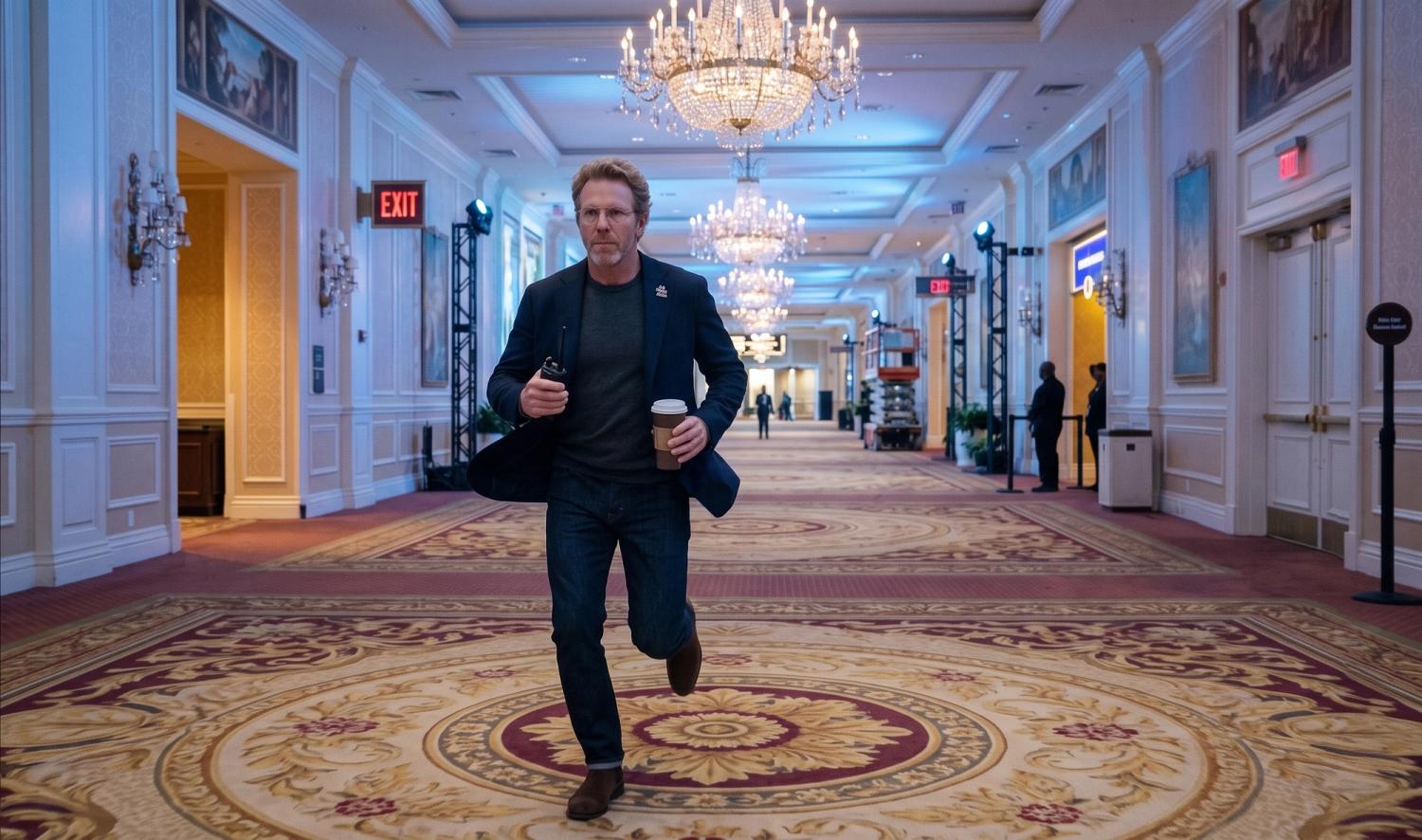
He was running down the main hallway connecting the Venetian Hotel to its convention center, which was wide enough to land a small plane and long enough that, by minute three of a sprint, you began to wonder if you had picked the right hallway at all. The carpet was one of those patterns that exist only inside large American hotels. The walls were lined with cherubs. The art was distinctly “Italian” in a sense that it was what the designers of a Las Vegas hotel thought it should look like to be “Italian.”
In one hand Dixon held a radio. In the other, a coffee that wasn’t his, because his Lighting Director Tara needed it and Tara was on the far side of the building. Tara got whatever she needed when the show was forty-eight hours and thirteen minutes from doors. On his lapel he wore a small enamel pin that read Not My First Rodeo. A vendor at last year’s event had given him a box of them. Dixon had been wearing one ever since, partly as a joke and partly because he really did believe what it said. This was not his first rodeo in any sense, although it might be his first circus.
The radio crackled.
“Dix, we’ve got a color temperature issue on the keynote stage,” Diego said. Diego, the production manager, was twenty-six and had been working for Dixon for two years and had the perpetual mild panic of a person three years away from being very, very good at his job.
“How far off are we?” Dixon said, still running.
“Oh, you know, we’re still getting that purple hue that the CMO thinks looks like Sony Playstation branding.”
“Oh he hates that,” Dixon answered, panting mildly. And the CMO did really hate that.
“What do you want Tara to do next?” Diego asked.
“Warm up the washes to twenty-eight hundred Kelvin. And tell Diego I’m two minutes out,” he said quickly, not really thinking.
“Tell Diego? I am Diego,” said a puzzled Diego.
“Well, tell yourself, then. And then please tell Tara,” Dixon said, embarrassed by the mistake. Dixon was typically good with voices over radios. Not always. He had worked a show in China many times where there had been a Chinese word that sounded just like his name and now he sometimes had PTSD every time he was on radio at all.
“Copy,” came the reply, from the somewhat hurt young man. Dixon would apologize later and he would recover.
One of two of Dixon’s phones buzzed in his back pocket. The personal one had been buzzing every six to nine minutes for the last forty-five minutes. It was Brenda from Marietta calling about the estate sale, which was happening back at home. He let it go to voicemail. The estate sale had begun at nine a.m. Atlanta time, which was six a.m. Vegas time. Dixon had been awake for it. He had been awake at four a.m. already working, so he was also tracking the progress of the sale even though he was two thousand miles away. He hadn’t had a moment to digest that people were lining up to rummage through his home, picking apart and taking away everything that he owned.
Brenda had assured him she had handled hundreds of these. Bobby and Brooklyn had volunteered to be on-site. Dixon had thought, foolishly, that “on-site” meant they would handle the on-site decisions. He was now learning that “on-site” meant they would be the ones calling him for every single decision and then patching Brenda in three-way. It was a game of Telephone that he really didn’t want to be playing. He wanted the stuff gone. He didn’t care how it went. But the three-Bs seemed to want his approval for every item whose price they were negotiating.
As he ran across the huge convention center lobby, with its giant windows to the outside, he took a quick look at the beginnings of the day. It would be the only time he, or any of his staff, would see the sunlight today. He turned in through the huge doorways of Hall B and crossed the chasm now lined with 25,000 chairs and reached the keynote stage. The stage was hundreds of feet wide with six enormous curving LED screens and a lighting rig that would have been appropriate for a Taylor Swift show. He took a quick scan of the scene. The fact that this canvas for modern storytelling had eaten up about $10,000,000 of the event budget wasn’t what he was considering. He was thinking about the hue of the lighting, which was still reading Playstation to him.
The Lighting Director, Tara, was up a ladder. Dixon’s Producer Imani was walking past with an armful of orchids, two of which were already wilting because the Vegas hotel was running at the humidity level of the Mojave in August. “Pretty dry in here,” she said with a sigh.
Tara was forty-one. She had black hair pulled into a low bun, a black Carhartt jacket over a black T-shirt, and the particular calm of a woman who had grown up in a family of four older brothers in Tucson and could weld. Her outfit is what people in the business call “Show Blacks” and gave her a Ninja-esque look. She had worked with Dixon as his preferred lighting director for nine years. The first thing she had ever taught him, in their first show together, was that he didn’t have to fix everything himself. She had taught it to him over the course of two months. She had taught it to him with the patience of a person who had unlearned it herself. Dixon’s job now, after nine years, was to deliver coffee to her, so she could keep functioning. And to stay out of her way.
He held the coffee up near the base of the ladder. Tara reached down without looking and took it.
“You’re a saint,” she said. “I seriously love you Dixon. Have I told you that this morning?”
“Not before now,” he said with a grin. “I love you too, friend. Can we maybe try to dial the Playstation out of the mix? The hue is still feeling really purple to me.” he asked very nicely.
“Seriously, Dixon, you are the only person that would even perceive that hue of purple,” she croaked.
“Well, unfortunately, that’s not true. There is one other person that will see that color hue. And he is the CMO of the very large company that is paying for this event,” he said as he turned and started to walk back away from the stage out into the sea of empty chairs. “Thank you!” he yelled over his shoulder with a wave. He knew Tara would fix it and that’s all he needed to know.
His back pocket buzzed. Brenda again.
“Imani,” Dixon called.
Imani turned. She was a stylish New Yorker in her late twenties, four foot eleven and a half inches tall, with braids pulled into a high knot and the kind of expression people developed when they had grown up the youngest of five siblings and had learned to get attention by being interesting. She wore Doc Martens, a denim shirt, and an event-staff badge clipped to a lanyard that also held seven keys, four zip ties, a roll of gaffer tape, and a Sharpie. The bundle of items around her neck jangled. It reminded Dixon of a reindeer, a very tiny one. He very much liked that image.
“I need to go take this,” Dixon said. “I’ll be in the hallway.”
He went back out into the lobby and stood in the wide carpeted nowhere between sections of the convention center and answered his phone. A group of workers was raising a 150 foot long banner into place, with an odd blue line running through the middle of a face in the graphic. He groaned silently to himself and turned the other direction so he didn’t have to look at it while he talked.
“Hi Brenda.”
“Dixon, hi, sweetheart. Sorry to bother you Hon’.” Brenda’s voice was warm, gravelly, and Southern. She was clearly a person that knew the correct plural of the word ‘y’all.’ “There’s a man here who wants the king bed from the master bedroom.”
“Yeah, great. Sell it. I hate that fucking bed. Reminds me of sex, which I miss,” he snarked.
“Well, darlin’, see he wants it for slightly less than we had discussed.” Dixon knew where this was headed.
“What’s he offering?”
“Forty. Dollars. Forty dollars.”
Dixon closed his eyes. Somewhere down the hall, a cherub watched him. Something in him clenched. The clenching was in the area of his butthole.
“Brenda. It’s a Sleep Number bed with the raising and lowering heads and feet. And the built-in Chillpad. It’s like a six-thousand-dollar bed.”
“He says it has stains.”
“It does not have stains. It had a mattress protector over the built-in mattress protector for shit’s sake.”
“I told him a thousand.”
“Tell him eight hundred.”
“He’s saying fifty.”
“What the fuck? No. Brenda, walk away from this man. Walk away. He’s testing you.”
“OK, if I can get him to $500 are we good?” she asked, this time seeking permission more explicitly.
Dixon’s face was in his hand. “Yes Brenda. That’s fine. Thank you.” Dixon was struggling with the idea that all of these things that he had spent so much money on were being sold off for a fraction of their value, but he also knew that it had to be done.
A pause.
“Brenda, sell the bed. Sell it. I love you. I have to go run a show.”
“I love you too, sweetheart. Talk soon,” she said as she hung up.
I hope not, he thought. But he knew he would.
He hung up. He looked at the screen. Forty-six minutes since the previous Brenda call. New record. That was progress.
The next few hours were calm. By eleven a.m., the team had solved countless small problems and Dixon had not had to think a thought longer than a sentence. This was, in his experience, the optimal cognitive state for an event load-in. Anything longer than a sentence and you were spinning. Spinning was time you weren’t using to walk to the next problem.
The next problem walked toward him in the form of Janelle, the senior vice president from the host company of the event, which was called “AI Galaxy,” which Dixon thought sounded a bit plain for the level of budget that was being put behind it. Janelle was small, blonde, and very put-together in the way that the Silicon Valley crowd was very put-together. She was wearing the gentle smile of a person about to ask for the impossible while pretending she was asking for the very possible.
“Dix, first, everything looks amazing,” she said, touching his arm lightly. “You’re a genius. You know that, right?” Dixon could see her from a mile away.
“Thank you, Janelle. We so appreciate your partnership,” he said warmly. Inside he was getting ready for it.
“I had a thought.”
Yep, she’d had a thought. Here it comes. What impossible thing will she want? He thought of the impossible things he had been asked in his career. There was the time someone wanted to bring a real space shuttle to the third floor of Moscone West in San Francisco. There was the time that another company wanted sky divers to jump out of a plane, with BMX bikes, and drop directly into a half-pipe on the top of a convention center. I mean, how bad could it be? “Well, you know, I LOVE your thoughts. What’s up?” he asked.
“What if we did cupcakes for the morning keynote? Like just had them under their chairs and then when Pat’s finishing his segment, everyone reaches down and BOOM cupcakes!” Great idea right?! To say thank you for being here.” Dixon indeed liked her enthusiasm. He wondered if she had practiced saying all that beforehand.
Dixon stopped moving. He looked at her. Janelle was holding her phone in both hands and watching him with what she had probably practiced as openness in front of the mirror in her room.
“So you mean. . . you’re talking about cupcakes for twenty-five thousand people,” he said.
“Just an idea,” she stopped short of adding “that won’t be too hard will it.” She didn’t say it, but Dixon felt it.
“Janelle, that’s like three container loads,” he said, resigned to the fact that this was already not just an idea.
“Or we could do a smaller version. Maybe just the platinum tier. That’s just six thousand,” she said sweetly.
“Six thousand cupcakes.” This was now a request.
“Well, you have until tomorrow morning, so I’m sure it won’t be a problem. I just thought it would be a nice touch,” her eyes were thanking him.
“Janelle,” Dixon said with his nose bowed into his hand, his fingers on either side of his nose as if he was about to rub his temples, which he did not do.
“Yes?”
“I’ll see what I can do.”
“You’re the best, Dix. I mean it.” She gave him one of those small executive nods that meant thank you for not making me explain myself to my CEO. She continued down the hallway, walking in a way that looked like she was pleased with herself.
Dixon raised his radio. “Imani, I need you to find me six thousand cupcakes by seven a.m. tomorrow. Don’t ask why. Just find them. Buttercream, mixed flavors, nothing weird.”
There was a long pause, in which Dixon could imagine everyone else listening on the channel being glad that they were not named Imani.
“Six thousand,” Imani said. It was not a question. It was a request for confirmation.
“Six thousand.”
“Copy.”
That was their entire exchange. No drama. No bitching. Dixon knew the political reality. Imani knew that Dixon wouldn’t have asked had there been any way to avoid it.
This was the gift Imani had that no one else on the team had. Other people, when handed an impossible request, asked clarifying questions. Imani asked one word and started making calls. Dixon had once watched her source three dozen Alpacas with custom printed sweaters from a farm in Reno with three hours notice. He had stopped wondering how she did it.
Lunchtime was approaching and Dixon was hungry. But the call came at 12:14 p.m.
Dixon was standing in the expo hall watching a crew lay cable across a floor the size of many football fields. The phone rang. Not the radio. The actual phone. The work one. The one that only rang when something had to be escalated right to the top. Right to Dixon. He answered it and held his breath.
“Dix,” said Justine.
“Go for Dixon,” he said, trying to be funny. Justine’s voice already had told him, in one word, that this conversation wasn’t going to be funny.
Justine was the show’s executive producer. She was based in New York and was supposed to be headed for the airport. Dixon could also hear, in the first syllable of their conversation, that she was not calling about her flight.
“We have a problem,” she said.
“Okay,” his head went back into his left hand. He rubbed his temples with it this time.
“Jon cancelled.” By Jon she meant the many Platinum record selling rock star who was headlining their concert in two days.
Dixon felt his stomach drop. He stood very still in the expo hall. The crew kept laying cable. He felt his free hand close into a fist, then release, then close again, the way a hand sometimes does when the body is trying to find something to do with itself.
“Why?” Dixon said, not really knowing why he asked the question. He was mostly just stalling for time.
“Strep.”
“Strep? As in throat?” Dixon asked.
“Yeah, his people just called. Obviously he can’t sing with Strep,” she said flatly. She was a rather un-dramatic person anyway, but this was even less dramatic than normal for her.
“You’re sure?”
“Dix, he’s in a clinic in Malibu. He’s out.”
“Okay fuck. That is the absolute last thing we needed,” he said in his calmest voice, which was masking his state of panic.
“What are we going to do?” she asked.
Dixon looked at the cable on the floor. He looked at the empty stage at the far end of the hall, where in less than forty-eight hours 25,000 people would be expecting a special performance by an artist who would now not be there. He felt, briefly, the way he sometimes felt at the very beginning of a project, before any of the design existed, when the room was empty and the budget was a number and the concrete of his plans had not yet been poured. He had not felt that way in months. He had not expected to feel it today. This was going to be a challenge.
“I’ll call you back in ten minutes,” he said.
“Dix?” she asked.
“Ten minutes.” He hung up.
He started walking. He walked the wide carpeted aisle of the expo hall toward conference room four. He did not think and he did not plan. He didn’t say anything into the radio yet. He needed a minute to do this particular thing his brain did before it started to design something, and that thing required walking and being quiet.
He stopped in the hallway outside room four. He picked up the radio. He sighed and composed himself.
“Team. Everyone,” he said. His voice came out steady. “I need all of you to drop what you’re doing and come to conference room four. Right away. We have a situation.” He paused and took a long deep breath. “Jon cancelled.” He lifted his finger off the radio button and the radio made a click as if to say “full stop.”
There was a five-second silence on the radio.
“Are you FUCKING kidding me?” Tara yelled across the radio.
“I am not fucking kidding you,” Dixon said as calmly as possible.
There was silence. Dixon clicked the radio back to life. “Bring laptops. Bring phones. Bring contact lists. Bring whiskey if you like.”
The radios were silent as Dixon’s team started running toward conference room four.
The conference room was a windowless beige box that the Venetian set aside for event teams who needed somewhere to have crises in. The team filed in. Tara, Diego, Imani, Marcus the stage manager, three PAs, and two interns.
Marcus was sixty-three. He had been a stage manager since the Reagan administration and had the calm of a man who had once dealt with a literal fire in a literal theater and had not raised his voice. He wore a vest with thirty-one pockets. He stood at the back of the conference room with his arms crossed and waited.
Ten people. One whiteboard. Two days to plan an event for 25,000 people.
Dixon picked up a marker. The team was looking at him with the kind of attention people give a person they trust who is about to ask them to do something hard. The room was silent.
“Okay,” Dixon said. “Our headliner cancelled. We are not going to find another headliner that can carry this show on their own. We are not going to spend the hours we don’t have chasing an A-list replacement that we cannot land. So we are not going to do that.” Dixon was thinking out loud.
The team did not relax. The team was waiting. One of the interns seemed to be crying softly.
“We are going to do something else,” he said looking at the blank board.
“What?” Diego said.
“We’re in Vegas. Vegas is full of the most random set of talents anywhere on the planet. So. . . we are going to host the most Vegas circus carnival that has ever been staged in Las Vegas.”
Tara made a small involuntary sound that was not quite a laugh. The other intern started crying.
“Let’s start with Cirque,” Dixon said, ticking on his fingers. “Donny and Marie. The Blue Man Group. Any of them. Or their understudies. Or their understudies’ understudies. Magicians. Fire-eaters. Contortionists. Sword swallowers. BMX trick riders. An eighties Vegas review band. We definitely need karaoke. How about improv comedians? A stilt walker. A balloon artist who can do something other than dogs. Showgirls in feathers. Dueling pianos. A guy who plays piano while juggling. I once saw a guy who plays piano while juggling and I bet I have his card somewhere.”
“You want a circus,” Tara asked incredulously.
“No! I want a Vegas circus!” He made a grand gesture with his arms. “I want the Cirque-meets-the-strip-meets-the-eighties carnival of fever dreams. I want this to be something that attendees will remember for the next ten years. I want them to forget that there was supposed to be a concert. I want them to call their partners from the floor and say ‘you would not believe what’s happening here right now.’ “
There was a moment. The team was thinking. Marcus, from the back of the room, uncrossed his arms. He looked around. He was already planning how to move things around the room.
“I can get Cirque,” Imani said.
“Really?” Dixon asked.
“I went to high school with one of their producers in Montreal. He owes me. He has owed me since 2008. I will collect that debt.
“What does he owe you for?” Dixon asked, with a sideways look.
“I’d rather not say,” she shot back.
“Great. I do not need to know. Get him on the phone.”
She was already dialing.
“I have a guy who books Vegas review bands,” Tara said. “He’s based in Henderson. He’s going to think this is the funniest call he’s ever received. He will be very excited to help.”
“Perfect. Call him. What else team?” Dixon scanned the room.
“Magicians I can do,” Diego said. “I worked a corporate gig in May with a guy who was friends with a guy who got fired by David Copperfield.”
“OK, not the credential I would have led with,” Dixon said. “But get him on the phone. Let’s go people. The clock is ticking.”
And with that, the team scattered. Dixon stayed at the whiteboard. He wrote across the top, in marker, the words AI GALAXY: THE ‘WHAT HAPPENS IN VEGAS, ONLY HAPPENS IN VEGAS’, CARNIVAL OF EVERYTHING. He underlined it. He capped the marker. He felt, against everything that he should have been feeling, very calm.
Then he uncapped the marker again and added, underneath, in smaller letters: Hard nos: animals, anything illegal, anything that requires water.
His phone buzzed. It was Brenda from the estate sale.
“Hi Brenda,” he said, walking to the corner of the conference room.
“Sweetheart, sorry to bother.” She was almost whispering. “The espresso machine.”
“Yes?”
“A woman wants to give us forty dollars.”
“It is an eighteen-hundred-dollar machine.”
“She says the levers are stiff.”
“The levers are stiff because it is a NEW, and high quality espresso machine. It was handmade by an Italian craftsman to last forever.” Dixon pressed his free hand against his temple. “Brenda, I love you. I trust you. Use your judgment. I have to go run a circus. I will call you back.”
“Got it,” she hung up.
Dixon turned back to the room. The team was on phones in clusters around the room, speaking in the urgent low voices of people who had been given permission to do something extraordinary but challenging.
His personal phone buzzed again. He looked at it without thinking. It was Meg from Dallas.
Meg: Hey :) any chance you’ve got fifteen minutes for that drink today? I’m at the Westgate.
He typed back: Unlikely, but will try. Catastrophe in progress.
She immediately wrote: Fingers crossed. ❤️
He pocketed the phone. He looked back at the whiteboard.
“Okay,” he said to no one. “Let’s fucking go!”
The next four hours were a fever dream of yeses.
Dixon stood at the whiteboard like a very calm conductor of a very loud orchestra and took proposals from his team as fast as they could surface them. Each proposal arrived attached to a question. The question was always the same.
“Cirque can do a six-person aerial silk routine and a contortionist,” Imani said, with her hand over the microphone on her phone. “They have a touring team between shows in San Diego that can fly in.”
“Absolutely, yes,” Dixon said.
“Donny is in. Marie is at a wellness retreat. Donny would be solo.”
“Donny solo is great. Get him,” Dixon replied as he wrote Donny on this whiteboard.
One of the interns shouted, no longer crying: “BMX trick riders. From the X Games scene. They can do a half-pipe in the lobby.”
“Yes! Flying bicycles again. At least they aren’t coming by parachute,” Dixon said as he scribbled.
“I have fire jugglers,” Diego called from the corner.
“Yes,” Dixon replied then asked, “what kind of fire are we talking about?”
“Real fire. Probably on the ends of things one juggles.”
“Alright . . . fire is not necessarily a problem. They will need insurance. Get them an insurance rider. Get them sand. Tell them twelve-foot perimeter, roped, with a fire crew on standby. And call the Fire Marshall please.”
“Two karaoke stages or one?” one of the PAs asked.
“Two. Definitely two. One will be grunge and one will be disco” Dixon said.
“Sword swallower?” Diego asked.
“100%. No circus or carnival is complete without a fucking sword swallower!” Dixon yelled over the din in the room.
“He wants to know if we care what kind of swords he uses,” Diego asked.
“Diego, I do not need to know about the swords.”
“He says it matters for the act,” Diego answered.
“Just tell him yes, please. Sword swallower’s choice.”
“What about a guy who juggles small people,” said the second intern, a young woman whose name was Priya and who had just put her phone against her shoulder. As soon as the sentence left her mouth, she heard it back in the silence of the room like an echo. Everyone stopped.
Dixon, very calmly, turned to her.
“Priya.”
Priya braced.
“We are not having anyone juggle anyone, no matter what size they are. That isn’t a thing we are doing. Hard no.” Priya started to point at the list of ‘hard nos’ on the whiteboard, but Dixon just gave a look that said “stop.”
“Sorry Dixon,” she said with her head down.
“It’s ok. Let’s keep at it, please,” he said nicely.
Priya nodded. Priya would never make that mistake again. She would, two years later, tell this story to her younger sister with great affection. She would always credit Dixon as the boss who corrected her without humiliating her.
Tara, smoothly, like a person who had not just witnessed the previous moment: “Topless dancers?”
“Hard no,” said Dixon immediately.
“What if they’re. . .” Tara started to say.
“Tara!”
“Okay. Hard no,” she said. “Maybe we need to add some more to your ‘hard no’ list on the board,” she grumbled.
Dixon paused. Someone had turned on music and Phish was playing. “HEY, WHAT IS MY RULE ABOUT PHISH?” Dixon shouted into the room.
One of the other PAs raced toward the computer playing the music and yelled, “sorry Dixon!” en route. “I forgot about the no Phish rule.”
“Magicians?” Diego said.
“Like Sigfried and Roy?” Dixon asked.
“No, more like Tina and Ray, from Cleveland.” Diego answered.
“OK, yes. Get all the magicians,” Dixon said.
“A guy who’s a really really ‘old Vegas’ regular and who is very available because he just got fired by his third casino since the 1990s?” one of the PAs asked.
“What’s his act?” Dixon asked, crinkling his nose as he said it.
“Card tricks and racy banter.”
“Get him,” Dixon said without hearing the answer.
“His banter is. . .uh. . . pretty salty,” she said despite the yes.
“How salty?” Dixon asked, suddenly paying more attention to the conversation.
“I think he was recently fired for calling people ‘Sweetheart’. Or maybe it was ‘Sugar.’”
“Well Sugar sounds very ‘Old Vegas’. OK, absolutely, no swearing. And whatever got him fired, none of that tonight. Got it. But get him. Card tricks are very Vegas,” Dixon said, already regretting his decision.
Imani, looking up from her phone: “What we need is an MC.”
Everyone stopped. Dixon looked at her. The team looked at her. Then the team looked at Dixon.
“No,” Dixon said.
“Dix,” she pleaded softly.
“No,” he said more firmly. Dixon was known to MC on occasion, but he was definitely not in the mood.
“You are the only person on this team who has done this enough times,” Imani said, with more vigor.
“I have never done this,” he said. “There is no person on this earth who has done this. I can’t imagine what I would say with this level of chaos happening. It would be like MCing Burning Man. There is no MC for this. I am not MCing a four-hour Vegas carnival in front of twenty-five thousand AI executives.” Dixon knew he was arguing with himself. If there was no one else, he would have to do it.
“There will be attrition. The audience will be smaller than that on closing night.”
“There will still be a shit ton of people Imani. And they will all be drunk.”
“Yes, that is true,” she conceded.
“Find someone. Please. I really don’t want to do it Imani.” He said it, but he knew had lost this one. He was already thinking about what to wear.
“I will find someone. I’m asking you as a fallback,” she said with more compassion now.
He pointed at her with the marker. “Find someone. Please.”
She nodded. She went back to her phone.
His phone buzzed. He glanced down. It was Brooklyn texting him.
Brooklyn: Dix. Are you sitting down?
Dixon: I am not.
Brooklyn: A guy wants your Rolex. He only wants to pay forty dollars.
Dixon stood still. Forty dollars for a fucking Rolex? He thought. The guy’s got balls.
Dixon: The vintage submariner that belonged to my father? He was confused because there were a few things that weren’t supposed to be in the sale at all. They were all in a small walk-in closet by Dixon’s office. The door was closed and there was tape across the frame that said “CAUTION DO NOT ENTER.”
Brooklyn: Yes.
Dixon: Tell him to fuck off, Brooklyn. Tell him no. Tell him absolutely not. The Rolex is not for sale. Pull it now. Take it. Keep it for me. He is not getting it for forty dollars. And please go check that no one is in the off-limits room. If Brenda sells the two books from my Dad I am not paying her for this sale.
Brooklyn: Got it. Pulling it. Holding it for you. Making sure that the room is still closed.
Dixon: Thank you. He felt bad for scolding her, but he was concerned about the breach in protocol. He had been assured some things would be kept safe. That included two first edition signed books from the 1920s that his dad had given him and a number of nearly priceless baseball cards that he had not had time to sell.
Brooklyn: Magnolia says hi.
Dixon stared at the screen. Magnolia could obviously not say ‘hi’. Magnolia mostly blinked and sometimes put her chin on a person’s knee when she wanted something. But he understood Brooklyn’s gesture. She was being kind, even after he had been sharp with her.
He typed back: Tell her I miss her face.
He pocketed the phone. He looked up.
“Okay,” he told the room. “Where are we?”
By six p.m., the carnival was a full-blown Vegas circus. Dixon was amazed at times what his people could pull off in a pinch. They were pros. It was their job to do the impossible. They were doing it.
Imani had Cirque. Tara had the Vegas review band. Diego had the magicians and a sword swallower who was, by all accounts, the only professional sword swallower currently working west of the Mississippi. Marcus had the BMX team and was talking to the head rider on the phone in the lobby about half-pipe weight distribution.
The whiteboard had filled up. Twenty-eight acts. Three stages. A roving balloon artist. A guy who would walk the expo hall on stilts dressed as Elvis. A psychic who would do five-minute readings. A pizza cart, which Imani had thrown in for reasons Dixon did not have time to question. An eighties Vegas review band called the Stardust Five, who had agreed to come out of semi-retirement for the night because their lead singer was deep into his AI hobby phase.
His radio crackled.
“Dix.” It was Marcus, who never used the radio for anything routine. “Lobby of the convention center. Now. Please boss.”
“Why?” Dixon was afraid to ask.
“Just come. I need your help with something,” Marcus said back.
Dixon, who had learned over the course of the last fifteen years that Marcus on the radio meant something rare, walked less hurriedly down to the lobby than he probably should have. He was getting tired. His feet hurt. He had already logged 36,898 steps today. And the day was not even close to over.
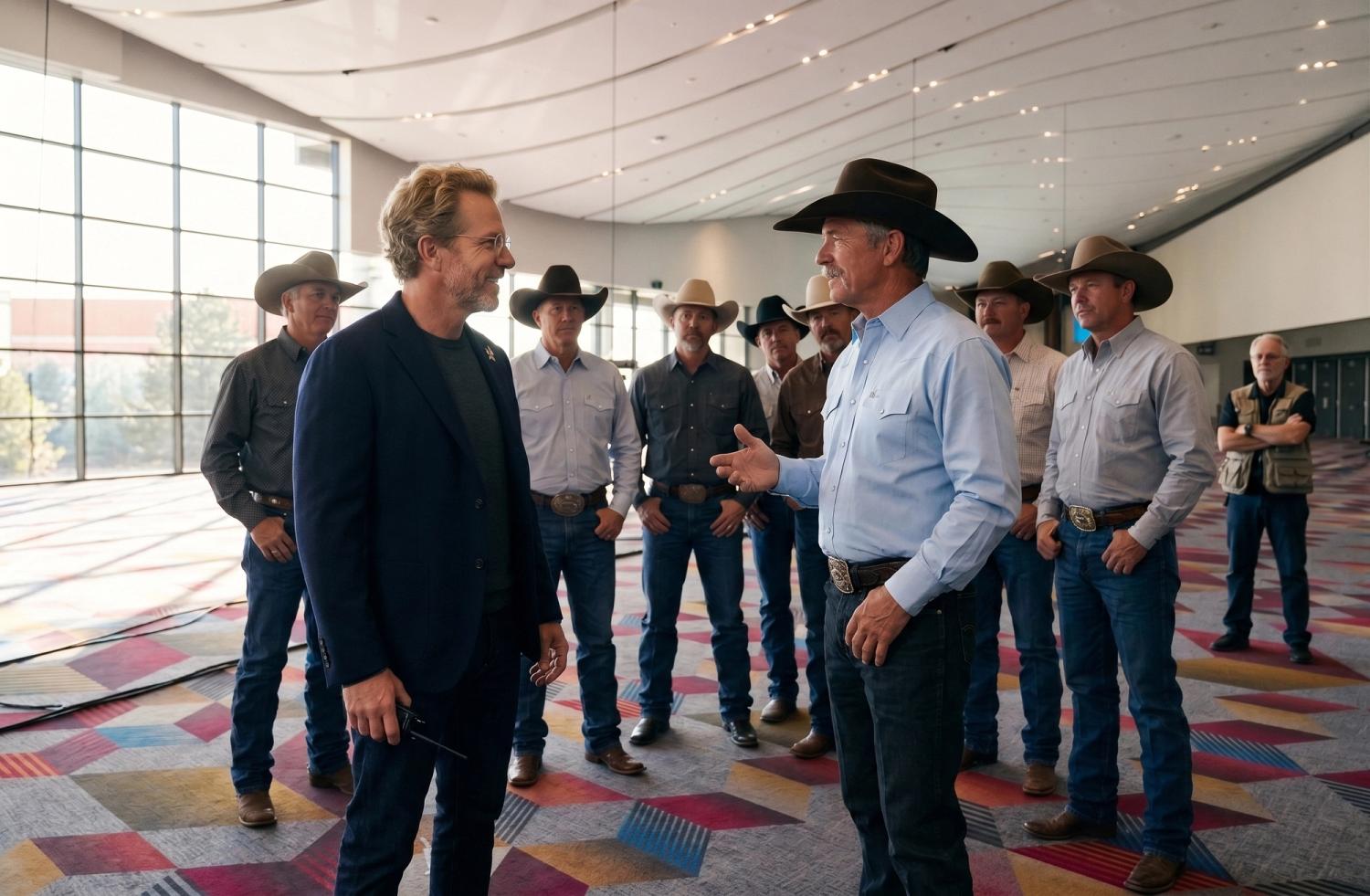
There were eight cowboys in the lobby of the Sands Convention Center talking to Marcus.
They were in full Western attire. Dressy, clean, formal Western wear. They had on cowboy hats, tall leather boots, silver belt buckles the size of license plates. Dixon could immediately tell these were real cowboys from somewhere in the West. They were not the kind of decorative cowboys that Vegas hotels sometimes hired for ambiance. The National Rodeo Finals were in town this week at UNLV, which Dixon had already noted from the many cowboys and cowgirls wandering around the casino the last few days. He had ridden the elevator with a couple of them too. He eavesdropped on a conversation about who was the best horse vet in Texas in the elevator that very morning. He liked their hats. He filed the thought.
These eight cowboys were also, he quickly sensed, somewhere between mildly buzzed and deeply committed to their night out on the town.
“Howdy,” said the lead cowboy to Dixon as he walked up. “You the boss? They said they were calling someone.” He sounded a bit like a sheriff in an old Western film. Stern and confident, without being menacing.
“Howdy sir,” Dixon said. He held out his hand and shook hands with the lead cowboy. He glanced around at the others with a smile of acknowledgment.
“See, we’re trying to get to the Sphere. And I can see that the door to the Sphere is right over there.” He pointed past Dixon down a long hallway to a door that led outside of the building to the Sphere.
“Yes, there is in fact a way to get to the Sphere through here, but the lobby is closed to the public for a private event.”
“So we can’t go through?” he asked politely.
“Through where?” Dixon asked, knowing the answer, but testing the cowboys’ will more than anything.
“Through here.” The lead cowboy gestured broadly with both arms at the convention center lobby, at the AI Galaxy signage, at the entire gigantic event that was set up in his path. His gesture knocked his hat sideways, which he corrected without missing a beat.
“Sir, I’m sorry, but you can’t cut through,” Dixon said. “There is another walkway to the Sphere accessible from the Palazzo Lobby if you cut through the Forum Shops. There’s a sign posted about a hundred yards back about this.”
“That’d be quite a hike,” he said wearily.
“Yeah, it’s about a six-minute hike,” Dixon replied.
“See, these are our formal boots. These boots ain’t made for walkin’,” he said. Dixon suddenly had the song “These boots are made for walking” in his head. He looked at the boots. They were, he had to admit, beautiful boots, and didn’t appear to be designed for walking.
The cowboy looked at Dixon’s lapel. He leaned forward, wobbled a bit, and squinted.
“Not My First Rodeo,” he read slowly. He looked at Dixon and grinned. “Well, shit, mister. That’s a hell of a pin to wear to your first rodeo.”
Dixon laughed. The laugh came out of him in a way that surprised him, the way real laughs sometimes do when the body has been holding too much in.
“I’m not actually going to the rodeo,” Dixon said. “It’s just an expression. It’s not the literal kind of rodeo.”
“What kind of rodeo is it then?” asked the now confused, drunk, cowboy. A few of the other cowboys were nodding in agreement with him. They were confused too.
“The kind where you set up a circus in two days because a rock star got strep.”
The cowboy nodded slowly. He didn’t understand. “That sounds hard.”
“It is.”
“I’m Earl,” he said, pointing to himself.
“Dixon,” he replied with a warm smile.
Earl held out his hand again. Dixon shook it again. This time Dixon sensed that Earl’s hand was hot and dry and rough across the palm, with calluses in places that suggested he worked hard for a living with his hands. Dixon’s hand was, by comparison, the hand of a man who worked on a computer. The handshake was the kind where the cowboy was deciding, in real time, whether the man on the other end of his hand was someone he could work with. Dixon had not known he had wanted to pass this test, but now he desperately did.
“Look, Dixon,” Earl said. “Here’s the thing. We are gonna walk through your hallway. We are not gonna cause any trouble. We are gonna walk in a straight line. We are gonna walk fast. We will tip our hats to anyone we see. And in three minutes you will never have seen us again.”
“Earl.”
“Yeah.”
“You cannot walk through. I do not have the authority to let you walk through. The venue does not have the authority to let you walk through. The fire marshal would lose his mind if you went through that door down there.”
“What if we walked real polite like?”
“Sorry, still no,” said Dixon.
“What if there’s a hundred-dollar bill in it for you?” Earl said, tilting his head a bit as he said it, as if he were telling a secret.
Dixon laughed again.
“Earl, that is very generous of you, but I still can’t let you though.” Dixon wanted to let them through, but he knew he couldn’t. Even at his level there were things he couldn’t do.
Earl laughed, too. He turned to his guys. “Boys, we gotta walk. Around,” he said in a resigned tone.
“Goddammit, Earl,” said one of the other cowboys back to him.
“In these boots?” complained another.
“Let’s go boys,” Earl said, motioning at them like they were lost cows.
The cowboys all started ambling back toward the hotel. Earl turned back one last time.
“Hey, Dixon,” he said.
“Earl sir?” Dixon said politely. Dixon could tell he liked Earl.
“Where’d you get the hat?” Earl asked.
Dixon furrowed his brow in confusion. “What hat Earl?”
“That’s my point. You’re not wearing a hat, son. You need to get a hat. You’d look good in one of these,” he said pointing to the brim of his hat.
Dixon smiled. “Tell me where.”
“Cowtown Boots, off Sahara. Ask for Linda. Tell her Earl from McAlester sent you.”
“Thank you Earl. I will.” Dixon didn’t really mean it at that moment. But something drew him to the hat. He had a good feeling about the whole exchange.
“Don’t get a felt for Vegas. Get a straw. Felt’s for winter,” Earl said as he moved his cowboys away.
“Got it. No felt. Thanks Earl.”
“Good luck with your circus Dixon,” he shouted back from several yards down the hall.
“Good luck with your rodeo,” Dixon shouted after him.
The cowboys disappeared from view. Marcus, who had been watching from twenty feet away with the expression of a stage manager who had no protocol for the cowboys-in-lobby scenario, walked over to Dixon.
“You handled that just fine,” Marcus said.
“Marcus.”
“Yeah.”
“Add getting a cowboy hat to my list,” Dixon said.
“The list of what?” Marcus asked.
“Of things I’m going to deal with after the event closes. Write it down for me please.”
“Copy that,” Marcus said. He took a small notebook from one of his thirty-one vest pockets. He wrote it down.
Meg texted at 7:14.
Meg: Drink? I just finished my session. Bar at the Wynn?
Dixon: Meg, I’m running a circus. Maybe tomorrow.
Meg: How is that different from normal?
Dixon: No, a real circus. Long story.
Meg: Drinks tomorrow then?
Dixon: OK. Drinks tomorrow.
Meg: I left something for you in an envelope on your computer. 🫦
Dixon cringed a little. Thanks. I will be back in the office in a bit.
She sent a heart, a martini, and a galloping horse emoji. Dixon, who still did not understand the horse, pocketed the phone and walked back to the staff office. He sat down at his computer. He opened a small pink envelope with ‘Dix’ written across the front. Inside was a pair of pink mesh panties. He groaned and closed the envelope. Good lord, he thought to himself.
Lyrics
[Intro]

[Solo acoustic guitar, close mic, gentle entry]

[Verse 1]
Seven forty-seven and I got Cherubs watching me
Somebody else's coffee, somebody else's voice
Wash is going purple, lots to do by morning
Body keeps moving when the mind wants to spin

[Chorus]
Let it come, let it spin, let it ride
Pin on the chest, takin' it in stride
World gets loud, body knows where to go
No, this ain't my first rodeo

[Verse 2]
Phone keeps lighting up between the radio calls
Her name on the screen — she's chasing, I'm trying to stay clean
Pink mesh in an envelope — boldest thing I've seen
She's texting me emojis — and I'm feeling kinda green

[Chorus]
Let it come, let it spin, let it ride
Pin on the chest, takin' it in stride
World gets loud, body knows where to go
No, this ain't my first rodeo

[Verse 3]
Phone's ringing again — every six minutes, every nine
Forty for this, eight bucks for that
But Magnolia's there — she's safe and she's home
Tell her I miss her. Tell her I'm coming home

[Chorus]
Let it come, let it spin, let it ride
Pin on the chest, takin' it in stride
World gets loud, body knows where to go
No, this ain't my first rodeo

[Bridge]
Amber lights come up, exactly where I built them
I can feel the people watching from the back of the room
It feels just like I meant it.
Pin says I've been here. Tonight I know it's true.

[Final Chorus]
Let it come, let it spin, let it ride
Pin on the chest, takin' it in stride
World gets loud, body knows where to go
No, this ain't my first rodeo
No, this ain't my first rodeo

[Outro]
No. This ain't my first rodeo.
By midnight, things were settling down. Dixon stood in the back of the empty expo hall and watched the crew put the finishing touches on the exhibits. The orchids Imani had ordered were, against all Vegas odds, surviving, because Imani had also ordered three industrial humidifiers. These had been delivered by a man with a thick Russian accent who had delivered them at eleven p.m. in a white van with no windows.
His back pocket buzzed. He pulled out his phone. He had thirty-one missed messages. Twenty-three from Brenda. Six from Bobby. Two from Brooklyn. He scrolled.
Sold the smoker. $50. To a guy in Cobb who is going to use it for ribs.
Sold the sous vide. $80.
Sold the Pantone book. The big one. To a designer. $40. She cried a little. She said it was her dream book.
Sold the chair. The expensive one. $90.
Sold the old chair from the spare room too. $35. To a guy who said he used to have one of them and couldn’t find a new one.
He shook his head.
He scrolled further.
Sold the brass telescope. $8. To a woman who said she’d put it on her bookshelf.
He stood in the empty expo hall and laughed for a few seconds quietly to himself. The reading with Mama Honu flashed through his head. He remembered looking at the telescope while she was telling him that his life was going to completely change. At the time, he hadn’t been able to imagine where all the pieces of his life might be headed. He now had some answers to some of them.
Dixon wrote to Brenda: Everything gone Brenda?
Brenda: Almost. Garage to do tomorrow. There’s a lot there. You sure you want it all gone?
Dixon: Brenda. Sell it all. Sell. It. All.
Brenda: You got it sweetheart.
He pocketed the phone. He walked to the keynote stage. Tara was up on the catwalk testing the cool wash she had warmed up thirteen hours earlier. The lights came up in the precise amber she had built. Dixon watched her work for a long second and felt something click. The purple hue was gone. It no longer looked Playstation. The vision he had had for this room eight months ago, with the exception of the circus, was coming into focus.
He walked back toward the door of the expo hall. His radio crackled.
Imani: “Dix. We found cupcakes.”
“IMANI. Have I told you that you are goddess today?” Dixon asked.
“You have not. But you can tell me in the morning. Six thousand cupcakes. We’re picking them up at five a.m.”
“You’re welcome Janelle,” he said, letting out a breath.
“You said it, Dix,” Imani replied.
“I did. I did indeed.”
The next morning, AI Galaxy opened in the bowels of the Venetian Hotel. The cherubs had been covered over with show graphics. Giant photographs lined the walls. Huge LED screens played videos. Formula 1 cars were on display. The final details of the show had been put in place at 7:58 AM.
At 8:00 AM precisely, the doors opened and a stream of twenty-five thousand AI enthusiasts filed in and filled the space absolutely to the brim. They looked at the videos. They visited the demos. They played the games. They mostly ignored orchids and hundreds of thousands of dollars of other florals. They ate the food. They consumed the session content. The cupcakes appeared, at the platinum breakfast, in a tower of buttercream, a tribute to the Leaning Tower of Pisa in the real Italy. The cupcakes, and thus the tower, vanished in nineteen minutes.
The keynote went off in Tara’s amber wash. Dixon stood at the back of the hall and watched the audience watch the speakers. He could feel the audience feeling the room, without knowing they were feeling it. He thought again, very briefly, of Mama Honu and her predictions, because this was the room he had been working on that day in his office. Some of his life had already changed. He was single, had a new car, had sold almost everything he owned, but he was still here doing this. He had a distinct feeling there was more to come.
But first, he had one hell of a circus carnival to run tomorrow night.
Published May 22nd, 2026 from near Capitol Reef, Utah.
Enjoying the story? Support the work →
All text, images and music copyright (2026), Slightly Moody Creative LLC and Joe English.