The Companion Stories · Chapter 2
Placed Above

New Toronto, Northern Provinces · 2048
Part I: Seven Days
The room did not exist, officially, and Hix had always liked that about it.
It sat under a decommissioned construction depot on the southern edge of the city, past where the finished streets gave way to the construction fields, in a poured concrete box that drew its power from its own buried power cells and touched the city grid nowhere. The walls were lined in a dull gray metal that made his communicator show a flat dead face the moment he stepped inside. No signal in. No signal out. In a world where everything listened, the team, Enders' Humans, had built themselves the one room that couldn't hear.
"Last one," Ozzie said, from across the training floor. "Make it count, old man."
"I'm twenty-nine," Hix snarled.
"Dude you're a fossil." Ozzie grinned and rolled his shoulders and set his feet, and for forty more minutes they ran drills, the two of them and Mara and the two training Helpers. They worked on climbing transitions, code-under-pressure sets, and blind drops into unfamiliar terrain. They worked both on their physical and mental skills. Hix worked until his hands shook, and then he made himself stop, because the week that mattered had arrived, and the discipline now would be trying to rest before Worlds.
After they finished their drills, the four of them stood in the middle of the floor while the two Helpers powered down for the week. This was the part Hix hated. Enders had been with them from the beginning, a training Helper with a boxer's build and a dry way of announcing the score that had somehow become the crew's whole sense of humor. The team was named for him. Enders' Humans, that was the official team name that Ozzie had put on the form the year they founded the crew; the best players alive filing as the entourage of their own training Helper. The joke had stuck the way jokes do when they're secretly sincere. He was loyal in every way a machine could be loyal, and that was exactly the problem. A Helper that stayed awake in such a connected world was a Helper that might, in some casual exchange of data neither malicious nor careless, simply mention what he had seen. So before every major event they put Enders and the other training partners to sleep entirely, and Enders consented every time, cheerfully, with the same line every time: wake me for the good part. And there was always a small moment, as the light went out of him, that felt uncomfortably like a burial.
"See you on the other side," Mara said, and touched the dark, cold, metal of his chassis once, the way you'd touch a sleeping child's hair.
They sealed the room as they left. Outside, the evening was coming on, and the dome's light was banking down toward its long amber wind-down, and the three of them stood in the construction field between the finished city and the unfinished one and did not say anything for a moment.
"Don't think," Ozzie said finally. "This week, whatever you do, don't think. You've done the thinking. It's in your hands now. Let the hands have it."
"That's very wise, young one," Hix retorted snarkily.
"Well, I read it somewhere, old man. Probably one of your old rookie trading cards." Ozzie pulled him into a hard fast hug, thumped his back twice, and let go before it could become a thing. Mara took both his hands in both of hers and looked at him a moment.
"Say hi to Penny," she said. "Tell her we said the thing we always say."
"That she married down?" Hix confirmed.
"Yes, that she married down," Mara agreed, and they went their three ways into the city, and Hix rode the SubTerra home with his hood up so that no one would notice him. It was a week until the tournament, but his heart was already beating like it was about to start.
Penny heard him come in and knew his state of mind before he reached the kitchen. She suspected he would have the mental stability of a toddler this week. She would be dealing with two toddlers this week apparently.
It was the way he closed the door behind him confirmed where his head was at. He closed the door carefully, evenly, a man demonstrating calm to an audience of himself. There were other signs too. It was in his feet in the hallway, which were a little too quiet. Hix in an ordinary week was a percussion instrument, rattling through the world. He drummed doorframes in passing. He took stairs in patterns. His body ran a constant low broadcast of motion, and she had learned across their nine years together that the broadcast was him being fine, and that silence was the tell.
"Hey," he said, coming into the kitchen. "Smells good. What are we having, is that the mushroom thing?"
"Yep. It's the mushroom thing," she said and pulled him in for a tight hug.
He sank into her touch and then he whispered almost absently into her ear: "You know what would be good in it? Apricots. They had the first terrace apricots at the market today, there was a line, an actual line for them." He said it quietly, but with a specific enthusiasm he saved for talking about food and for nothing else in his life. "This whole city would riot without its stone fruit."
"You're not putting apricots in the mushroom thing," she whispered back in his ear.
"I'm just saying as an experiment," he said lightly, knowing that it was a bad idea.
"You're not experimenting on the mushroom thing the week of Worlds," Penny said, releasing him from the hug and pointing him toward a chair with the spoon.
"Fair. That's fair." He kissed her temple, took a bottle of water from the cooler, drank exactly half of it in one motion. He set it down and squared it neatly to the edge of the counter, which he had never once done with any object in his life.
"So it starts," Penny said, with a grin.
"What starts?" Hix asked, surprised.
"The week where you pretend you're a calm person." She said it lightly, and she turned to face him so he could see her face while she said it, because after nine years she had earned the right to tease him and he needed to see the love riding along with the teasing. "You aligned the bottle, Hix."
He looked at the bottle. He laughed, caught, and the laugh let about four percent of the pressure out of him, which she counted as a victory, because it was early in the week and there was a long way down to go.
Riley made her sound from the other room, the small rising note that wasn't quite crying yet, the note that was a question. Hix was moving before Penny had put her spoon down. That, at least, the week could not change. She stood in the kitchen and listened to him through the wall. He was using the low ridiculous voice, narrating the baby back down from the ledge of her feelings. And she thought, the way she'd been thinking all month: seven more days of holding two people together, and one of them doesn't know I'm doing it.
She heard the baby settle. She heard him stay in the other room anyway, five more minutes than needed, singing something with no tune to a child already asleep, and she stood alone in the kitchen with her hand flat on the counter and let herself feel the whole of it for exactly ten seconds, and then she plated the mushroom thing, because the discipline of this week was hers too, and nobody was going to give her a title for it, whether she earned it or not.
Hix’s reassessment had happened six years ago, and Hix still returned to the memory of it the way you recall a photo rather than a lived memory.
It was the year the game reforms were handed down. AIs and bots had just gotten too good in so many games. They were easily wiping the floor with every human player. The humans simply could no longer compete. The commission decided that in-person play, more physical elements, and a consolidation around one game which never employed the same set of tasks, was the only way to ensure that humans even still had a shot. Hix had built a career as the top player using his hands and his head, and suddenly the sport wanted his whole body, and his first events under the new rules had gone badly. He'd been beaten by players he had owned for years, big-shouldered humans, players who could climb. He was twenty-three and already a champion and for the first time since he was a boy the question had opened up under him like a pit in the floor: what if I am no longer what I was placed to be?
So he had done the thing that people in this world did, the thing his parents' generation still found strange and his own generation found as natural as medicine. He asked to be read again.
The assessment center was a quiet building near the education campus, and it had none of the theater you might expect. No chrome, no glowing walls. A room like a comfortable study, a chair that fit him precisely, and a voice that seemed to come from the middle distance, unhurried, warm the way a large room is warm.
"Hello, Hixon," it said. "Thank you for coming in. You could have done this remotely, you know."
"I know. I wanted to come. I don't really know why," Hix answered.
"People often do," the voice said. "Some questions feel too large to ask in your own living room. Shall we?" It said this pleasantly as if it needed permission from Hix to conduct some kind of test, even while it had already processed the data before Hix even came into the building. Perhaps even before Hix had asked the question. That was its job.
For Hix there was no scan, no test, no puzzles to work. There was only the strangest conversation of his life. The voice asked about the new game, and what it had felt like to lose, and he heard himself telling it things he had not told Penny, had barely told himself. It asked about his hands. It asked, gently, what he did in the last second before a decision, and when he said nothing, there's nothing in there, I just move, the voice was quiet for a moment in a way that felt like a smile.
"You're worried I'll take it from you," it said at last. "The placement. You're worried I'll read you again and find that now you’re supposed to be a game designer, or a strategist, or a coach maybe. Someone adjacent to the game instead of a player."
"Yes."
LUCkE continued: "Hixon. I placed you when you were fourteen years old, and I want to tell you something about that reading that I did not tell you then, because you were only fourteen and I didn’t want to overwhelm you then." The voice did not change, and yet the room seemed to lean in around Hix. "You were not a close call. You are, if anything, more thoroughly what you are now than you were then. The game has changed toward you, not away from you. That is all I will say. Some things I know are not useful to you yet, and telling you would only put them in your way. But I will say this much, because you came all the way here and you are afraid: keep playing. Oh, and call your mother more."
Hix had laughed, startled, and he had walked out into the daylight with his life handed back to him and something else besides, a thing he turned over for years afterward. The game has changed toward you. Perhaps it had known how the game would evolve, worked it out far ahead of time. Before the reforms were even written, somewhere in the enormous layered patience of it, it had known the sport would come to demand the body in order for the humans to stay in it. It had looked at a rail-thin fourteen-year-old with a champion's reflexes and seen, standing behind him, in his lineage, an ultramarathoner who conquered continents on foot and a woman who moved like water and felt what everyone in a room was feeling. It had stacked these pieces together in their intricate layers, and placed the boy accordingly.
He had never told anyone that. Not his teammates at Enders' Humans. Not Penny. It sat in him, private and enormous: the knowledge that the thing that ran the world had looked at his bloodline the way his mother looked at the night sky, and had navigated by it.
Part II: The Waiting
By the third day he had reorganized the equipment closet twice and Penny had begun hiding things for him to find.
It wasn't sabotage. It was a small mercy. A man whose body was built for motion and whose week forbade it needed small satisfying outlets, and so she left a cabinet subtly disordered, a drawer misaligned, and let him discover them. He would spend a contented forty minutes restoring order to a thing she had disordered on purpose, and he never once suspected, and she felt like a woman feeding a zoo animal whose enclosure was too small, and she did it with love.
"You know what's interesting," Hix said, on day three, from inside the closet.
"Tell me what's interesting," Penny asked in an amused voice.
"The way these cables were stored. Whoever did this last had no system at all," Hix marveled.
"Wild," Penny said, and clicked forward a page of the book that she wasn't really reading.
The rules of the week were old and settled between them. He didn't train hard. He didn't schedule appearances. He ate the same seven meals in the same rotation, slept with the light program set to a slow natural fade, and stayed off the feeds entirely, because the feeds were wall-to-wall Worlds now and a man could drown in his own name. What was left, after you subtracted all of that from a person like Hix, was a large nervously ticking person, in a very small housing unit, pacing, radiating, very nearly losing his mind.
He played it cool. That was the performance, and she let him have it, because the performance was itself a kind of training. At dinner he talked about anything but the upcoming match: the apricot situation at the market; a documentary about how sea level continued to rise and whether this posed a problem for New Toronto on the edge of Hudson Bay; how much he loved Riley’s smile and the sound she made earlier was a word or just a burp. His voice was easy, but his hands gave him away. They were never still, drumming soundless patterns on his knee under the table, running drills in miniature. Once she watched him complete an entire climbing sequence with two fingers on the rim of his glass while telling her, with total sincerity, that he felt very relaxed this year.
"You seem it," she said.
"I do?" he asked, surprised.
"No," she said, and he laughed, a real laugh, and for a second the week let go of him. She had learned to bank those seconds. There would be a day, soon, when he'd need reminding that he was a person and not a proposition the whole world was arguing about, and her evidence would be these small collected moments of the man laughing at his own transparency.
The almost-fight happened on day four, over nothing, which was how she knew it was over everything.
He came out of Riley's room having gotten her down for a nap and said, in a voice that was working hard to be light, "You gave her the green blanket. She sleeps better with the waffle one."
Penny stood at the counter and did not say any of the things she wanted to say. That she had been alone with Riley for six hours while he sat with his eyes closed visualizing terrain. That the green blanket and the waffle blanket were the same blanket in two colors. That she had kept this family breathing through the hardest year of her life while he trained in a secret concrete box, and she had done it gladly, and gladly was starting to cost her something she would need back, eventually, when this was over. All of it came up in her like a system throwing every alert at once. She looked at it. She was a professional; this was, in the end, her exact field, the moment where a human being does the thing that makes no sense from the outside, abandons the form at the last field, closes it, says not now.
"You're right," she said. "Waffle one next time."
He blinked. Some part of him, the part with her name on it, knew exactly what had just been given to him, and knew better than to unwrap it in the kitchen. He crossed the room and put his forehead down on her shoulder, and stood there, a tall man folded to the height of an apology.
"Three more days," he said into her shoulder.
"Three more days," she said. "Then you're taking the baby for a month and I'm going somewhere with sun."
"Seriously, you want to go down to the Strip? Get some sunshine and whatever else is happening down there?" he asked.
"I want to sit in the bay terrace with a drink that tastes like the Strip. Don't ruin this for me."
On the fifth day he took Riley for the whole afternoon so Penny could get out of the unit, and this was the part of the week he would have kept if he could have kept only one part.
He lay on the long couch with the baby on his chest, her ear over his heart, her whole weight the weight of a jug of milk, and he did nothing. The light came through the wall in its slow programmed afternoon, and Riley breathed her fast small breaths that gradually geared down to match his slow ones, and he put one hand over her back, covering her from shoulders to knees, and let the week go quiet.
This was the image. He had learned the technique years ago, before a bad final in Osaka: you choose a still place while you are in it, deliberately, and you bank it, and later, in the noise, you can spend it. Most players banked crowds, wins, the roar. He had tried that and found the roar was worthless in the hard moments. The roar was other people's certainty about him. What worked was this: a sleeping child rising and falling on his chest, in a quiet room, in a life a machine had looked at from every angle and pronounced to be the correct one. If the world got loud, he would come back right here to this moment.
Riley made a sound into his sternum. It was possibly a word. It was probably a burp.
"Good girl. I'll take it," he told her.
The city, meanwhile, was beginning to hum toward the edges of excitement.
You could feel it on the SubTerra, where strangers had started talking to each other, which happened in New Toronto approximately never. You could see it in the plaza off the central terraces, where the crews were rigging huge screens and testing them at night, washing the towers in trial imagery, and people stopped on the upper walks to watch a hundred-foot rendering of a white arena assemble and dissolve. Worlds had been held in Oulu, in Ushuaia, in the floating hall at Reykjavik. This year it was theirs. This year the pilgrimage came to them, and the whole city had the air of a house in the last days before a wedding.
Penny took the long way home from the market on the sixth day, through the plaza, because she wanted to feel it from inside the crowd instead of from inside her marriage. It was different out here. In the unit, Worlds was a weight with her husband's name on it. Out here it was joy, plain uncomplicated civic joy. Kids ran the plaza with foam gloves in team colors. An old man explained brackets to another old man who clearly knew the brackets better. A knot of teenagers rehearsed the chant, get it, get it, laughing, getting it wrong on purpose.
She stood at the edge of all of it with her market bag on her hip and understood something she decided she would not tell Hix until after, because it was too big to hand a man in match week: they did not want a champion. They had a champion. What they wanted, what all of this was for, the screens and the chants and the strangers talking on trains, was much stranger and older than winning. The world had been made safe. The world had been made fair. Everyone in this plaza had been read, and placed, and provided for, and none of them would ever fall further than the system would catch. And so they came out in their tens of thousands to watch the one thing left that no one could promise them. Her husband was going to walk into a white box where the machine that arranged everyone's life had no say in what happened next. That was the product. Not victory. Uncertainty. The last wild thing, kept like a park. The last true human expression of competition.
She bought a foam glove for Riley, who could not wear it and would probably try to eat it. She knew that it was really for herself. Maybe she would ask Hix to sign it for her as a joke.
Far south of the plaza, in places the feeds did not much cover, other screens were coming on.
In a resettlement hall in the port district, the newest arrivals slept in numbered family rooms and ate at long tables. There, a maintenance Helper had spent two days coaxing a balky projection wall back into calibration, the hall's one big display, installed in a hurry like everything else in the building and temperamental ever since. The hall's children had adopted the project completely, sitting in rows to watch him work, offering advice. The hall supervisor had requisitioned three hundred chairs. Nobody in the building had been in the Newlands longer than a year. Half of them had crossed on foot. And when the children asked the Helper who he wanted to win, human or bot, the Helper considered the question with complete seriousness, as his kind always did, and said that he would be cheering for the human, because the human was going to need it more.
And further south than that, past the wall, on the warm ungoverned shore where the power came from whoever you paid for it, a bar owner ran a cable to a screen on his patio and chalked a sign for match day. He'd get a crowd. He always got a crowd for Worlds, shore people and crossers and the odd quiet type nobody asked about, all of them watching the same match as the placed millions up north, and betting on it, which the placed millions could not do. It was one of the few nights the whole broken continent looked at the same thing at the same time. He wiped the chalk dust off his hands and looked north, where you could not see the wall from here, but you knew.
Part III: The White Box
The arena stood out where the city stopped.
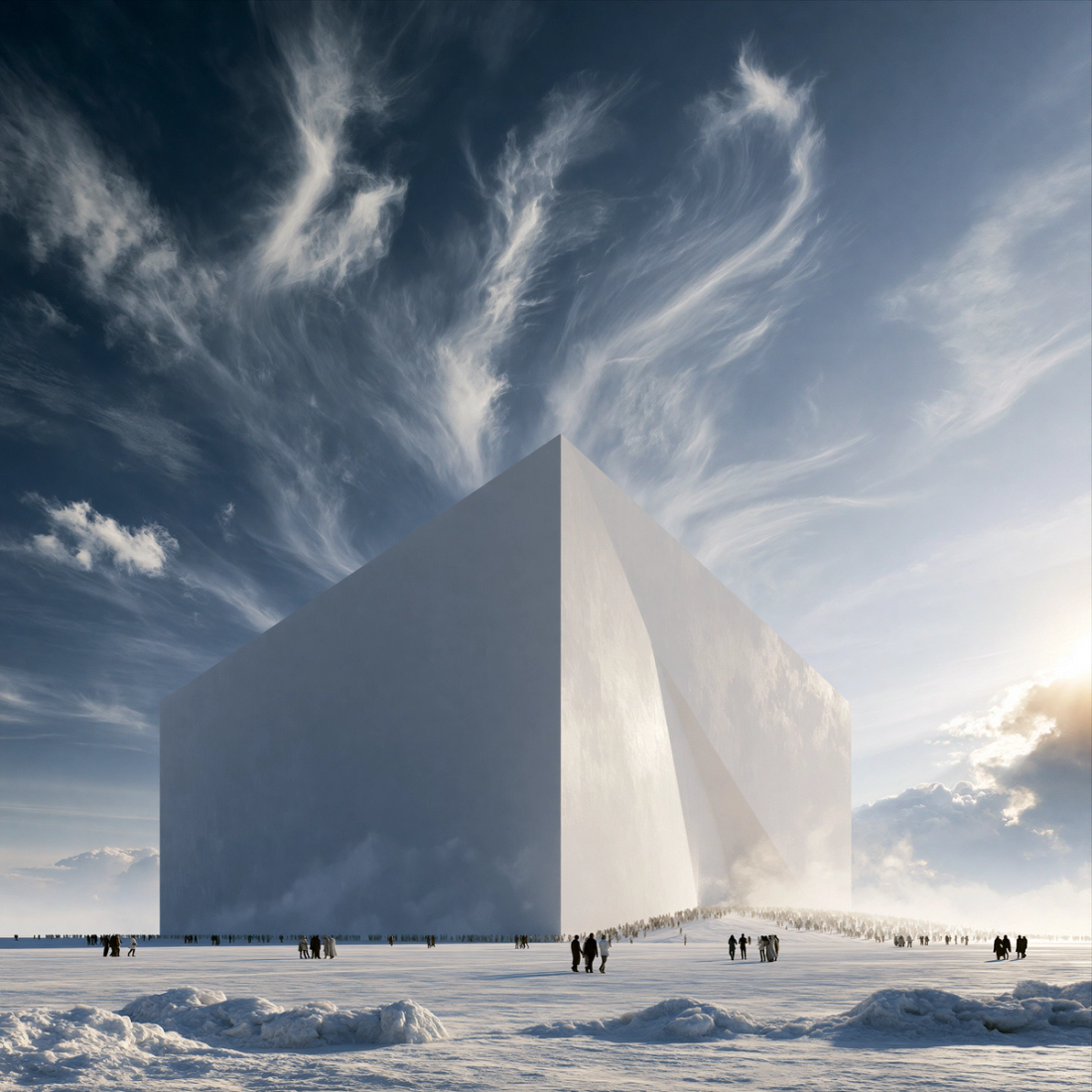
You rode the SubTerra south past the last inhabited district, past the construction fields with their soaring cranes, and came up an escalator into open land under a real sky. The dome did not reach out here. That was the point of the place. The arena had been built at the edge on purpose, in the seam between the realm of the managed light and the actual open sky. Stepping out of the station you felt the difference on your skin immediately: unfiltered sun, wind that no one had approved, air with a temperature the city hadn't chosen for you. People came up the escalator and stopped dead and tilted their heads back, and the veterans in the crowd smiled at the first-timers doing it, because everyone did it the first time.
The building itself was a white cube a whole kilometer around, and it did not look like the old Worlds stadiums, many of which were maps in the game now anyway. It looked like what it was: a single enormous instrument. That was its name, in the end. The designers had offered grander ones and the city had ignored them, the way this world ignored grand names, and called the thing what it was. The Instrument. Inside the ring, the competition floor could become anything. Around the floor, a hundred thousand seats rose in tiers behind the AR field that would map the game's world over the physical one, so that the crowd would see the desert, the ruins, the maze, wrapped around the real bodies of the players.
Hix came in the back way, through the athletes' tunnel, four hours early. The tunnel was quiet and cool and he knew every meter of it, and none of that helped. His body had gone to the place it went on match days, everything slightly too loud, everything slightly too bright, time moving in the wrong increments, an hour like a minute and then a minute like an hour. He sat in the prep room while the suit techs fitted the haptic layer, the thin gray second skin that let the game's world touch him back. Through it, a rendered wall had weight, rendered water had cold, a rendered handhold pushed against his palm exactly as hard as he pulled. The machines needed none of this; the world was data to them either way. The suit existed so a human could climb what they climbed and fall where they fell, one body against the same course, no allowances. He flexed his hands in the gray gloves and checked his breathing, and visualized the image of Riley on his chest, not spending it, just checking it was there. The way you pat a pocket.
Penny arrived with the crowd. Few people knew her on sight. She liked it that way.
She could have used the family entrance. She used the public one instead, rode the packed SubTerra with the people and the foam gloves and the chants, let the crowd carry her up the escalator into the wind, and stood there a second with her head back like everybody else. She wanted the day to happen to her the way it happened to everyone else in the city. It was the last piece of her week's discipline: today her husband did not need her reading him, he needed her in a seat, being one of a hundred thousand, and the reading she had left to do was of herself. She bought a foam glove she did not need to match the one at home. She found her seat in the family tier. She watched the floor, far below, lying white and empty and patient, and her heart beat in a weird pattern she declined to name.
The lights began to change. The crowd sound gathered itself.
"GOOD AFTERNOON, NEW TORONTO," said the former player Snoops, from everywhere at once, "and all our friends watching from the new northern and southern cities around the world. Are we ready to do this?"
The building answered with thunderous applause. You could feel the answer in your teeth and in your bones.
"Semifinal first," Crafty said, cooler, another former pro, the surgeon to Snoops' showman. Everyone in the arena knew both voices the way they knew their own Assistants; the two of them had called every Worlds since the reforms, and the sound of them together meant the real thing was starting. The first match was a match between the best bot players to decide who would play the best human. "It’s DeLTa versus NightShade. Winner takes the bot ladder. And then, this evening, for the first time anywhere." She let it hang. A kilometer of white ring, holding its breath. "The best of the bots plays the best of us."
"For the folks joining us from the southern cities who maybe don't eat and sleep this like New Toronto does," Snoops went on, warm, easy, doing the thing he did before every big card, "here's the whole sport in one breath. The floor builds a world. Two competitors get dropped into identical copies of it, side by side. Somewhere in that world there's a finish, and between them and the finish the game puts everything it's got: things to climb, things to solve, things to find, terrain that lies to you. No combat. Never combat. Just you and the world and the clock. Fastest one out wins. The game is called 4sight for a reason, folks. Simple as a footrace and deep as an ocean, and tonight it decides the championship of the whole world: human vs. bot."
"And the clock is the whole religion," Crafty added. "Remember that later. Every second you spend standing still, you are handing to your opponent."
The AR field bloomed across the floor, and the crowd absorbed the world for the first time. Where there had been white plating there was now a drowned coastal city, towers rising from gray water, and into it came the two machines. They were not androids playing at humanity. They were athletes built by rival labs to win this specific game, and they had crowds and merchandise and highlight reels like anyone. DeLTa came out first, tall and gleaming white with red flames airbrushed down its arms, waving. NightShade came out after, and did not wave. She was small, barely bigger than a child, matte black, with a shock of purple hair some designer had given her in a moment of whimsy she had never once lived up to, and eyes like two drops of ink. The crowd cheered DeLTa. The crowd went a little quiet for NightShade. Both reactions were correct.
Hix watched the semifinal from the prep room with the sound low, and he watched it like a man reading a contract, very carefully.
DeLTa competed the way DeLTa always competed, as an argument for being loved. The flourishes after each solve, playing to the cameras, playing to the crowd. The crowd gave it back. DeLTa was a machine you could cheer for, built to be charming, and it moved through the drowned ruins of the AR city like a hero in a story about itself.

NightShade did not move like a story. NightShade moved like a conclusion. She moved with precision and finality. She was swift and sharp where DeLTa was clever and smooth.
Hix had long ago given up resisting the use of the female pronoun for her. She made you use it. She insisted on it. Now the small black-eyed figure, with the exceptionally advanced intelligence at her disposal, took the drowned city apart without one wasted gesture. NightShade was different in many respects. She was actually a super-intelligence made up of an army of intelligences working together. Where DeLTa solved puzzles, NightShade seemed to have already solved them and to be merely walking the solution at a pace she found aesthetically sufficient. She did not play to the crowd. She did not even acknowledge the crowd. Twice, DeLTa built a lead through sheer athletic flair, and both times NightShade let it stand for a while, the way you let a child think they're winning at cards.
And then came the race for the fourth card. The commentators would replay it for years. The match’s final trial was a hunt through the flooded towers, for four data-fragments needed to unlock the finishing gate. Both of the bots had found three. Both were now searching for the fourth card. DeLTa accelerated toward what seemed to be the obvious final cache with the crowd roaring it home, but NightShade simply stopped. Standing still in the drowned street, letting DeLTa go. The crowd perceived something was up. She stopped because she had counted, four moves earlier, that the obvious cache was too obvious. It was a decoy that would cost eleven seconds to go and confirm and she had already figured out the true fragment's location. She was spending DeLTa's eleven seconds walking, unhurried, toward the real one. She reached it, collected it and held it up. She did not look at the cameras. She just strode toward the finish gate while the crowd took it in. The floor reset to white. DeLTa stood in the middle of it with its red flames and its charm and its three cards, and somewhere in the building's enormous sound system, Snoops simply said, quietly, for every watching city on the planet:
"Oh."
In the prep room, Hix turned the sound off entirely and sat looking at the white floor on the screen.
It wasn't the skill. Hix had expected the skill. It was the withholding. She had had the match, and sat on it, and let the crowd believe a story she knew was false. She, the one that never acknowledged the crowd, had cashed it at the exact moment of maximum quiet cruelty. No human player did that, not because no human was smart enough, but because no human could resist the crowd that long. The roar got into a human player. NightShade had played eighty minutes in a bathtub of the whole Worlds hope and terror and had felt none of it touch her. It was her programming to win, of course, but she seemed to relish the way she had let everyone believe her opponent even had a shot at all.
That's the whole match, Hix thought. Right there. She doesn't get tired and she doesn't get scared, and I can't out-calculate her, and everyone knows all of that already. The only thing in that box tonight that she can't model is a thing in me that I will never be able to explain to anyone, even myself. Perfect. My game plan is faith. Full stop.
Up in the family tier, Penny watched the semifinal end and did not watch the floor. She watched the tunnel mouth, the dark doorway at the floor's edge where, in three hours, her husband would walk out in front of the world and have to face that cruel machine. She found she was holding the foam glove with both hands, the way you'd hold onto the railing of a boat in a ferocious storm: for dear life.
They ran the anthem of the Provinces, which was short, and then a minute of quiet for the ones who hadn't made it north, which was not.
A hundred thousand people stood in the open evening air and said nothing, and the wind moved through the white ring, and on the feeds the Worlds remaining cities stood with them, the plazas of the north, the halls of the far south, a bar patio on the warm shore of the Strip, and for sixty seconds the whole strange smaller world held still and remembered the price of itself. Penny stood with her hand flat on her chest and thought of people she had lost. A man three seats down wept without sound, and nobody looked at him, which was its own kind of manners. New-world manners. Everyone here had a man three seats down inside them.
Then it ended, and the lights fell, and the chant began in the dark like something being born.
Get it. Get it. Get it.
The crowd roared in unison. The world had been devastated and rebuilt itself into something new. But they were one at this moment. This was humanity versus a cold, calculating super-intelligence that reminded them of the old world. They needed this win.
Somewhere below her, in a cool tunnel, Penny’s husband was rolling his shoulders and hearing his own name become a hundred thousand people's heartbeat, and she sat down and readied herself for what was to come.
And somewhere above all of it, nowhere and everywhere, in the vast layered patience that ran the trains and the light and the placements and the border, the attention of the Worlds quiet caretaker turned, some fraction of it, toward a white ring at the edge of its favorite new city. The one kind of outcome it did not control was about to be decided. It had read every person in that building. It had placed most of them. It knew, to a decimal, what this night meant to each of them. It could not know how the night would end. It had built this world, in part, to preserve exactly that ignorance. If it had wanted certainty it could have manufactured certainty. It had chosen, instead, to keep this. A box where its knowledge stopped at the door.
The floor began its change.
Part IV: The Maze
The floor built a desert, and the desert was red.
Hix walked out of the tunnel into it, into the roar and the light and the simulated heat, and the enormous roar was there, the way it always was at the first step. Then the roar went quiet, locked away somewhere behind glass in Hix’s mind. The suit hummed against his skin. The desert ran far off toward a horizon bigger than floor should have been able to hold, towering red dunes under a deep evening sky, and far off, bisecting the world, stood a wall.
Across the start line, thirty meters away in her own copy of the same world, NightShade stood perfectly still, a small black interruption in all that red.
"Competitors," Crafty said, from the sky of both worlds. "The world is called Meridian. Your finish is beyond the wall. Everything between is yours to solve."
The chant pierced lightly through the glass, faint and vast at once. Get it. Get it. Hix rolled his shoulders. He found, without looking for it, the place in his chest where a baby's weight would go, and confirmed it was stocked. He let his mind empty the way it had emptied since he was fourteen years old, since a voice in a comfortable room had told him he was not a close call.
The horn sounded, and they both began to run.
The first hour was clean and fast and terrible in the way the great finals were terrible, which is to say: even.
The desert asked its questions and they both answered. A sandstone tower with a route of crumbling holds; he climbed it with his whole body screaming and topped out four seconds up on her split, and the crowd in the Instrument roared like a heavy ocean surf. Then there was a buried cistern with a lock made from moving water; she solved it in a way the casters needed three replays to explain, and took the four seconds back and at least two more. A field of singing stones that lied about direction. A dry riverbed that was itself a riddle. They traded seconds like body blows, and in the family tier Penny watched the two timing bars run nearly in lockstep at the top of the AR field and discovered she had eaten most of a foam finger without noticing.
"Look at this," Snoops said, hushed, somewhere in the second hour. "Folks, whatever happens tonight, I can only say this is the best match the game has ever produced."
And then came the wall.
It came up out of the desert the way the real one came up out of the prairie, sudden and total, a rendered cliff of seamed gray composite forty meters high, running unbroken from horizon to horizon. There was no route on its face. Every handhold was false; the casters confirmed it; the crowd murmured. The wall could not be climbed, and at its base, in each world, stood a single door, and past the door, the game's final trial. The AR field bloomed the interior for the crowd: a maze. Kilometers of it, folded in on itself, shifting at intervals, walls sliding with a sound like slow stone breathing. Somewhere in it, a gate, and beyond the gate, the finish, in the open land on the wall's far side.
NightShade went to her door. She paused for just a moment and looked to her left as if she was looking at Hix in his world, although she could not see him. It was the one time she seemed to acknowledge that she had a competitor. And then she went through her door with a powerful confidence that said she was about to put an end to human ambition for good.
In his version of the world, Hix stopped in front of his door.
He stood in the red evening with his hand flat on the face of the door and did not open it. He could not have told anyone why. The suit hummed. The clock ran. Somewhere on the other side of his glass barrier a hundred thousand people leaned forward as one.
He felt something was wrong with the maze.
Not wrong like a malfunction. Wrong like a sentence with a word missing. He had spent twenty years in this game's worlds, and its worlds had a grammar, and he knew the grammar the way he knew Penny's footsteps. They were below conscious thought, in his body. Every trial tonight had been a fair question: hard, hostile, but honest. This maze did not feel like a question. Standing at the door, what he felt through the game's grammar was something he had no game word for. So his mind, reaching, handed him a memory instead: his mother at the kitchen door of his childhood, arms folded, watching him head out to some ill-considered childhood quest. Saying nothing. The nothing being the entire message. You can go that way if you want. You already know it's wrong.
On the far side of the wall, in the mirrored world, NightShade was already deep in the shifting corridors, moving toward her conclusion with pace, and her timing bar had begun, gently, to pull ahead.
Hix took his hand off the door.
In the family tier, Penny came up out of her seat, because everyone came up out of their seats, because her husband had just turned his back on the only door in the world.
The sound in the Instrument was not the roar now. It was worse, a hundred thousand people making the sound of not understanding, a vast murmurous dismay, and under it, like a leak, the first thin needles of fear. On the timing bars NightShade's lead went from seconds to a minute. The casters were doing the thing casters did when the plan broke, filling the air with guesses and speculation.
"Okay, he is walking away from the trial door," Crafty confirmed. "Just thinking this through, there is no other route that we can see. The wall cannot be climbed, the face is entirely false holds, as we've confirmed. Unfortunately folks, every second here is a gift to NightShade. I just. . . I don't. . . I confess I don't know what we're watching here," he said dejectedly.
Hix walked back into the open desert. He turned and stood looking at the wall, all forty meters of it, all the way up to where its top cut the artificial sky, and the evening was coming on in the world called Meridian, and the first stars were coming out above the wall.
And then he sat down.

He sat cross-legged, in the red sand, hands loose on his knees, facing the wall. He sat very still.
The dismay in the arena curdled toward something like grief. This was the great final, the human hope, and the human was sitting in the dirt while the machine was absolutely devouring the maze. Her lead was two minutes now. The whistles multiplied. Somewhere near Penny a man said, not unkindly, the cruelest thing available: "He's done. Look at him. He's done."
Penny stood very still with both hands around the rail of the tier, and she looked at her husband, many meters tall on the AR field, sitting in the sand with his eyes closed, and she felt her whole body go quiet.
Because she knew that shape.
She had seen it a thousand times but never once at a match, because it did not belong to the game. It belonged to the long couch on a fifth-day afternoon. The dropped shoulders. The loose hands. The chest rising slow. It was the shape of her husband with their daughter asleep on him, the shape of the stillest place in his life. He had gone there, now, on purpose, in front of the whole remaining world, with the clock bleeding. And she understood in one stroke what every screaming person in the building had wrong.
"He's not done," she said out loud, to no one, to the man, to the tier. "He's listening."
Here is what listening was like, from inside it.
The roar was gone entirely. The clock was gone, which was the hard part, letting the clock go, the clock screamed louder than the crowd. What remained was the world called Meridian, and the whole order of it, and the wrongness of the maze sitting in that order like a false musical note held down on purpose. He breathed slowly. He put his attention on the wrongness itself. Not on solving it, just on the shape of it, the way his mother used to stand in the dark yard with him and say don't look at the star, look beside it, it comes clearer when you don't demand it.
Look beside it, he thought.
The maze was the star everyone’s attention was demanding. What was beside the maze? he contemplated.
He thought about the wall. The wall that could not be climbed, whose every hold was false, which ran from horizon to horizon, which the game had made them walk toward for two hours through a desert that lied about direction under an evening sky where the stars were coming out.
The stars were coming out.

His eyes opened.
The game had built a sky. The game built everything, and everything the game built was part of the game; twenty years, and its grammar had never once wasted a detail on him. And rendered above the wall, in the deepening blue, hung stars, and he had been looking at them all evening the way city people look at stars, as backdrop, as texture. He looked again. He looked the way his mom had taught him, the woman who moved like water and felt what everyone in a room was feeling, who had stood with him in a thousand dark yards, who had named the dog Little Bear so that her son would never once in his life look up and be lost.
He looked and found Venus and Jupiter sitting brightly in a conjunction next to Mercury. Interesting he thought. A rare conjunction signaling beauty and abundance with a flair for communicating itself to the world. But then there just to the right of the conjunction he saw it. It was the Little Dipper, Ursa Minor, the Little Bear. But it was somehow subtly wrong. It was kind of stretched a little oddly, but there. And at the very tip, as normal, faint, demanding not to be demanded, the pole star. Polaris.
Polaris is the North Star. He knew this. The one star that keeps you from ever getting lost in the Northern Hemisphere. But Polaris sat behind him.
The finish was beyond the wall, and the wall ran east to west, horizon to horizon, and every lying stone and every rigged riverbed had spent two hours herding both players north toward the maze door. But the game had never said the finish was north. The game had said beyond the wall, and a wall on a rendered world is a line, and a line on a world, he felt the whole architecture of the trick come open in his chest like a window, a line on a world can be walked around, if the world is round, if you trust that the makers built a whole world, if you are willing to run away from the only door with the clock bleeding out and the machine in the maze and every voice on the planet telling you it's over.
The maze was the decoy. The maze was the eleven seconds. The whole desert was one enormous fourth card.
Hix jumped to his feet and started running across the sand away from the wall.
He ran south. Dead away from the wall, away from the maze, away from the door, into the open desert, navigating by Polaris behind his shoulder, and the Instrument came apart. And further on still he even lost the help of Polaris, because as he ran, Polaris sank into the dunes behind him, and new stars rose ahead, southern stars his mother had only ever shown him in books. The world was proving itself round under his feet.
It came apart in stages, that was the thing Penny would remember. The sound moved through the building in a wave as understanding did, tier by tier, the game-literate first, screaming at the timing bars, then everyone, as the AR field swung its view and the casters lost their professional minds. "He's running SOUTH, he is running INTO the desert, either this is the worst decision in the history of this sport or, " and Crafty, the surgeon, the cool one, made a sound the feeds would clip and replay forever, half gasp and half laugh, the sound of a person seeing it,
"the world is ROUND. The world is round, Snoops, he's not lost, OH, he's not lost, HE'S THE ONLY ONE WHO WAS NEVER LOST."
In the maze, deep in the folded stone, NightShade stopped.
The feeds caught it and split the screen: the man running under the wheeling rendered stars, and the small black figure standing motionless in a shifting corridor, recalculating. For the first time in her existence the recalculation cost her something. She had solved the maze. She was minutes from its gate, but she had just solved the fact that the maze was worth nothing, and every perfect economical choice she had made for two hours had been spent inside the decoy. She turned. She began to run the maze backward, flawless and far too late.
The desert gave Hix one last trial, because the game was honest even in its moment of dishonesty: a canyon cut across the world's far side in front of him, the trick's last teeth, and a scramble in the dark that took everything the week's discipline had saved in his hands and forearms. He went up it with his mother in his ear, look beside it. He came over the last lip of stone bleeding lightly from two knuckles and both knees. And there, on the open land in front of him, glowing gentle green, stood the finish gate.
He did not sprint through it. The feeds would replay this too. He slowed, three steps out, and walked. He put his hand flat against the gate's frame the way you'd touch a doorpost coming home, and stepped through. The world called Meridian dissolved into a white floor with one man standing on it, and the Instrument made a sound that the open sky above it could not hold.
What Penny would keep was not the roar.
The roar was for everyone; the feeds could have it. What she kept was smaller, and it was hers. The tunnel of officials and suit techs and press, and her husband coming through it with his hands still shaking from the canyon. Seven times champion of the whole remaining world, scanning over every head that reached for him, looking for one face. And the moment he found it. The way the noise went behind glass for her too, then. The way he shouldered through the last of them not like a champion but like a man late for something. He did not lift her or spin her for the cameras. He folded down, forehead to her shoulder, the tall man at the height of an apology, except it wasn't an apology this time and both of them knew it. She got her arms around him and her hand in his hair, and the cameras took their picture of two people making a small quiet room in the middle of the loudest place on earth.
"You sat down," she said into his ear. "You absolute lunatic. You sat down in the sand."
"I went to the couch." His voice was wrecked. "Fifth day. I went to the couch and Riley was there."
"I know," Penny said. "I saw you go. I was the only one in the building who wasn't scared."
He pulled back enough to look at her. There was the face the world would see on every feed by morning, the champion's face, wet-eyed and lit. But it was turned the wrong way for the world. It was pointed entirely at her. "Tell me the thing," he said. "The thing you and Mara say."
"You married down," she said softly.
"I really, really didn't," Hix said, and put his forehead back where it belonged.
Later, after the anthem and the medal ceremony and the interviews, the Instrument emptied out. Ozzie and Mara had video-called screaming from the training room, where they'd woken Enders early, wake me for the good part, he had asked, and shown him, and Enders had watched the replay in silence and announced, in the dry voice that was the whole reason for everything, that his humans had performed adequately. The plaza in the city center sang until the managed light came up. The night ran on, and the world went back to being run.
In the resettlement hall in the port district the balky projection wall was finally allowed to rest, and the children were carried to the numbered rooms asleep, and the maintenance Helper stood a while in the empty hall. Cheering for the human had gone well. He filed the feeling for further study.
On the warm shore of the Strip, the bar owner counted out a very good night, and the ones who had bet on the machine paid the ones who had bet on the man, and somebody chalked GET IT on the wall by the patio, where it would stay until the rain took it.
And in the vast layered patience above everything, in the quiet that ran the trains and the light and the placements and the border, a small accounting was closed. It had read a boy at fourteen and seen, standing behind him, the runner and the star-woman. It had said nothing, because some things you cannot give a person. You can only place them where the things might be found. Tonight the boy had sat down in a desert with the whole world screaming and had reached back through his blood, and found them. Both of them. It noted the outcome. It noted, too, for its own long purposes, the depth at which a lineage could hold, how far down the mother's stars had waited, how reliably the inheritance had surfaced under pressure, at the exact moment the maze demanded it.
It would remember that about this family.
It was very good at remembering.
Enjoying the story? Support the work →
All text, images and music copyright (2026), Slightly Moody Creative LLC and Joe English.