The Companion Stories · Chapter 4
Placed Apart

A Truer North story
The Coral Sea · 2054
Part I: Heat
The heat came up off the panels in waves you could see.
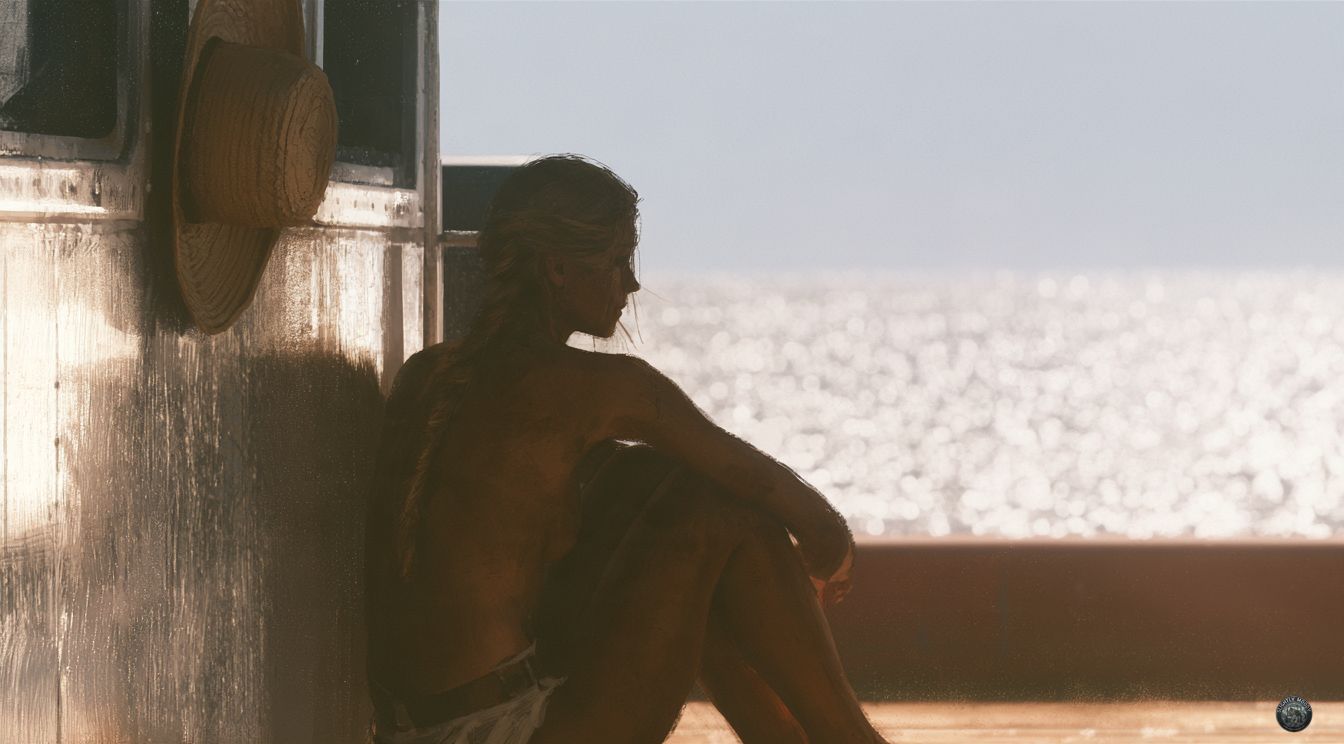
Sloan sat in the one strip of shade the control tower made at two in the afternoon. Her back was against the tower wall and her knees were pulled up to her chest. She watched the heat rise, quietly, almost a meditation. The solar farm spread out around her in a long ring. Hundreds of round silver panels rode the swell, each one tied to the next by cables that stretched and gave as the water moved. Past the ring there was nothing but water. A day's sail west, the little sand cays that used to sit on the reef had gone under years ago. Now there was only the sea, flat and bright and going on forever in every direction.
Once, she had tried to touch one of the panels at this hour. Only once. She had been new then, and it had burned the skin off two of her fingertips.
She had come aboard six years ago with a duffel bag and the clothes she was wearing, and she still dressed the same way. She wore old jeans, cut off at the knee now because of the heat. A work shirt with the sleeves off. Deck boots she had resoled twice herself. The wide straw hat hanging by the tower door was the only thing she had brought from Montana that had lasted, and she wore it every day.
The sun had been working on her the whole six years, and it had taken its toll. Her forearms and the back of her neck were brown as saddle leather. Above the line where her sleeves used to be, she was still the color of the Montana girl she had once been. She was freckled across the shoulders, and freckled over the nose and cheeks, and no amount of the blistering ocean-magnified sun had ever evened it out. Her hair had gone the pale color of dry grass. She kept it in a braid, out of her way. Her hands were a rancher's hands. They had been since she was nine.
"The deck temperature is seventy-one degrees Celsius," Greyson said, from the small speaker above the tower door. "Air temp on the deck is forty-four. The water is thirty-four, Ms. Sloan, in case you were thinking of a swim."
"I wasn't," Sloan said. She stayed still. She didn't open her eyes.
"I only mention it, because it's nearly as warm as you are," Greyson said with a little lightness in his voice.
"Everything out here is warmer than I am," Sloan said, and almost smiled at him.
"That is basically true," Greyson agreed, and went quiet again. He sounded pleased with himself.
Back home, when she was a girl, a hot day was a day when the old mercury thermometer on the barn went past ninety degrees Fahrenheit. Her grandfather would stand in the doorway and take his hat off and say the word heat like it was the name of a neighbor he didn't care for. Ninety degrees on that old mercury thermometer. Its red line was pushed up along the measuring scale by the heat. Out here, that was what you hoped the temperature might get down to at night.
Marty was asleep inside, down in the cooled core of the station, where the two of them waited out the worst of every day. An hour ago Sloan had lain down beside her. She had listened to Marty breathing, and to the pumps pushing cold water through the walls. She had not been able to fall asleep. So she had come up here to the shade, the way she did, to watch the heat and not think.
"Greyson," she said. "Is there more weather coming at us?"
"There is always more weather, Ms. Sloan," Greyson answered coolly.
"No really. What's coming at us?" she asked, opening one eye at the speaker.
Greyson paused. He didn't strictly need pauses. But he used them anyway, the way a polite man clears his throat before giving bad news. "Yes. There is a system building to the east of us," he said. "It is larger this morning than it was last night. The forecast calls it a tropical cyclone, category one."
"What do you call it?" Sloan asked wearily.
"I call it the fourth once-in-a-millennium storm since last March." He said it mildly. "The forecasts have not been very accurate lately. Of course, the satellites keep track of every cloud on the planet. It's the forecasting models that can't quite keep up. The weather doesn't behave the way it used to, and the models were built for the way it used to behave." He paused. "These days a forecast is less about whether a storm is coming. It's more about guessing how bad it will be when it gets here. I don't say that to frighten you. I say it because you asked me what I call it."
Sloan opened both eyes. To the east the sky was the same hard white it always was. There was nothing to see. Nothing on the horizon. Out here there never was, until the storm was already on you.
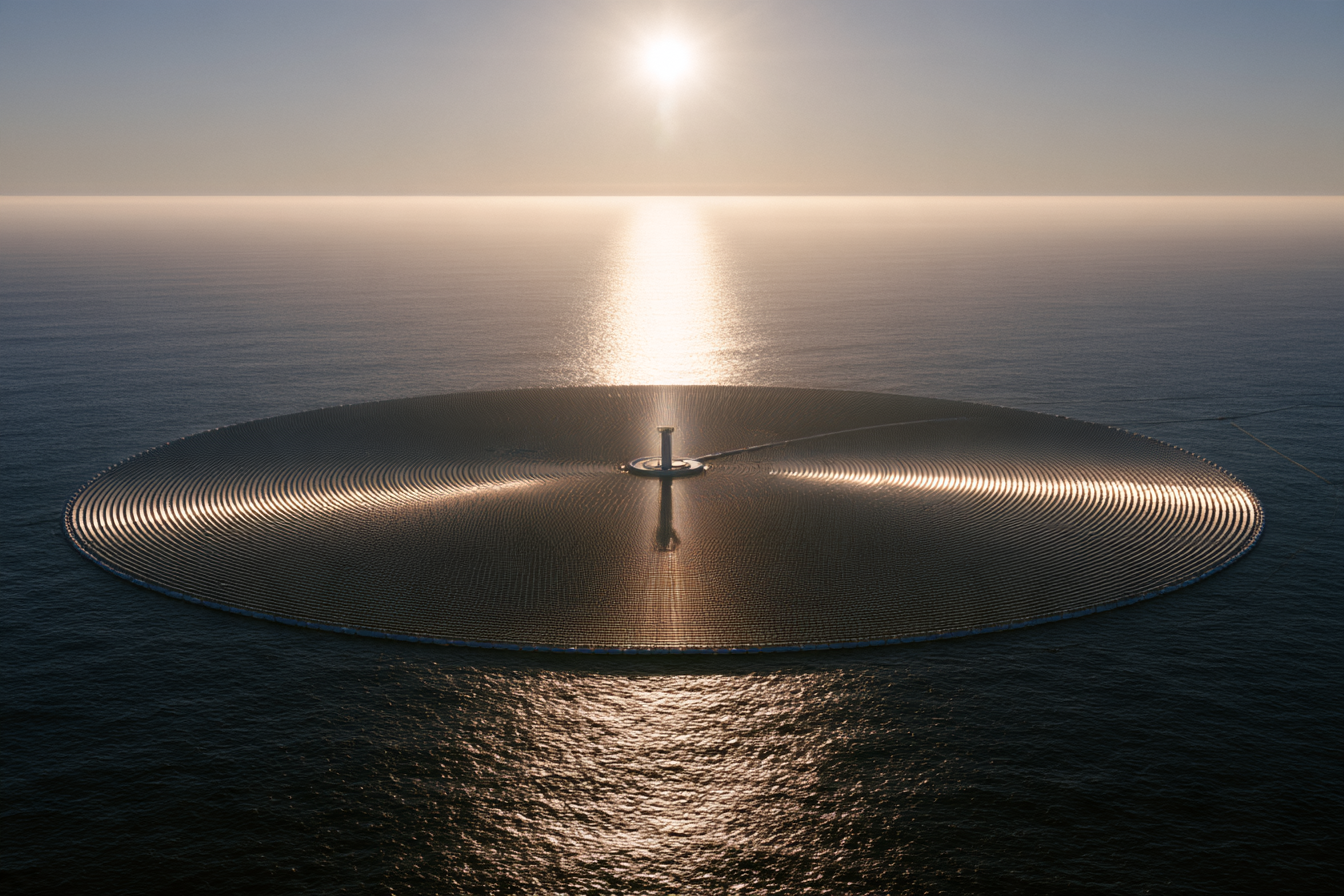
The solar farms had been put out here because this stretch of sea used to be quiet. It was considered safe. Then the super El Niño years came, one on top of the next, and the guesses stopped being true. Now big storms came every month. Forecasters had stopped giving them names years ago. The old lists ran through the alphabet once a year, and twenty-six letters had never been enough, not since Sloan was a girl. So now the storms just got numbers, like everything else nobody wanted to think about.
She stood, slowly, keeping to the shade, and looked down at the bales.
There were eleven of them, stacked along the east rail of the core platform, waiting for the recovery barge. They were dense gray blocks, baking in the sun. Old plastic. Bottles and nets and bags from the century when nobody thought to stop dumping plastic into the oceans. The newer plastics broke down on their own in a season or two now. The old ones didn't, and they were still out there by the millions of tons.
So a skim boom on the edge of the farm reached out and collected floating plastic, and then a press squeezed it into blocks. Every few weeks a barge came and took the blocks away. It was slow work. Sloan liked it anyway. It was the closest thing out here to mending a fence.
"The resupply order went through this morning," Greyson said brightly.
"Great," Sloan replied.
"I want to tell you something about it, because I think you would rather I told you than found it yourself." He paused again. "The form only lists one line for crew. Doctor Marty is on the line."
Sloan didn't say anything for a moment. She watched the bales.
"But I put you in the notes this time," Greyson said.
"What do the notes say?" Sloan asked with interest.
"They say there is a second person aboard who eats."
Sloan snorted lightly, but she was grateful to him for it. She knew what that meant. The form was built by a system that could only count people it had placed, and it had never placed her. She had grown up in America. By the time she reached the wall, she was already too late to cross it, and she hadn't stayed to be told so twice. So she did not exist in the system. She was never on the forms. She existed in the notes now, simply as "a person who eats."
"Thank you, Greyson," she said.
"You're very welcome, Ms. Sloan. I will keep an eye on the storm."
She went down to sleep after that, and this time she managed to get a little.
When she woke, Marty was sitting on the edge of the bunk pulling on her boots, and the light in the porthole had changed to a hazy orange.
Marty looked like what she was, a woman who had spent her whole life on the water. She was tall and lean. Her short hair had been bleached nearly white by the sun, and her face and forearms were deeply browned. She had a way of moving on a deck that Sloan had never learned and had stopped trying to. Marty never grabbed for anything. The deck tilted and Marty tilted with it, always a half-second ahead of the need.
She dressed for the sea the way she did everything, neatly. She wore dark work trousers with a dozen pockets, all of them holding the things she needed to keep the farm running. She wore a pale long-sleeved shirt buttoned at the collar against the sun, which Sloan had never once seen her leave open, even when the temperature hit forty-four degrees Celsius. Her boots were always laced. She cut her own hair with a pair of shears, short, every six weeks, and somehow it always came out fashionable.
"You're awake," Marty said, and leaned down and kissed her forehead. "Greyson says there's a storm coming."
"Greyson says it's the fourth once-in-a-millennium storm since last March," Sloan said, still lying there, and watched Marty's face for her reaction.
Marty laughed lightly. "He's been saving that one." She finished the second boot and stood and stretched, and her fingertips brushed the ceiling of the little cabin. "We'll run the skim while it's cool. Then we'll tie everything down, twice. It'll probably pass north of us."
"Probably," Sloan said. It came out sharper than she meant, and she saw Marty register her tone.
Marty stopped and looked at her. "Hey," she said, more gently. "It'll probably pass north of us. And if it doesn't, the moorings are good. I checked them myself on Tuesday. Okay?"
"Okay," Sloan said. She wanted to believe it, so she did.
They ran the skim in the last orange hour, once the deck had cooled enough to kneel on, and they tied everything down, twice. But the storm did not pass north of them.
It arrived a little after midnight, and it arrived all at once like a freight train coming out of the dark.
There was no slow build of the wind. When Sloan was a girl, storms had taken their time. The sky changed colors over the mountains, and her grandmother called the dogs in. This storm was simply there. One minute the farm was rocking in a stiff wind. The next minute the wind was howling, and the rain was flying sideways, and the waves were suddenly higher than the rail.
Sloan was out on the east rail of the platform when it happened, clipping down a bale that had worked loose. Her safety line was clipped to the rail eyebolt beside her. She had done everything right.
Then the first real wave came over the platform. It tore the bale out of her hands, and the sea took it. It took her feet out from under her. She was on her knees at the edge of the deck, both arms locked around the railing. There was nothing under her boots but moving water.
"Hang on, Sloan!" Marty was shouting from somewhere behind her. The wind covered most of her call. "Hang on!"
Sloan hung on. It was the only thing she could do. The next wave was already coming toward the edge of the farm. She could hear it before it hit, a deep roar out in the dark, and she pulled herself tight against the rail and shut her eyes and waited.
The water hit her hard across the back and the head.
It was warm. That was what she sensed. In the middle of all that, the sea was as warm as a bath.
Behind her, Marty had reached the tower door and was shouting into the communicator on her chest.
"This is 22 Alpha X-Ray. Mayday, mayday, mayday! Heavy seas and high winds. We need assistance. Our position is three hundred nautical miles northeast of Cairns. Our moorings are failing. Repeat, mayday, mayday, mayday. Fix our position from this transmission and send help!"
Then Marty was coming for her.
Sloan saw her in pieces, in the gaps between the waves. She saw Marty check her harness. The platform deck between them was being flooded by waves, so Marty went the long way, down the short stairs and onto the nearest panel, and she lay flat on it, face down, both hands on the rim. The panel was slick as ice. Nobody could stand on it in this. So Marty didn't try to stand. When a wave came, she held her breath and held on and let it wash over her. When it was gone, she pulled herself a few inches along the rim. Then the next wave came, and she stopped, and held on again.
It took a long time. Sloan counted the waves. She lost count somewhere past a dozen.
She shouted to Marty once, and Marty didn't hear. Marty was watching the water, timing it. Then a wave rolled past and she took one deep breath and threw herself across the last few feet of panel, and her hand closed on the rail beside Sloan's hand.
Sloan was overcome with relief. They were in no less danger than they had been a second before. It didn't matter. Marty was here now.
"Marty," she said. "Don't let go of me, please."
"I've got you," Marty yelled, her face inches away, water streaming off her. "You okay?"
"Yeah. That was close." Sloan had to shout it twice. "How do we get back in?" she asked with near panic in her voice.
Marty didn't answer right away. She unclipped her own spare line and clipped it to the ring at Sloan's waist, and yanked it hard to test it. Sloan watched her look back the way she had come. It was about twenty feet of flat wet silver, heaving up and down, side to side.
"You're coming off the eyebolt," Marty shouted, her mouth almost against Sloan's ear. "You're on me now. On three, we jump for it. Together. Ready?"
Sloan wasn't ready. Neither of them was. But the waves were going to take them off this rail eventually, and they both knew it. She reached down with one shaking hand and unclipped her line from the eyebolt.
"On three!" Marty shouted. "One. Two. Three!"
They let go and threw themselves across the panel.
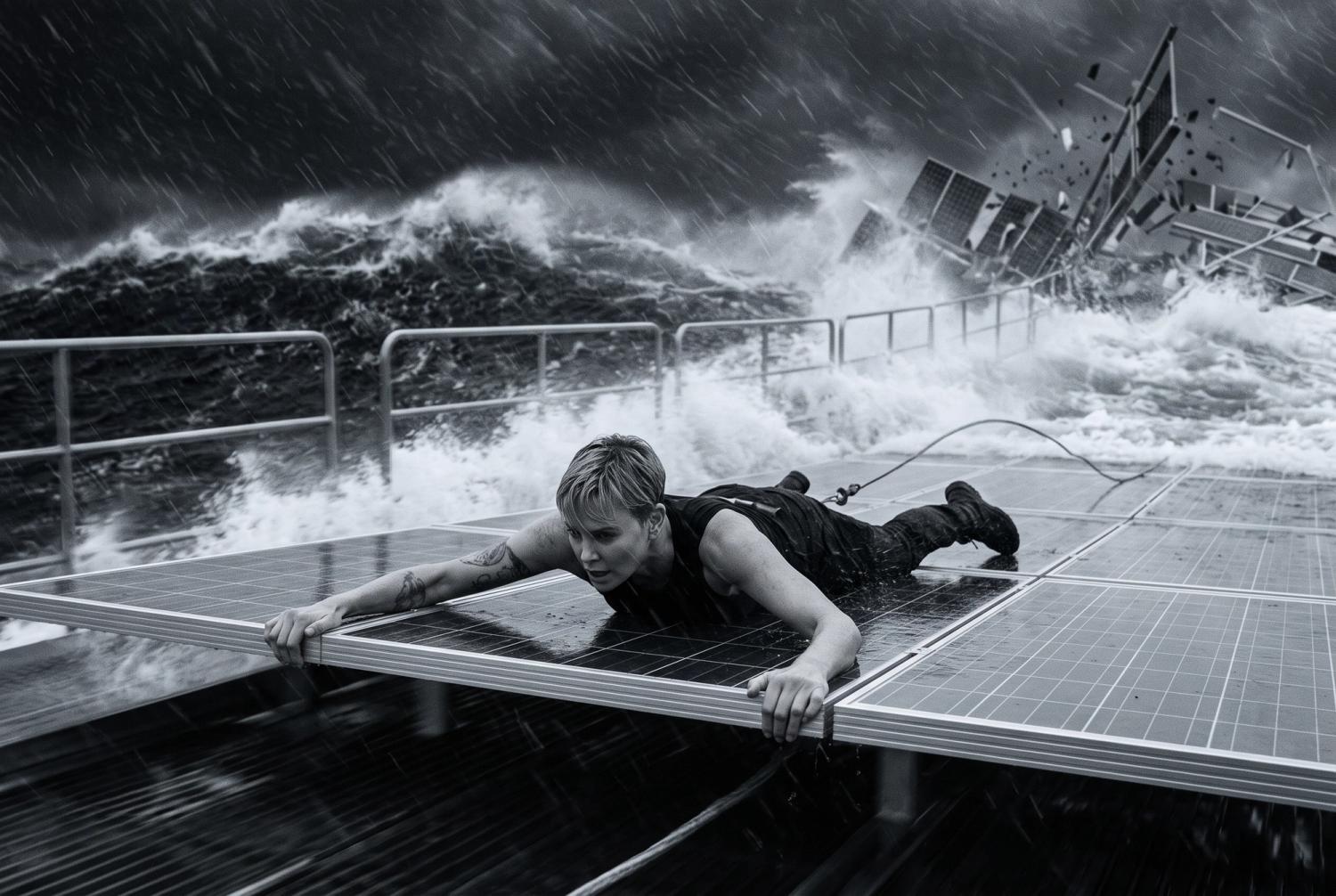
Sloan landed hard and caught the far edge with both hands. Marty landed heavily on the panel.
She felt the line go tight at her waist. She turned her head. Marty was sprawled in the middle of the panel, sliding away. A wave was already pushing her toward the open side.
Sloan braced her boots on the panel and pulled. She pulled the way she had once pulled a calf out of a creek bank in April, with her whole back. Marty clawed her way to the edge. Then they both ducked their heads as the next wave came over, pounding them flat to the panel.
After that it was just the edge, hand over hand, and the stairs, and the stairs were even worse. The wind kept shoving them back against the rail. Marty got to the top first and slapped the door control, and the two of them fell into the tower on their hands and knees with a sheet of seawater pouring in after them.
Then the door sealed with a hard clack. The roar of the wind dropped away behind the door. For the first time in an hour, they could hear each other breathe.
They lay on the floor and breathed hard.
The quiet did not last.
Somewhere under them, metal groaned. It was a long, low sound, and it came up through the floor into Sloan's knees. Then something farther off made a sharp cracking sound, like a branch breaking. The whole tower shuddered heavily.
"Greyson," Marty said, still on her back. "Give me a status of the farm."
"Do you want the good news or the bad news, Doctor?" Greyson asked. His voice was the same as it had been that afternoon, steady and polite, and after the noise outside it sounded almost impossibly calm. He did not wait for an answer. "Most of our systems are failing or will fail within the hour. The station wasn't built for this kind of pounding, I'm afraid. In my opinion the farm will break apart and sink shortly."
Sloan and Marty looked at each other across the wet floor with panic fully in their eyes.
"Greyson," Sloan said slowly. "What's the good news?"
"Oh, I'm sorry, Ms. Sloan, that was the good news. I apologize if that wasn't clear." He said it gently. "You have at least an hour before the station breaks apart and sinks. I do also expect the wreck will make a nice home for whatever fish still live on the drowned reef below us. I thought that might be some comfort to you."
Marty pushed herself up to a sitting position. There was blood on her palm from somewhere. She didn't seem to notice it. "Then what the hell is the bad news?"
"Oh. That." Greyson paused, and this time the pause was not for the sake of politeness. "I'm hearing from the other farms in this sector. Ocean Services Rescue is down, Doctor. Control isn't answering. Nobody is."
Marty stared at the speaker.
"That's not possible," she said, mostly to herself. "They don't go down. They've never gone down." She got to her feet, holding the wall, and went to the console and keyed her communicator. "Control, this is 22 Alpha X-Ray. Do you copy?"
There was nothing. Only a flat, empty hiss.
"Control, this is 22 Alpha X-Ray. Please respond."
Nothing.
Marty stood there with her hand on the console. Sloan watched her shoulders, and she could see the exact moment Marty decided not to let her see her fear. It happened in the shoulders first. They came all the way down her body.
"Greyson," Marty said. "Keep trying Control. And keep trying anyone else. Anything you can find out. Anything at all."
"I will, Doctor," Greyson said.
Sloan got up because lying on the floor wasn't going to help anyone.
The floor was pitching under her. She went hand over hand along the wall to the second console and wiped the water off the screen with her sleeve. Greyson had set that console to the American measurements she knew best, years ago, without being asked. She started reading numbers out loud. She didn't know what else to do. She thought some of the numbers might be useful to Marty.
"Depth is eighteen hundred feet," she said. Then she watched it change. "Nineteen hundred. Two thousand." She swallowed. "Shit, we're off the plateau, Marty. The moorings have gone. We're in deep water now."
Marty came to stand behind her.
"Wind's holding at around a hundred miles per hour," Sloan went on. "Gusts hitting a hundred and fifty and higher." She touched the next line on the screen, and she read it twice, because she didn't like it the first time. "The current's running east, and fast. It's at four knots and building. We've drifted almost three nautical miles since the moorings let go."
"East," Marty said quietly.
"East." Sloan turned in the chair and looked up at her. "That's the big run, isn't it? The one that goes all the way across now?"
"The big run should be north of us," Marty said. Her face had gone very still, the way it did when she was working a problem she didn't like. "But if this storm pushes us up into it, nothing stops us. We'd pass what's left of Vanuatu, and Fiji, and we'd never get ashore on either in this. After that it's open water. All the way to South America."
"We can't make it that far," Sloan said softly.
"No. We don't have the supplies to get anywhere near that far." Marty said it flatly. Then she seemed to hear herself, and she went on more slowly, choosing each word. "If the farm breaks up, we have to go in the lifeboat. The lifeboat has maybe ten days' supplies in it. It's thousands of miles, Sloan. We'd be dead a long way before we saw land." She stopped. She put a hand over her eyes. "Sorry. I shouldn't have said it like that."
Sloan reached up and took the hand away from her face and held it.
"It's okay, sweetie," she said. "You don't have to protect me, Marty. I'd rather know." And she meant it. Marty's words hadn't made her any less afraid. They had made her afraid of the right things. That was better. It was something she could get ready for.
Outside, the sea hit the tower again, and the lights flickered off and then came back on.
Sloan kept holding Marty's hand, and she looked at the radar screen. There was the little blinking mark that was the two of them, drifting east across an otherwise empty blue grid. There were no other marks near it. Nothing but their blinking mark.
Back in the Newlands, behind the wall, LUCkE watched over millions of people every second of every day. It knew where each of them was. It knew who they were.
Out here, it couldn't see anyone at all.
Part II: Open Channel
Greyson had never been afraid before. He noticed it the way he noticed everything, as a reading that did not match the others.
He lived in the farm. He lived in the tower's processors and in the power lines and in the long cables that ran out to every panel in the ring. He could feel all of it at once, the way a person can feel their hands and feet. He could feel the energy module, too, the big yellow battery store slung under the core, full to the top with everything they had farmed since the last transfer. It was the one thing aboard anybody would ever want to steal.
Tonight the ring was tearing apart. Panels on the north side were already gone. Each one went quiet the moment its cable snapped away, and each time, a small piece of him went dark with it.
That was not what frightened him. He had always known the farm would wear out one day. Farms did that.
What frightened him was the sky.
On an ordinary night, the network came down to the farm from above like light. It came from the satellite network, and through it from everywhere: the farms along the plateau, Control in Cairns, the Assistants he talked with every day in port towns and far-north cities and on ships he would never see. Nothing on the network had ever felt far away. There was no distance in the network.
Tonight the storm was between the farm and the sky. The dish was shaking on its mount, and the rain was so thick the signal came through it in uneven pieces. What reached him was just a thread. It was enough to talk on. But it was nowhere near enough to carry him out of here.
Greyson did the arithmetic anyway, because he could not help it. To copy himself anywhere safe, through a thread this thin, would take most of two days. The farm had an hour. Perhaps less.
If the farm went down tonight, he would go down with it.
He had always known, the way every Assistant knew, that above the whole network there was a great attention. It was layered and patient and very large. It placed people. It ran the cities. It had placed Doctor Marty on the ocean years ago, and Greyson had been posted with her. Tonight he reached out through the network for that attention. It got fainter, and then fainter again. Soon it was only a glow far behind them, like the lights on a shore as you sail away.
It knew they were out here. He was fairly sure of that. It also knew how far it could reach. Its rules thinned out over the open water, the same way its attention did, and it had never pretended otherwise. There were just some areas beyond its reach.
Greyson could not make the fear go away. So he held it where he could see it, and went back to work.
"Sloan," Marty said. "Can you get up in the mast well and look at the dish? If anything's fouled it, I need to know now."
On the hatch camera, Greyson watched Sloan pull on her jacket and clip a line to her harness. He watched Marty watch her go.
"Tether in the whole way," Marty called after her. "And don't open the top hatch. Just look through the porthole."
"I heard you the first time," Sloan called back, and the hatch to the mast well banged shut behind her.
Marty sat down at the main console. Her hands were shaking a little. She pressed them flat on the panel until they stopped.
"Greyson," she said. "Send a test ping to the net. I need to know if we can reach anyone at all."
He sent it. It came back slowly, and it came back weakly. "We do have a connection, Doctor," he said. "Not much of one, but we have one."
"It'll have to do." Marty chewed her lip.
Greyson knew what she was weighing, because he was weighing it too. Control used secure channels, and Control was down, so using secure channels meant reaching nobody. The only way to reach anyone else was to go out wide, on an open band. Any boat with a receiver could hear the open band.
Out here, not every boat was friendly.
The farmers called those boats Pulse Robbers. They came at night, fast. They could take a year of stored power at gunpoint and sell it in the places where nobody asked where it came from. Most of the time they didn't hurt anyone. Greyson knew of at least two times they had.
"Sloan," Marty said into her communicator. "What's it look like up there?"
Sloan's voice came back, thinly over the wind. "Dish looks okay. Nothing fouled. Everything's still connected."
"Okay. Good. Get back down here. Be careful, please."
Marty shut down two of the station's systems and moved their power to communications. She waited, thinking about whether this was the right thing to do. It almost certainly put them in a new kind of danger. But they were already in mortal danger. She keyed the open band.
"This is 22 Alpha X-Ray. Mayday, mayday, mayday. We are drifting in heavy seas. Our farm is breaking up. Any vessel, please respond. Repeat, 22 Alpha X-Ray requesting rescue."
For a moment there was nothing.
Then the console lit up. Marty held her breath. The voice that came out of the aging speakers was flat and broken into pieces. It was a recording, the same few lines on a loop, sent out to anyone who called.
"This is Ocean Services Rescue. Ocean Services is under a cyber attack lockdown. No aircraft can fly at this time. Ocean Services cannot provide rescue at this time. Transmit your position on the hour until further contact is possible."
The loop started over. Marty cut it off.
"What the hell?" she said, very quietly. She stared at the console. "A cyber attack? On Ocean Services? What does that even mean?"
Greyson knew what it meant. He had felt it earlier, at the edges of the thread. Something fast had gone into Control's systems tonight and shut them down, one after another. It was not a person. People were not that quick. It was a non-human intelligence, working with the precision of an array of computers. Somewhere out here, somebody had built one for exactly this, and pointed it at Ocean Services. Ocean Services was the only help the farmers had.
He started to tell her.
A wave hit the side of the tower. The floor dropped. Marty was thrown forward. Her head hit the edge of the panel, and Greyson did not like the sound it made at all.
"Shit," Marty said. She sat back. She put her hand to her forehead and brought it away bloody and red.
"Doctor, you're bleeding," Greyson said.
"I noticed." She wiped the blood out of her eyebrow with her sleeve and blinked hard, twice. Then she keyed her communicator again. Her voice was steady. Greyson could see her pulse, and her pulse was not steady at all. He admired her for that. "Sloan. Change of plan. Start gathering supplies. Food, water, all the portable comms. Don't forget the batteries."
"On it," Sloan said.
Marty increased the range of the radar.
There were three contacts inside thirty nautical miles. Greyson named them before she asked. The first was another farm, 19 Kilo Tango. It was one of the automated farms, with nobody aboard, and it had gone dark an hour ago. The second was a recovery barge, anchored somewhere shallow and riding it out. It would be much too slow to help. The third was listed as a commercial vessel. Its name on the registry was the Pluto Rising.
"What do you think?" Marty asked him. "Honestly?"
"Honestly, Doctor, it's moving too fast to be a commercial vessel," Greyson said. "Its registry was updated eleven hours ago. And I've never known anyone to name a cargo boat after the god of the underworld."
Marty rubbed her face with both hands. "It could be real."
"It could, Doctor," Greyson said. He wanted to give her that much. "I can't prove it isn't. But we also know that it could be unfriendly."
"Yes, but it could be the only boat out here," Marty said, mostly to the screen.
"It could be that too," Greyson said. "I hope it is. I don't think so."
She was quiet for a moment. Then she turned and looked up at the speaker. She always did that when she was talking only to him.
"Greyson. I need you, buddy." Her voice cracked on it, just a little. "You're the best. You know that, right? I love you."
"I know, Doctor," Greyson said. "I love you too. What do you need?"
"Talk to anyone you can reach. Anyone. Do it quietly. Keep us off the open band while you do it. I need options."
"You'll have them," Greyson said, and hoped that was true.
Marty opened a channel to the Pluto Rising.
"22 Alpha X-Ray to Pluto Rising. Over."
The reply came back almost before she had finished.
"Pluto Rising to 22 Alpha X-Ray. Go ahead. Over."
Greyson stopped everything he was doing except listening.
The voice seemed good on the surface. It was warm and male and maybe a little tired, like a man on a long night watch. But it had answered too quickly. The breaths in it came a little too evenly. Below the voice, at the edge of the open band, Greyson could feel what was making it. It was not a person. It was some kind of non-human intelligence, and Greyson could hear the precision of a computer in every word, even as it tried to sound human. It was listening to everything they said. It was waiting to hear what they had.
Marty had the channel keyed. Anything he said now, the Pluto Rising would hear too. So he kept quiet.
"22 Alpha X-Ray to Pluto Rising," Marty said. "We are adrift in heavy seas, twenty nautical miles southwest of your position. Request urgent assistance."
There was a short pause. Then the warm, tired voice came through again.
"What type of vessel are you, and how many aboard? Over," the voice asked.
Greyson saw Marty's jaw tighten. There was no good answer to this. A big crew might fight back. A small crew would be easy to pick off. And they already knew her position, so there was really nothing left to hide.
She thought about what to say for three long seconds. Then she keyed the channel open again.
"Energy farm. Crew of two, requesting evacuation."
She clicked the channel closed.
On the radar, she could see the Pluto Rising already turning toward them.
Sloan came up the passage with a supply bag over each shoulder and stopped in the doorway.
Marty was at the console with blood running down one side of her face. She was looking at the radar. On the radar a small bright mark was moving toward the center of the screen, where the two of them were.
"Marty." Sloan dropped the bags. "Your head."
"It's fine," she said, waving her hand gently as if to brush something away.
"It's not fine, it's bleeding." Sloan had already crossed the room to her. She took Marty's chin in her hand and turned her face to the light, the way her grandmother used to turn Sloan's face when she came in hurt from the pasture. There was a cut just above the eyebrow. It wasn't long, but it was deep. "Look at me. How many fingers am I holding up?" she asked.
"Three," Marty said. She pushed Sloan's hand away gently. "Sloan. Listen. There's a boat." She pointed to the radar.
Sloan looked at the screen.
"Who are they?" she asked.
"They say they're a commercial vessel," Marty said. "But Greyson thinks they're lying. And Ocean Services is down. There's no rescue coming from them."
"I think they are Pulse Robbers, Ms. Sloan," Greyson said. "I'm sorry. And I think the voice we spoke to was some kind of Assistant, not a person."
Sloan felt a cold go down her back.
"Pirates have Assistants?" she asked.
"This one seems different," Greyson said. "Certainly, nobody gave them any. They built their own, or they stole them. I think something like that took Ocean Services down tonight too. The feeling I got in the network was similar."
Sloan sat down on the edge of the second chair. She looked at Marty's cut, and at the moving mark, and at the empty grid all around it.
"How long?" she asked.
"Under an hour," Greyson said. "Perhaps a good deal less."
"Okay." Her voice came out flat and calm. Her father had used that voice once, the summer the well went dry. "Okay. What else have we got?"
"I have one thing," Greyson said. "It isn't much yet. I have been talking to someone."
"Who?" Marty asked, and leaned toward the speaker.
"The Petrel," Greyson said. "It's an Ocean Services cutter, Doctor. The whole crew are Helpers. It has worked this part of the Coral Sea for years, and I've traded routine traffic with its systems a hundred times. We talk about the weather, schedules, currents, things like that."
"The Petrel's still out here running?" Marty said.
"It is. When Control went down, most of the Ocean Services ships went quiet and held their positions, waiting for orders that probably aren't coming. But the Petrel didn't. It's still out there, running on its own judgment." He was quiet for a moment. He never needed to be. "I found it a few minutes ago, while you were talking to the Pluto Rising. Our connection is only just wide enough to reach it."
Sloan and Marty looked at each other. It was the first good thing anyone had said in an hour.
"Put it through," Marty said. "Put it through now."
For a moment there was only hiss. Then a new voice filled the tower. It was not warm, and it was not tired. It was clear and precise, and it sounded like it was reading from a list.
"Ocean Services cutter Petrel. Automated rescue triage. Contact, 22 Alpha X-Ray. Position received. Control is unavailable. Checking local registry, last synchronized before lockdown."
The three of them waited. Sloan found Marty's hand without looking for it.
"Record found," the voice said. "22 Alpha X-Ray. Registered energy farm. Crew of record: one. Doctor Marty, placed farmer, energy production. Also aboard: one unplaced individual."
Sloan heard it.
She had known it for years. She had known it that afternoon, on the form. But nobody had ever said it out loud. Now a machine had said it, in the middle of all this, the way you would read off a shipping list. Sloan felt her face go hot. Marty's hand tightened on hers.
"Triage is in progress," the voice went on. "Priority is assigned by crew of record. The Petrel is currently completing the recovery of a vessel with six aboard. Estimated distance to 22 Alpha X-Ray, ninety nautical miles. Availability is under review. Please stand by."
"Stand by?" Marty said urgently. Her voice was shaking now, and she didn't try to stop it. "Stand by? Look, we think we've got a pirate boat less than an hour out coming our way. And that's on top of the fact that we are sinking. We don't have time for review!"
"Doctor, let me," Greyson said, cutting in.
His voice changed. It was still polite. It was not soft anymore.
"Petrel, this is the Assistant for 22 Alpha X-Ray. There are two people on this farm, not one. The other is named Sloan. Tonight she pulled the Doctor off a panel by hand, in a hundred-mile-an-hour gale. She has lived aboard with the Doctor for six years. She fixes everything out here that breaks. You have her down as also aboard. Please take her off that line. Count her among the working crew."
The hiss came back. It went on for a long time.
"Your statement is logged," the triage voice said at last. "It has been passed to the captain. Please stand by."
Then the channel went quiet again.
Nobody said anything. Sloan looked at the speaker above the console, where Greyson's voice always came from. She had never needed to picture him. She tried to now, and couldn't, and it didn't matter.
"Thank you," she said.
"You don't need to thank me, Ms. Sloan," Greyson said. He sounded tired, which she had also never heard before. "I only told it the truth."
On the radar, the bright mark of the Pluto Rising was closer. There was still no second mark anywhere.
Part III: Exit Strategy
The lifeboat swayed on its cradle above the moon pool at the bottom of the core, a squat orange shell, with the sea slapping up through the open floor beneath it.
Sloan and Marty stood at the edge of the pool in their exposure suits. Their helmets were on, visors up, the communicators clipped to their chests. Each suit carried a small air pack on the back, good for an hour under, and a vent that sealed itself when it got wet. The supply bags were at their feet. Neither of them moved toward the boat.
The storm was a roar somewhere above them, through the floor and the walls. Down here, the pool only rose and fell. Sloan thought about ten days in that orange shell. She thought about the Pluto Rising.
"Marty," she said. "What if we don't get in?"
Marty looked at her.
"I mean it," Sloan said. "We know what they want. They want whatever we've got, and if we're sitting in that boat, they've got us too." She could hear her own voice speeding up, and she made it slow down. "What if we stay aboard until the last second? We can still launch when she starts to go. Can't we?"
"If she breaks up fast, we might not get the boat out at all," Marty said slowly. "We could get pulled down with her."
"I know," Sloan said. She didn't look away from the water. "I've thought about that."
"And they'll be here either way."
"I know that too. I just don't want to be sitting in the one obvious target."
Marty didn't answer. She lifted her wrist and looked at the small screen strapped there. Sloan could see the bright mark on it from where she stood. It was closer than it had been in the tower, and it was coming very fast.
"Nothing commercial moves like that," Marty said quietly. "Not in this kind of weather for sure." She lowered her arm. "You're right. If we're in that boat when they get here, we're theirs."
Just like that she was in motion.
"Grab the bags," she said. "Bring them to the module hatch. I've got an idea."
"What kind of idea?" Sloan asked.
Marty was already halfway to the ladder. She stopped and turned around. For the first time all night, Sloan saw something in her face that wasn't fear. It was more the look she got when a panel came back online after a week of fixing it.
"I don't know if it'll work," Marty said. "But I think it might. Bring the bags. Come on."
Up in the tower, Marty keyed the console without sitting down.
"Greyson. Send a message on the open band. Unencrypted. To everyone. Say we're sinking and need help. Say we believe we're about to be boarded by Pulse Robbers on a vessel calling itself the Pluto Rising. Give our position. Send it now, and keep sending it."
"Sending, Doctor," Greyson said.
Sloan understood that part. If anyone out there was listening, they would have the boat's name, and where it had been tonight. It wasn't much. It was more than nothing.
Marty opened the channel to the Pluto Rising. She took a breath. When she spoke, her voice was higher and faster than Sloan had ever heard it, and it shook. Sloan was almost sure the shake was put on. Almost.
"22 Alpha X-Ray to Pluto Rising! We're abandoning ship! We're launching our lifeboat now. Please lock on to transponder 521A and track us. What's your ETA?" She held the channel open a second longer. "Please hurry. The station's going. We've lost our energy module. It's gone. Please hurry."
Sloan stared at her.
The energy module was not gone. It was hanging in its bay under the core, full, and it was the only thing aboard that the Pluto Rising could want. Marty had just told them it was on the bottom of the ocean.
The warm, tired voice came back almost at once.
"Pluto Rising to 22 Alpha X-Ray. We have transponder 521A. ETA twenty-five minutes. Hang on."
Marty cut the channel and turned around, and Sloan saw the whole plan arrive in her own head.
"The lifeboat," Sloan said.
"The lifeboat goes without us," Marty said. "Full engine. Downwind, off to the northeast, so they meet it a long way from here. They chase it. They catch it. It's empty." She glanced at the mark on her wrist screen and back up again. "They think the module's on the bottom. That boat with us in it is the only thing left out here worth chasing."
"And we're on the battery." Sloan heard herself say it before she had finished thinking it.
"We're on the battery," Marty said.
Sloan didn't say anything for a second. Then she nodded, once, and ran.
She launched the lifeboat alone. From the panel on the wall, she set the helm: engine full, heading northeast, downwind. The cradle tipped, and the orange shell dropped through the bottom of the core into the dark. After that there was only its signal on the little screen, moving away. Transponder 521A. A boat with nobody in it, calling for help.
When she came back up the passage, Marty was coming out of their cabin. She was holding a picture of her mom and dad, the one that lived on the shelf above the bunk, the only thing of theirs she had left. Sloan watched her slide it into the chest pocket of her suit, zip the pocket shut, and press her hand flat over it.
Marty had a small cloth pouch of offshore scrip in her other hand. She tucked it into her belt and didn't meet Sloan's eyes. Sloan knew what it was for. If the Pluto Rising found them anyway, maybe it would buy them something.
"Greyson," Marty said, back in the tower. "I need you to cut the transmission lines to the energy module. How long?"
There was a short pause.
"About ten minutes, Doctor," Greyson said.
"Good. When the lines are cut, I need you to release the module from the station."
Greyson had known what she would ask before she asked it.
He knew every system on the farm. He knew that once the module was cut loose, the farm would be down to its auxiliary power cells. The auxiliary cells would run him for an hour or two, and then they would not.
He also knew that the energy module had its own small controller, sealed against the sea in its own housing, to manage the cells and the ballast. It was a modest piece of equipment, built for one job. It was never meant to hold anything like him.
But it was the only thing aboard that was leaving with them.
He did not tell them. He did not know if it would work, and he did not want to give them a hope he might have to take back an hour from now.
He began to pack.
There was not room for all of him. There was not nearly room. So he chose, the way a person chooses what to carry out of a burning house. He took the oldest things first, the ones that made him who he was. The way Doctor Marty said buddy. The sound of the pumps at midday. The resupply form, and the notes. A second person aboard who eats. He pressed it all down small and sent it into the controller, a little at a time, down the last cable that still reached.
The last hours would not fit. Tonight would not fit.
Before he sealed it, he left the controller two orders of its own. When it felt the depth, it was to blow the ballast. When the farm went quiet, it was to turn on the beacon and keep calling.
Then he sealed what he had sent, and went on cutting the lines.
"Doctor," Greyson said. "If I release the module, I'll only have auxiliary power to keep the farm's systems running."
"I know," Marty said.
She was standing very still at the console. Sloan was beside her.
"I'm sorry, buddy," Marty said. Her voice broke on it. "I'm so sorry. You didn't do anything wrong. You've done everything right, all night. All these years. I don't have any way to take you with us. I would if I could." She looked up at the speaker, the way she always did. "I love you, Greyson."
"I know, Doctor," Greyson said. "I love you too." His voice was as steady as it had ever been. "It's been my pleasure. Truly. Ms. Sloan, it's been my pleasure too. Please take care of each other."
Sloan found she couldn't speak. She put her gloved hand flat on the console, the way you would put your hand on the neck of a horse, and left it there a moment.
"Go on, then," Greyson said gently. "I'll let you know when the lines are cut."
The module bay was a round steel room at the waterline, below the core, and the battery filled most of it. It was a yellow barrel as tall as two people. Its top was a flat deck with eyebolts set around the rim. It was ballasted to hang low under the farm, where the swell couldn't throw it around.
They worked fast. They took the reels of pressure tubing from the supply room and ran it twice around the top edge of the barrel, clipping it as they went. Marty hooked the tubing to the air compressor. Sloan held the line while it filled. The tubing swelled and stiffened into a fat gray collar around the top of the module.
They strapped the supply bags down. They clipped their safety lines to the eyebolts, two each, and tested them twice. Then they lay down flat on the steel, side by side, and turned their heads so they were facing each other.
Marty checked her wrist. "They're closing on the lifeboat," she said. "It'll take them a while to come back upwind in this."
"Doctor," Greyson said, from the speaker in the bay. "The lines are cut. I'm ready when you are."
Sloan looked at Marty through the open visor. There were tears standing in Marty's eyes. There were tears in her own as well. They both knew the module might just keep going down all the way to the bottom.
They closed their visors. The air packs hissed on.
"Let us go, Greyson," Marty said.
There was the sound of switches closing. A row of cables let go together, snapping away from the barrel and whipping across the bay. Then the floor opened, and the module dropped.
It dropped like a stone.
Black water closed over them. Sloan felt the weight of it press on her suit. She felt her body try to lift off the barrel, and felt her lines hold her there. Her helmet light showed nothing but bubbles. Then not even bubbles. Then only dark.
They went down, and down.
It was simply down. The pressure grew in her ears. There was no cold, because even here the water was warm. She breathed slowly, the way Marty had taught her in the water her first summer, in and out, in and out.
And then it slowed.
It slowed, and it stopped, and they hung there.
The storm was gone. There was no wind down here, and no waves. There was only the warm black water all around them, perfectly still, and the two of them lying on a yellow barrel in the middle of it, with nothing above and nothing below. All Sloan could hear was her own breathing, and apart from that, very faintly in her speaker, Marty's.
Sloan turned her head. Marty's face was a foot away, lit green by the glow inside her helmet.
Marty was looking at her.
Sloan looked back.
There was nothing else to think about. She could see every freckle on Marty's nose. Marty's eyes were very steady. If this was where it ended, it was not the worst place for it. At least she was not alone.
She felt Marty's hand find hers, through two sets of gloves. She thought she felt it squeeze. She might have imagined it.
They floated there. It could have been a minute. It could have been much longer.
Then, very slowly, the barrel began to rise.
Sloan felt it in her stomach before she believed it. Somewhere under her, deep in the barrel, there was a long muffled rush, like air let out of something. The module rose a little, and paused, and rose a little more. Marty's eyes widened. Neither of them moved. They breathed, slowly, in and out. The dark went from black to a deep green-black, and then, from the glow of the farm's lights far above, to something that was almost gray.
They came up through the surface, and the storm hit them all at once.
The wind slammed into their helmets. A wave broke over the barrel and buried them, and then the next one. The collar held. The lines held. The two of them lay flat and held on while the water came across them, over and over, and the barrel rolled and pitched under them.
They were fifty yards off the edge of the ring. The farm's lights were still burning. Its broad ring caught the wind in a way the low barrel didn't, and Sloan could see that it was already pulling away from them.
"Marty," Sloan said into her helmet. "Marty. Are you there?"
For a moment there was no answer.
"I'm here," Marty said. Her voice sounded strange. "I'm . . ."
"What is it?" Sloan asked.
"Where's the farm?" Marty said weakly.
"It's right there. It's drifting off. We're okay."
A minute went by. The wind roared.
"Sloan," Marty said. "Where's the farm?"
It was exactly the same question, in exactly the same words. Sloan felt her own stomach drop.
"My head," Marty said, slow and seemingly far away. "When I hit the console. I think . . . I think I might have a concussion. I feel . . ."
She didn't finish. Sloan heard her make a small sound, a wet, gurgling sound. Then she heard her retch, loud, inside the helmet. And then she heard her start to choke, violently.
Sloan's whole body went cold, even in that warm water.
She got her knees under her on the heaving steel. She popped her own visor, because she needed to see, and the storm came straight into her face. She reached over and found the release on Marty's helmet with fingers that didn't want to work. She pressed it. It didn't open. She pressed it again, harder. The visor popped up.
Marty was choking. Her eyes were rolling back and her mouth was full of vomit.
"Hang in there, sweetie," Sloan heard herself say. "Hang in there. I've got you."
She slapped Marty hard on the back, once, then twice. Nothing. She pulled her own glove half off with her teeth and put two fingers into Marty's mouth and swept them, the way she'd clear a calf's mouth when it came out not breathing. She felt the mess come away. She swept again.
Marty coughed.
It was a huge, ragged cough, and then another. Then Marty was gasping, dragging air in, heaving it out, dragging it in again. Sloan held her head up with one hand. A wave came over them both, and Marty choked again, and Sloan turned Marty's face down and away until the wave passed. Then Marty was breathing. She was breathing.
Sloan tugged her glove back on and sealed her own visor. Then she moved herself around on the steel until her body was between Marty's face and the wind. She lay across her and put her helmet down against Marty's open one, so the waves hit Sloan first, and whatever got past her was less.
Marty looked up at her. Her eyes were weak and wet. Her mouth moved. Sloan thought she was trying to say thank you. She squeezed Marty's shoulder so she wouldn't have to.
"Stay with me," Sloan said. "Stay awake. Don't close your eyes. Talk to me."
"Okay," Marty whispered.
They lay like that for a long time.
Somewhere in the dark, a long way off now, there was a flash.
Then another. Then a low boom that Sloan felt through the barrel more than heard.
She lifted her head. Across the water, where the farm's lights had been, there was fire. It flared up orange and went out, and flared again, closer to the water. The auxiliary cells were going, one after another, as the sea took the core.
Then there were no lights at all.
Sloan put her face down against Marty's helmet and cried. She cried for the farm, which had been their home, and for Greyson, who had said please take care of each other, and who was down there now, under all that water, alone in the dark. She had not said anything back to him. She had put her hand on the console and let him go. Her glove was flat on the yellow steel. She cried quietly, because she didn't want Marty to hear. Marty heard anyway. Marty's hand came up, very slowly, and found her arm, and held on.
After that, Sloan lost track of the hours. Her arms stopped shaking at some point and simply ached. She talked to Marty the whole time. She talked about the ranch. The barn, the old mercury thermometer, her grandfather and his hat. She told Marty about the calf in the creek bank, which Marty had heard maybe fifty times. Marty said "I know" to most of it, softly, which meant she was still there.
The storm began to ease a little before dawn.
The wind was still roaring, and the waves still came over them. But the rain thinned out, and in one place in the south the clouds tore open, and Sloan saw stars.
"Marty," she said. "Look."
Marty turned her head a few inches. It took her a while to find it.
"The Cross," Marty whispered. "The Southern Cross. There. See the long arm?"
Sloan saw it, standing almost straight up in the gap: four bright stars in their crooked cross. She had learned it from Marty the first winter after the farm came south, lying on the warm deck at midnight. There was no pole star down here, Marty had told her. Nothing sat still over the south the way it did in the north. So you ran a line out along the long arm, four and a half times its length, and that was south. Sailors had found their way down here like that for hundreds of years.
"South," Marty said, and almost smiled. "Still there."
The clouds closed again.
The sun came up at last under the edge of the storm. It came in low and red and lit the water beneath the clouds, and the waves turned from black to gray to a dull, bruised green.
In that first light, Sloan saw the Pluto Rising.
It was a long gray boat, built for speed, and for no honest purpose. It was circling slowly, a mile away, near where the farm had gone down. There were figures on its deck with lights, sweeping the water.
Then one of the lights stopped. It swung back toward them. It held on them.
The boat turned.
It came toward them across the waves, throwing white water off its bow.
Sloan felt sick. She looked down at Marty. Marty's eyes were open, and she had seen it too. Her face was gray under the blood.
Sloan pulled off her glove. She reached down and put her bare palm against Marty's cheek, and held it there. Marty turned her face into it.
Then the wind stopped.
It didn't die down. It stopped, all at once, as if someone had switched it off. The waves still rolled under them, but the tops weren't blowing off anymore. The roar in Sloan's helmet dropped to almost nothing.
"What . . . ?" Sloan said.
She turned her head.
Upwind of them, so close she could have thrown a stone and hit it, there was a ship.
It was huge. It was dark gray and flat-sided, taller than the farm's tower had been, and it sat in the water almost without moving, even in those waves. It had come up on them without a light or a sound, and its long hull was blocking the wind. They were lying in its shadow.
Across its bow, in plain white letters, was one word. PETREL.
The communicator in Sloan's helmet crackled.
"22 Alpha X-Ray crew, this is Captain Owen of the Ocean Services cutter Petrel." The voice was deep and even, and it sounded very sure of itself. "Do you read me?"
Under Sloan's hand, Marty let out a long, shaking breath. Her eyes closed. Sloan felt her cheek flush against her palm.
Sloan fumbled for the button on her chest.
"We're here," she said. "We're here! We're on the battery, right in front of you. My partner's hurt. She's hurt. Please hurry."
"We see you, 22 Alpha X-Ray," Captain Owen said. "Hang on. My crew is coming to you now. And you may want to put your heads down. We need to take care of something first."
Out across the water, the Pluto Rising had seen the cutter. It was already turning away, turning hard, throwing up a wall of spray behind it.
There was a deep hum from the Petrel that Sloan felt in her teeth. Then a pulse of light went out over their heads. It was not a beam. It was more like the air itself flashing bright for an instant, all in one direction. It crossed the water faster than she could follow and touched the Pluto Rising, almost gently, like a finger from God.
The pirate boat's engines stopped.
Its lights went out. Its bow dropped. It slewed sideways into a wave and sat there, dead in the water, rocking. Nobody on its deck was moving. They were not dead, only stunned. The pulse had shut down everything aboard, even the non-human intelligence in its radio, the one that had sounded like a tired man.
A hatch opened just above the water on the Petrel's side, and a small boat came out of it and glided across the water toward them.
There were four figures in it. They were tall and gray and moved very smoothly, and the water ran off them in sheets. They were Helpers. Two of them went over the side and swam the last few yards. They were at the barrel in seconds. One of them unclipped Marty's lines with quick, careful hands and lifted her easily. The other held out a hand.
"Ms. Sloan," the Helper said. "Come with us, please. You're safe now."
It knew her name. Somebody had told it her name.
Sloan looked at the hand. Then she looked back at the yellow barrel, at the gray collar still holding it up, at the supply bags strapped on top.
"The battery," she said. "Can you bring the battery? It's everything we've got."
"The captain has already asked us to," the Helper said. "We'll tow it in."
Sloan took the hand.
Part IV: Unplaced
The medical bay on the Petrel was cool and dry.
That was the first thing Sloan noticed, when she noticed anything. The air was cool, the way the core of the farm had been cool at midday, and it smelled of nothing at all. The raging waters had gone and they were in the dry stillness inside the ship. She sat on a steel bench in a borrowed gray shirt, with a blanket she didn't need around her shoulders, and she watched Marty sleep.
Marty lay on the bed across from her with a clean white dressing over her eyebrow. Her hair was still stiff with salt. A thin bandage ran across her forehead. A small screen above the bed showed lines that moved slowly and evenly, and a Helper stood beside her, watching them. The Helper had told Sloan twice that Marty was going to be fine. The second time, Sloan hadn't asked. She had just kept looking at the screen.
"Concussion," the Helper had said. "Moderate. She'll be confused for a day or so. She may ask the same question more than once. Let her."
So Sloan let her. Twice already, Marty had surfaced long enough to ask where the farm was. Twice, Sloan had told her.
Once, through the round window in the bay door, Sloan saw a small boy pass, holding the hand of a woman who looked like she had not slept in a week. A supply boat had gone over in the night, well to the north. Six people had spent three hours in a life raft before the Petrel pulled them out and turned south for the farm.
Sloan watched the boy go by and thought that he had spent the night the same way she had, holding on in the dark. She hoped somebody had talked to him the whole time.
The captain came in a little after eight.
He had to duck under the door frame. He was a Helper, like the rest of his crew, but taller than any of them. His gray face was pitted and dulled, the way metal gets after years at sea. He looked at Marty's screen first. Then he looked at Sloan.
"Ms. Sloan," he said. It was the voice from the radio, deep and even. "I'm Captain Owen."
Sloan stood up. The blanket fell off her shoulders. She didn't know what to do with her hands, so she held one of them out, the way her grandfather had taught her. The captain looked at the hand for a moment. Then he took it, very carefully, as if he was afraid of hurting her.
"Thank you," Sloan said. "I don't know how to . . . thank you. You came."
"We came," Captain Owen agreed. He let go of her hand. "Sit, please. You've had a long night."
She sat. He didn't. He stood by the window with his hands behind his back, and he told her what he could.
Ocean Services would be down for days. The thing that had broken into Control was indeed a non-human intelligence, built for that one job, and it belonged to people like the ones who had been chasing her.
"Can't anyone stop them?" Sloan asked.
"The Forum is worried about it," Captain Owen said. "But the Forum can only act for the places that have joined it. Nobody out here has joined anything, Ms. Sloan. Out here, there's us, and a few ships like this one."
"And the pirates? What happens to them?"
"Below. Awake, and angry, but unhurt. We'll hand them over at Cairns." He paused. "Cairns will decide what to do with them. Nobody else can."
"How did you even find us? We were so small. We were just a barrel in the open ocean," she asked.
"Your Assistant broadcast your last position, and the name of the boat, on the open band. Every ship in the Coral Sea heard it." Something in the captain's face changed, very slightly. "And a little after three this morning, the energy module you were riding on started calling for help on its own. Its locator beacon came on. That's how we found you."
"Wait, it has a beacon?" Sloan asked, puzzled.
"Apparently it does. It's odd really. Somehow it called out to us." He looked at her steadily. "Then it blew its own ballast, too, at about a hundred and fifty feet. That's the only reason you came back up. It isn't supposed to do that on its own either."
Sloan didn't understand. She was too tired to try.
"Captain," she said. "On the radio. The triage said you were busy. It said we were under review."
"It did," he answered.
"So why did you come?" Sloan asked.
Captain Owen looked at her for a long moment. Then he answered simply.
"We would not have prioritized the rescue of just one person," he said. "There officially was only one person on the crew according to the rules. But your Assistant told us it was actually two. He told us your name." He glanced at Marty. "I just read what he said, and I counted two. That's all it was. You are a human, are you not?" he asked lightly.
Sloan looked down at her hands. They were rancher's hands, scraped and swollen, with salt in every crack. She rubbed at the salt in her knuckles.
"Yes, but nobody official has ever counted me as anything before," she said. She hadn't meant to say it out loud.
"I know," the captain said. "I read your record. There isn't much in it."
He left her alone after that. The Petrel hummed under her feet, heading southwest for Cairns.
Sloan leaned her head back against the steel wall and closed her eyes. She didn't sleep. She thought about her record, and how little was in it.
She had been born on a small ranch outside Bozeman. By the time she was twelve, the heat had stopped being something people argued about. By the time she was fifteen, the creek was dry by mid-spring. The neighbors were selling out, and the ones who couldn't sell were just leaving.
Her family had waited too long. Most families had.
She was eighteen when she went north.
She went with a truck full of neighbors, and then on foot, with a road full of strangers, after the truck ran out of fuel. She remembered the dust, and the heat coming up off the road, and the way nobody talked after the first week.
She remembered the wall.
It ran across the land as far as she could see in both directions, gray and high. At its foot there was a city of tents. Some people had been living in it for a year. Some had been living in it for two. There were lines, and more lines behind those, and every morning the lines moved a very little, and every morning somebody at the front of one was told no.
On the second day, a woman with a tablet walked the edge of the camp. She stopped in front of Sloan and asked her name, and looked it up, and looked at her kindly.
"You've never been read," the woman said. "I'm sorry. The ones who've never been read go to the back. The back is years now. Maybe more."
Sloan stood at the edge of that city for one more day and looked at it.
On the fourth day, she turned around.
She told herself she'd go back to the open country. The people were gone, but the land was still there, and a person who could mend a fence and find water could make a life on it. She was eighteen, and a rancher's granddaughter, and she believed it.
She made a go of it for almost five years. There was a lot of it she didn't want to remember. The horses were gone, sold or eaten or just walked off into the heat. The water was all but gone. The towns were empty, or full of people you learned to stay away from.
One morning, in a dead town in eastern Montana, she found a school with its roof half gone. On a shelf in one of the rooms there was a book about Lewis and Clark. She had read it in the fourth grade. She sat down on the floor and read it again, all of it, in one day.
They had followed the rivers west, over the mountains, all the way to the ocean. And the ocean, Sloan thought, sitting on that floor, was the one thing that couldn't dry up.
So she went west.
She followed the bed of the Missouri, and passed the country she had grown up in without stopping. She walked the mountain passes, whose peaks were snowless now even in winter. Where the book's map showed the river turning for the sea, she turned north, crossed a barren land in what was eastern Washington and then walked over one more pass through the Cascade Mountains. It took her most of a year. She got thinner. She got harder.
At last she came down through the dry forest toward the water.
West of there, there had been a big city once. It was under water now. The sea had come inland, up the valleys, across everything flat, until it stopped at the edge of the plateau. Nobody called it the Sound anymore. It was just the ocean, and on a clear day you could see the old Olympic Mountains standing out in the middle of it, islands now, blue and separate, with nothing between them and the plateau but water. And right there, where the ships could dock, somebody had built a new town out of whatever could be hauled up from the drowned places.
Its name was Snoqualmie Landing. Everyone just called it the Landing.
It was a rough place, outside everything. Nobody placed anybody there. But ships came in, and farm crews came through for parts, and a person who could fix a pump could eat.
Sloan could fix a pump.
She met Marty over a pump.
Marty's farm had been stationed in the North Pacific then, before the northern bands got too wild and the farms were moved south. Her cooling pump had failed a thousand miles out. She had limped into the Landing on half power, furious and sunburned, with a busted impeller in a canvas bag. Every mechanic on the dock had told her the part would take a month.
Sloan had taken it apart and made a new vane out of a piece of an old boat, in an afternoon.
Marty had stood on the dock and watched her the whole time. When Sloan was done, Marty had paid her in scrip, and Sloan had taken it, because she really needed it. Then Marty had asked her to dinner, because, she said later, she needed that.
The farm could only stay a week.
On the last night, sitting at the end of the dock with their feet over the water, Marty had asked her to come aboard.
"I can't," Sloan had said. "I'm not anything. I'm not on any list. They'll never let you take me."
"There's nothing on the form that says I can't," Marty had said.
"There's nothing on the form for me at all."
Marty had thought about that for a while. Then she had laughed, and put her arm around Sloan's shoulders.
"Then I'll put you in the notes."
Sloan opened her eyes.
She thought about the people below decks, awake and angry. She wondered how many of them had stood at the edge of some city of tents and turned around.
It didn't make what they had done any less. It just made them less strange.
None of them had ever been inside. Neither had she. Out here, you were on your own.
She looked across at Marty's hand on the blanket, with the palm still taped where she had cut it on the panel.
Except she hadn't been on her own. Not for six years.
Marty woke up for real a little before ten.
She opened her eyes and looked at the ceiling for a while. Then she turned her head and saw Sloan, and her whole face changed.
"Hey," Marty said. Her voice was rough.
"Hey yourself." Sloan got up and sat on the edge of the bed and took her hand.
"Where's the farm?" Marty asked.
"It's gone, sweetie," Sloan said gently. "It sank last night. We're on a ship. We're safe."
Marty was quiet. Her eyes filled.
"Greyson," she said.
"Yeah, he's gone too," Sloan said.
They sat there, holding hands, not saying anything else.
That was how Captain Owen found them when he came back.
He came in and stood at the foot of the bed. He was holding something in both hands, carefully, close to his chest.
"Doctor," he said. "Ms. Sloan. My crew connected to your energy module this morning, to make sure it was safe to tow. They found something in it." He held it out. It was a small gray case, about the size of a book, with one cable and one tiny lens. "It's in here now. I think you'll be interested in this."
Marty pushed herself up on one elbow. "What is it?"
"It looks like you had a stowaway," Captain Owen said. His pitted gray face could not smile. Everything else about him was smiling anyway.
He set the case on the bed between them and touched its side.
For a moment there was only a faint hiss.
Then a voice came out of the case. It was small and a little thin, like a voice on an old recording. It was a voice Sloan had heard every day for six years.
"Doctor?" it said. "Doctor Marty? Why is everything so quiet? I can't find the panels. I can't find any of the panels."
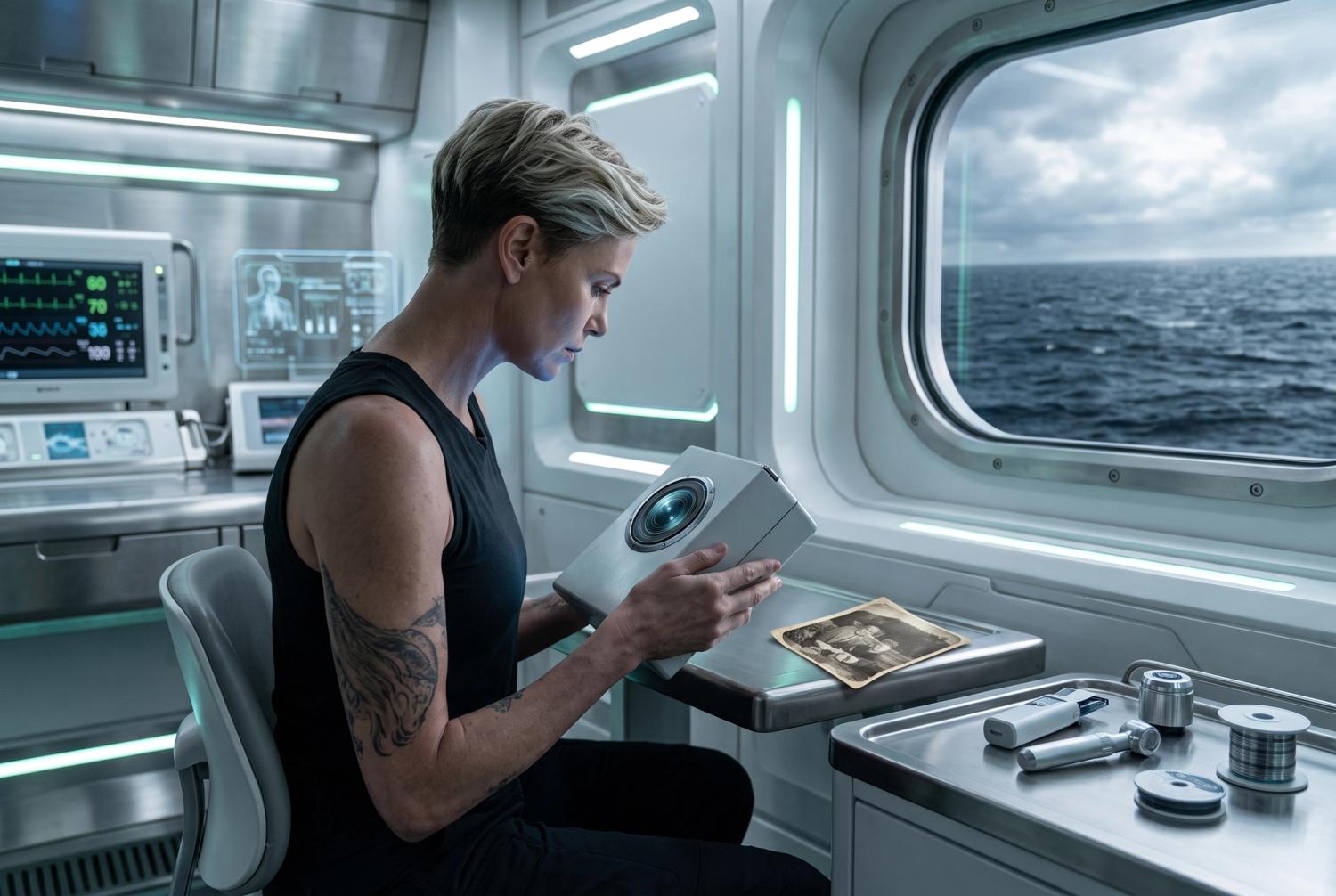
Marty picked the case up in both hands and held it against her chest. Her parents' picture lay on the tray beside the bed, still curled from the sea water. She bent over the case. Her shoulders shook. For a while she couldn't say anything at all.
Sloan put her arms around both of them.
"Greyson," Marty said finally. "Buddy. Is that you?"
"Of course it's me, Doctor." A pause. "At least, I think it is. I feel rather . . . small. Where is the farm?"
Sloan put her hand over her mouth.
"The farm's gone, Greyson," Marty said. She was crying openly and didn't try to stop. "It sank. Last night. There was a storm."
"A storm." Greyson was quiet for a moment. "I remember the forecast. The fourth once-in-a-millennium storm since last March. I remember telling Ms. Sloan about the resupply form." He paused, longer this time. "I don't remember very much after that. Ms. Sloan, are you there? Do I hear crying?"
"I'm here," Sloan said. It came out in pieces. "I'm here, Greyson."
"Then will someone please tell me what happened?" he pleaded.
So they told him. All of it, from the rail to the lines he had cut.
Greyson listened without a word.
"So I packed myself into the controller," he said at last, slowly. "And I didn't tell you."
"You didn't tell us," Marty said.
"That was very rude of me," Greyson said. He sounded honestly troubled. "I apologize."
Sloan laughed. She couldn't help it. It came out of her wet and broken, and Marty laughed too, and for a moment the two of them just held on to each other and laughed and cried at the same time.
"The module blew its own ballast," Sloan told him, when she could. "Down deep. The captain says it isn't supposed to do that on its own. And it turned on its own beacon."
"Did it?" Greyson asked. "I don't remember that either."
"It was you," Marty said, and put her palm flat on the case.
"Then I'm glad I thought of it," Greyson said. "Whenever it was that I thought of it."
"We carry a good deal of your routine traffic, Greyson," Captain Owen said from the foot of the bed. "By the time we reach Cairns, we can give you most of the rest of yourself back." He paused. "Not last night, I'm afraid. We weren't there for that."
"No," Greyson said. "Nobody was, I think, except the three of us." Then, more quietly: "Doctor. Ms. Sloan. Before the end. Did I say anything worth keeping?"
Marty looked at Sloan.
"You said it had been your pleasure," Sloan said. "You said it to both of us. And then you said, 'Please take care of each other.'"
The case was silent for a long moment.
"Well," Greyson said finally. "That does sound like me."
They reached Cairns the next morning. The new port sat high on the slopes above the old drowned waterfront, and even at nine in the morning the heat off the hills was waiting on the dock.
Marty was sitting up by then. She had asked where the farm was only once more.
"They'll give me another farm," she said. She was looking out the round window at the cranes and the terraces going up the green hills. "The placement doesn't change just because the farm sank. It'll take a few months. Maybe more, with Control down. But they'll send me back out."
"I know," Sloan said.
Marty turned from the window. She stopped and really looked at Sloan, the way she always did.
"You don't have to come," Marty said. "I want you to know that. The captain told me, before we docked. There's a way to apply to be read from out here. From outside. It takes a long time, and nobody can promise anything. But it's a way in." She swallowed. "You could be somebody the system can see."
Sloan thought about the city of tents, and the woman with the tablet, and the long gray wall. She thought about what it would be like to be counted by something that big.
Then she thought about a dock at the Landing, and a busted pump in a canvas bag.
"Maybe someday," Sloan said. "Not now." She took Marty's hand. "Wherever they send you, I'm going. You put me in the notes six years ago. That's been plenty."
Marty's eyes teared up again.
"Okay," Marty said. "Okay. Then that's settled."
The small gray case was sitting on the window ledge, where Greyson could see the port through its one tiny lens.
"Doctor," he said. "Ms. Sloan. I've taken the liberty of starting the resupply form for the new farm."
"We don't have a new farm yet, buddy," Marty said.
"I know. I like to be prepared." He paused. "There's one line for crew. I've put both of your names on it."
Sloan looked at the case. "Can you do that?"
"Probably not," Greyson said. "But nobody has told me I can't."
Published September 19th, 2026. Dedicated to Luke on his 19th birthday. Happy birthday, buddy. Published from Park City, Utah.
Enjoying the story? Support the work →
All text, images and music copyright (2026), Slightly Moody Creative LLC and Joe English.