The Sit Boy · Chapter 10
The Facebook Post

The goodbye was easier this time and that made it worse.
Six weeks earlier, Dixon had handed Magnolia through that same door and driven away with an empty back seat and a hole in his chest. Now the door opened and the dog was already home, exactly where she belonged, and his son hugged him in the doorway with the whole casual confidence of a kid who knew his father would be back. Nobody cried. Nothing was being given up. It was just the end of a good summer, the ordinary kind of goodbye that families with two addresses learn to do.
"Text me when you get wherever you're going," Cash said.
"I don't know where I'm going."
"Yeah." Cash grinned. "Text me when you get there anyway."
Magnolia escorted Dixon to the door, accepted a kiss on the head, and trotted back to the couch. She did not follow him out. Dixon stood on the walk for a second and heard the door close behind him, the small solid sound of a home sealing itself back up with everyone inside it who lived there, and he walked to the car alone.
He posted some pictures that night summarizing the last few weeks with the kid and the dog. Cash and Magnolia on the couch, the kid's arm around the dog, both of them looking at the camera like a portrait of everything Dixon didn't have an address for. He wrote what he had started calling ‘the bright version’ in the caption. “End of another summer. Fulfilled and heartbroken at the same time, which I'm told is called parenting. He'll be seventeen next month. Until the next visit.” The little hearts came in all evening. Nobody asked where he was sleeping or what he was doing next.
The math was the ugly part. School was starting, and the start of school scrambled the visiting schedule, and when he and Cash's mom had worked out the calendar it came to almost eight weeks before he'd see the kid again. Eight weeks. The usual rhythm was five. Three extra weeks did not sound like much until you had nothing to put in them.
And he had nothing to put in them. Work had gone quiet in the way big companies go quiet after a merger finishes digesting, his calendar of calls thinning from six a day to six a week, the machine running fine without him while somebody three levels up decided what he was for. There was a corporate term for it: Gardening Leave. A man being paid to tend to a garden he didn't have.
Eight weeks. No house. No dog. No meetings. Nowhere to be and nothing to do when he got there.
He was about to learn the difference between rest and idleness, and it was going to cost him some sleep.
He rented a houseboat for three weeks, on a moorage on the Columbia just north of the city, because it was August and the listing photos showed a deck over green water and he thought: that looks like rest.
The houseboat was genuinely lovely. Cedar-shingled, low and snug, a kayak on a rack he never touched, the river moving underneath everything so the whole house breathed a little, up and down, all day. Ospreys worked the channel in the morning. The end-of-summer heat lay down on the water every afternoon and turned it to hammered tin. Dixon lay on the deck in the sun with a paperback he wasn't reading and a guitar he was barely playing, a man with no obligations on a floating porch in beautiful weather, and he was bored beyond anything he had ever felt in his life.
Not just bored. It took him days to find the right word, and the word surprised him.
Tired.
He had nothing to do and he was exhausted, and the exhaustion made no sense until he started doing the arithmetic of his days. He had been on the move most of the summer. Sometimes every day or sometimes every week, everything he owned went into the car and came back out of the car. Every new town started from zero. Where was the grocery store? And then, inside the grocery store, where was everything he was looking for? He had stood in the coffee aisle of a Fred Meyer for five full minutes because every grocery chain hides the filters somewhere different and this one had chosen, apparently, to hide them near the pet food. Grocery stores apparently arranged things for people that lived in the neighborhood, visitors be damned.
There were things he needed to take care of, like going to the doctor or the dentist. He needed a haircut and he'd had the same hair stylist for a few years in Atlanta, a man named Gus who knew his head like a map, and now a stranger with clippers spun the chair around and asked "what are we doing today?" and Dixon looked at himself in the mirror and genuinely did not know. Every errand was a small research project. Every day was a first day.
That was the thing nobody told you about the road. It wasn't the driving that wore you down. It was that you never stopped solving. A person at home solves the puzzle of their life once and then lives in the solution. Dixon solved his life fresh every morning, and the solving never showed up anywhere as work, and it never stopped.
And then there were the beds.
He started counting them one afternoon on the deck, and the counting turned into a kind of accidental meditation. The bed at home that sold for five hundred dollars. The air mattress on the floor. The Hampton Inn in Missouri with Magnolia in the exact center. Rhonda's guest bed under the forty angels. Phoebe's bed with Patches between their legs. The furnace bed in Needles with the sheets on the floor. Motel beds soft as soggy bread, others hard as a sidewalk. And now the houseboat's bed, a fine bed really, except that it moved all night with the wakes of passing barges and his body kept waking to ask the room where it was.
People say a home is a place to lay your head. Dixon had laid his head in more places these last months than in the ten years before it, and his body had learned none of them. That was what a bed was, he decided, lying on the deck of a house that floated. A bed was a negotiation between your body and a room, and the negotiation took time, and he never stayed anywhere long enough to close the deal. He was not resting anywhere. He was only stopping. He didn’t have that one place to go back to. The place that meant you had stopped moving. And, at least for the foreseeable, he never would.
In the evenings he played the guitar on the deck. Three chords and the stolen fourth, over and over, the song from Reno circling. Twice he propped the phone against the rail and recorded himself doing it, because Sloane had said send it and Sloane did not say things twice. Twice he listened back and deleted it. It wasn't the bar in Reno. Nothing was the bar in Reno. He texted her ‘still working on it’ and she texted back a single eyebrow-raise of an ellipsis, and he set the phone face-down and watched the river go by, carrying its water somewhere with a confidence he envied.
Graham lived two boats down, and Graham was the most relaxed human being Dixon had ever observed at close range.
He was somewhere around forty, lean and sun-tanned, with a swimmer's shoulders and reading glasses he wore on top of his head like they'd been born there. On weekday mornings he sat on his deck at six with a mason jar of cold brew and a stack of legal briefs, working in total stillness while the ospreys screamed. He was a corporate lawyer downtown. "Mergers," he said, when Dixon asked, and Dixon could only laugh because they were both a part of the machine spun by big corporate capital. Graham raised his mason jar in salute. "To the machine," he said. "May it keep not needing either of us."
On weekends, Graham disappeared east up the river in a small daysailer and came back at dusk, looking tan and serene. On the second Friday, he appeared at the rail of Dixon's deck with the boat's cover already half off.
"I'm sailing up to Rooster Rock tomorrow," Graham said. "You should come. Fair warning, it's a clothing-optional beach, and I intend to exercise the option." He looked at Dixon over the top of the reading glasses. "You strike me as a man who could use some optional in his life."
Dixon, who recalled the evening in Madison, ran the sentence back once and checked. "Is this a pass? I want to be accurate about what I'm saying yes to," he asked.
"It is not a pass." Graham smiled, unbothered, a man entirely at peace with both the question and his sexuality. "If it were a pass, I'd have led with the part where I'm an excellent cook. This is just an invitation to go to the beach, albeit a fairly non-traditional one. Bring water and leave the watch. Oh, and make sure to put on sunscreen. . . all over." Dixon laughed. It sounded like fun. It sounded like something to do actually, and that sounded necessary.
They sailed up the gorge in the morning with the wind funneling down between the walls, the Cascades rising in green forest on both sides, and Graham handled the little boat with the same total stillness he brought to the legal briefs. He talked easily and listened better. By the time they anchored off the long sandbar at Rooster Rock, Dixon had told him most of his story, the whole leaving and driving and shedding of it, and Graham had absorbed it all with lawyerly calm and said only, "so you're between everything. That's a real place, you know. People act like it isn't. It's the realest place there is." Dixon nodded. He wasn’t sure he understood, but he appreciated the thought.
Then Graham took off all his clothes, stepped off the boat into the shallow water, and waded ashore through the warmth of the Columbia River.
Rooster Rock at the clothing-optional end was two worlds separated by a shallow strip of water, and Dixon spent the afternoon wide-eyed in both of them.
On one side of the cove was the men's scene, orderly and social, towels laid with real precision, sunscreen offered around like communion, small groups standing in the water at conversational distances that were not accidental. The naked bodies glistened in the sun, covered in oil and absent of body hair. Techno thumped and Pride flags waved in the breeze. Graham moved through the scene greeting people by name, entirely himself, a lawyer with no briefs on. Across the water on the other side of the cove was a small encampment, and the encampment was a different civilization entirely: there were tents and tapestries strung between driftwood poles, a guitar circle, women doing yoga on paddleboards, a man with a cooler who was either selling mushroom tea or sharing it, the distinction blurry on purpose. The body hair was next-level over there. Dixon had never seen so much of it. The music on this side of the lagoon was a mixture of Grateful Dead and Jimi Hendrix. Dixon was pleased to note a lack of Phish.
Everybody on either side of the cove was some version of naked and absolutely nobody cared. A few women had on underwear or bathing suit bottoms. Many had on hats and glasses. The level of tan ranged from first-day-in-the-sun white to never-been-inside-a-building leather. The people ran the gamut of ages from young children, who didn’t seem to have even noticed the lack of clothing, to very old men and women who seemed absolutely delighted by it all.
Dixon undressed the way you enter cold water, in stages, negotiating with himself. Then he stood there in the sun, a fifty-two-year-old man wearing nothing but a straw hat, and discovered that the negotiation had been the whole problem. Once you were naked, you were just another naked body, sagging or gleaming or scarred or magnificent or hairy. But the moment you joined the crowd, you became a part of it and the people wearing clothes were suddenly the odd ones out. Naked was the social convention here and so it felt entirely natural. He waded out into the middle of the cove and floated on his back with his hat on his chest and he laughed out loud at nothing, at the sky, at the sheer unlikeliness of his own life.
He could not have been more foreign here and it didn't matter. The men's side read him in about four seconds, decided he was Graham's straight friend, and folded him into conversations about music and politics. The tent side took longer, because the tent side had never seen anything quite like him. He was too fit for a man his age and too groomed for a hippie and too obviously ‘somebody’ for a beach where nobody was anybody. These were people that drove 1992 Nissan Sentras and, without even knowing that he now drove a very practical little Toyota, they sensed on him that he had most recently owned a newish Land Rover.
A woman with colorful dreadlocks and a sun-creased face studied him over the rim of a tin cup for a long time before delivering her verdict.
"You're not from around here," she said. It wasn't a question.
"Well that’s true," Dixon said. "But if you’re going to ask where I belong, get ready for a very long story."
He braced for the usual barrage of questions. But instead the woman's whole face opened and she motioned for him to sit down.
"A man from Nowhere, now that’s a story that I want to hear," she said. She motioned to the man with the cooler, the one offering the mushroom tea, with a reverence that Dixon could feel. "He lives Nowhere too. Most people spend their whole lives trying to get to Nowhere without even understanding why they need to get there." She refilled her tin cup from a thermos and raised it to him. "The need for an address is the first lie they sell you. It's the way they turn you into a cog in the machine. Once you have an address, you need a job, the things, the chase for more and more. It’s a never ending quest to keep you staying Somewhere. Nowhere is the only place you are truly free," she said. "Hey, you want some tea? It's just tea. His cooler is the other tea," she added.
Dixon declined both teas for the moment, but he stayed an hour telling her his story. He had spent the last couple of months apologizing his way through these conversations, softening the word ‘homeless’, watching faces fall in Chicago and Atlanta, and here at the nude beach along the Columbia River was the first group of people in America who heard ‘I live nowhere’ and celebrated him for it. A kid brought him a cool rock with an infinity symbol painted on it. The guitar circle invited him in and he played his three chords. Dixon was strumming his guitar naked, except for a straw hat, while a man with a beard down to his sternum kept time on a five-gallon bucket, and it was, in every measurable way, one of the strangest and best afternoons of his year.
And underneath it, all afternoon, his emotions were doing the thing that they’d been doing a lot lately. Dixon felt like the compass in his chest was just slowly turning in circles, rather than settling on true north.

He noticed it on the sail back, with the sun going down the river ahead of them and his skin tight with sun and sweat from the heat. Graham asked, "good day?" and Dixon said, "great day," and meant it completely, and then felt the feelings arrive right on schedule, the way they did every evening now, no matter what the day had been. The tent people had celebrated his freedom. The freedom was real. And the freedom was also this: a great day that ended with no one to describe it to, docking at a house that floated, anchored only to the other boats around it but not to solid ground, going to bed in the eleventh bed of the summer.
"You went somewhere just now," Graham said, watching him. Lawyers watched.
"I go there a lot lately," Dixon confessed.
"Mm." Graham adjusted something and the boat leaned softly. "For what it's worth, between-everything is a real place. But nobody lives there for long. You’ll find a home for yourself again someday. It just might look different from what you had before."
Monday he took care of logistics, because a man with nothing to do will invent errands to feel like a person.
He drove across the river to Camas, because Washington was his home state and if his mail was going to land somewhere it might as well land where he was from. He rented a mailbox at a mail store in a strip mall between a Pilates studio and a juice bar. The clerk handed him a key the size of his thumbnail. His entire postal existence now had to fit behind a brass door four inches wide. He stood in the parking lot and put the little key on his key ring.
Then he rented a small storage unit, the overflow kind, and spent an afternoon organizing it. The cargo carrier came off the top of the RAV4, and it was a genuine wrestling match. A man at the next unit watched the entire thing without offering to help, which Dixon respected as a boundary. Into the storage unit went the cargo carrier, a duffel of dress shoes he had not worn since Atlanta, and one large suitcase of shirts chosen by a simple test: had he reached for it even once all summer? The car came out of it visibly lighter, sitting higher on its springs, and the unit's narrow roller door came down on another little museum of his former life, and the man at the counter gave him another small key to add to the key ring.
Five keys on the ring now: one to a storage unit in Atlanta, another to a storage unit in Portland, plus a mailbox in Camas, the cargo carrier, and the bike rack that sat on the back of the car. He turned the ring of keys over in his palm in the parking lot. His life had keys the way a janitor has keys, lots of them, none to anywhere he could sleep. He was accumulating access to closets and boxes and locks. It should have depressed him and instead it struck him as darkly funny. He had a similar number of keys to what he’d had before he left, but they were keys to a very different, much more portable life.
On the way back to the houseboat he stopped at an office supply store and bought the biggest paper calendar they had. It had four panels divided by spiral rings. Each panel displayed three months. With the whole thing opened it displayed an entire year. It actually had four years of paper and could be spread out as one quarter, two quarters or four quarters. This was going to be the place where he’d capture the details of his upcoming travels. He just didn’t grasp the complexity or emptiness of that task as of yet.
He opened up the calendar and hung it on a nail on the wall. Its massive presence changed the room, and then it changed his mood.
He filled in what he knew, and he did it in pencil, because his plans only earned pencil. The Cash weeks went on first, every fifth week penciled out to December, the visits that were the fixed stars of his sky. In September he wrote “CASH 17” on a Saturday and looked at it for a while. Seventeen. Then he penciled in the one work summit they'd asked him to attend, in October, two days.
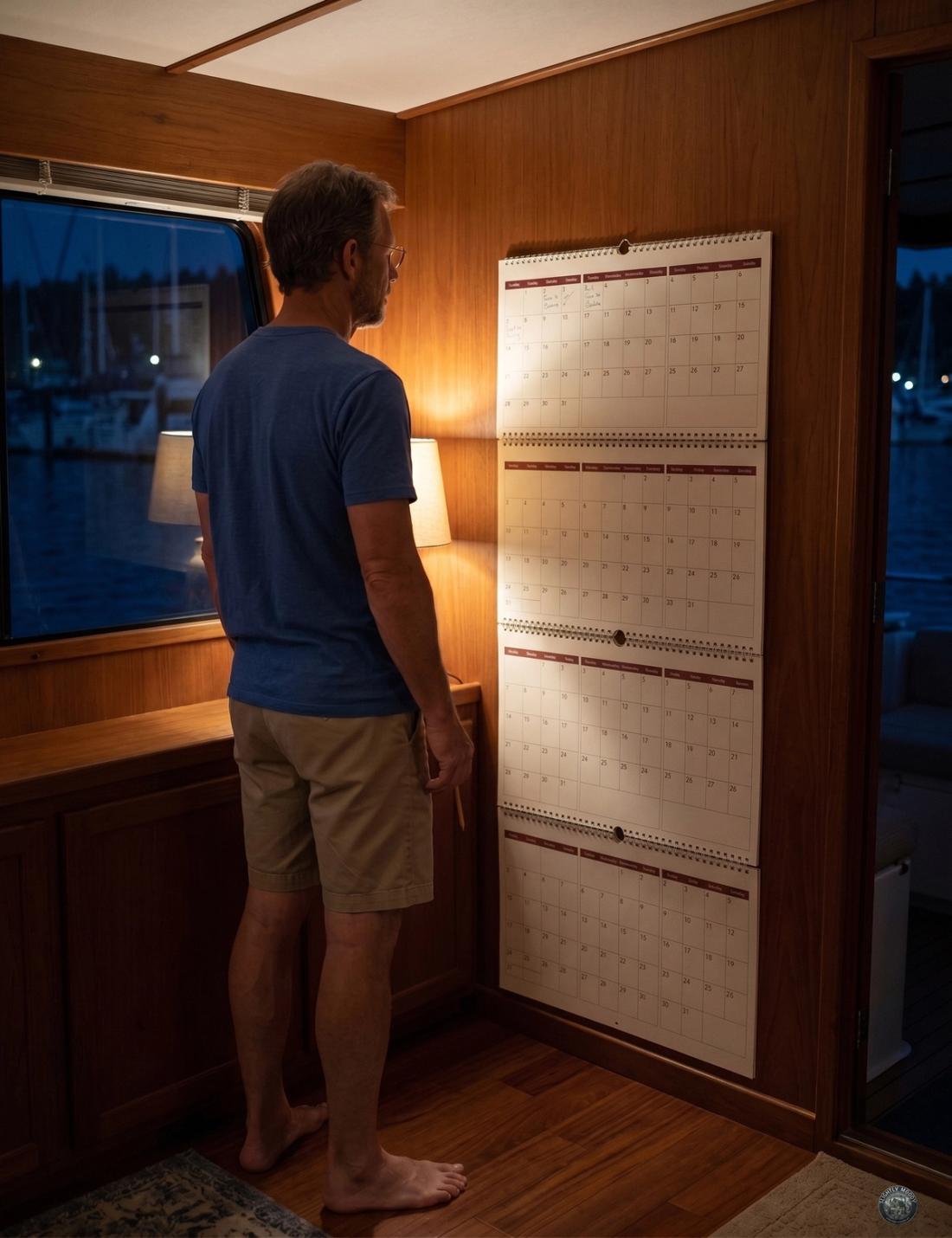
He stepped back and looked at the calendar, and the calendar looked back, and the emptiness of the whole thing shocked him.
There it sat, the detail areas all starkly white. From the middle of August to the end of December sat something like a hundred and forty days, and he had penciled maybe twenty of them, and the rest was a collection of blank squares in rows, each one representing a night that he had to fill in. He stood in the middle of the floating living room and made himself look at what the white actually meant. Every square was a bed he had not found yet. Every square was a town he'd have to decode, a grocery store with its hidden coffee filters, a new series of door codes to learn, a new app to pay for parking on the streets, a decision of where to be that night. A hundred and twenty separate solutions to the same problem, which was, essentially, where does the man sleep tonight, multiplied out to the horizon.
He sat down on the couch, in the houseboat, which belonged to a stranger, and started to do math in his head.
He'd been telling himself the road was cheaper than owning a home, because of all that goes with owning a home. But his notes said otherwise. Hotels, motels, AirBnBs, extended stay places, even the sad ones, cost real dollars that added up. The lovely houseboat was a splurge he could not repeat monthly. He priced long-term rentals, a month here and a month there in the cities on his loop, and the numbers came back with a straight face: for anything he'd actually want to live in, the road cost as much as the mortgage he no longer had. He had sold a house to be free and the freedom was quietly billing him like a house. He had money to pay for it. That was not the point and he knew it. The point was that even if he lived frugally on the road, it might cost even more than owning a home.
He sat with the notebook and the calendar of empty squares. He was suddenly a man in need of a life hack, some kind of a solution to a problem and that’s where Dixon’s brain was exceptional. He knew that if he thought about this problem, spun it around in various ways, he’d find a unique way to solve it. He was confident that he just needed to give it time and the solution would emerge.
He walked around the houseboat thinking. He jumped in the water and floated around thinking. He ate dinner deep in thought. He scrolled through Instagram, thinking all the while. He knew that a solution would come to him as soon as he stopped looking directly for it. And it came to him a bit later that very night.
It was 11:40PM. He was looking at a post one of his friends wrote about getting a new puppy who they were potty training. This made him think about the dogs in his recent life. Magnolia trotting back to the couch, home, done with him. Bagley hitting Priscilla at the knees. Peanut towing Earl across an Amarillo parking lot to get to him. Patches asleep between his legs in Flagstaff. Forty dogs mobbing him at a singles bar in Atlanta while his date checked her watch. Throughout his whole life, dogs had crossed rooms and parking lots and dog parks to get to him, and for two months he had been driving through America dogless, sleeping in bed after bed with nothing warm against his legs, and he missed it the way you miss a language you used to speak every day.
And then he thought about Dale, the ‘Buy Nothing’ guy in Atlanta.
Dale, who had emptied his freezer in twenty minutes because Brooklyn had said ‘post it and watch what happens.’ There was a whole economy under the visible one. He'd seen it at work. People out there needed things you'd never guess they needed, and the internet was a porch light, and all you had to do was turn it on.
Dixon sat up in the eleventh bed of his summer and opened Facebook and started typing. He didn’t really set out to post what he posted, but this was the way Dixon worked. Something spurred him into action. Maybe it was the astrology of the moment acting on him. Something moved under him and the post started to form.
The first draft explained too much. He deleted the paragraph about the divorce. The second draft apologized, ‘I know this is a weird ask,’ and he deleted that too, because it wasn't weird, or if it was, apologizing wouldn't fix it. The third draft he read twice and posted before he could change his mind:
“I'm working on my travel calendar for the next year. If you might need in-home dog and house sitting for 1 to 4 weeks, message me. I will come to you, and I will love on your dogs like it's my job, because as of tonight it sort of is. (Not sure where I'll be coming from, but longer stays are preferred if you're a long way from me.)”
He posted it at 11:47 p.m., the hour when nothing good happens, and put the phone on the nightstand.
The phone lit up before it touched the wood.
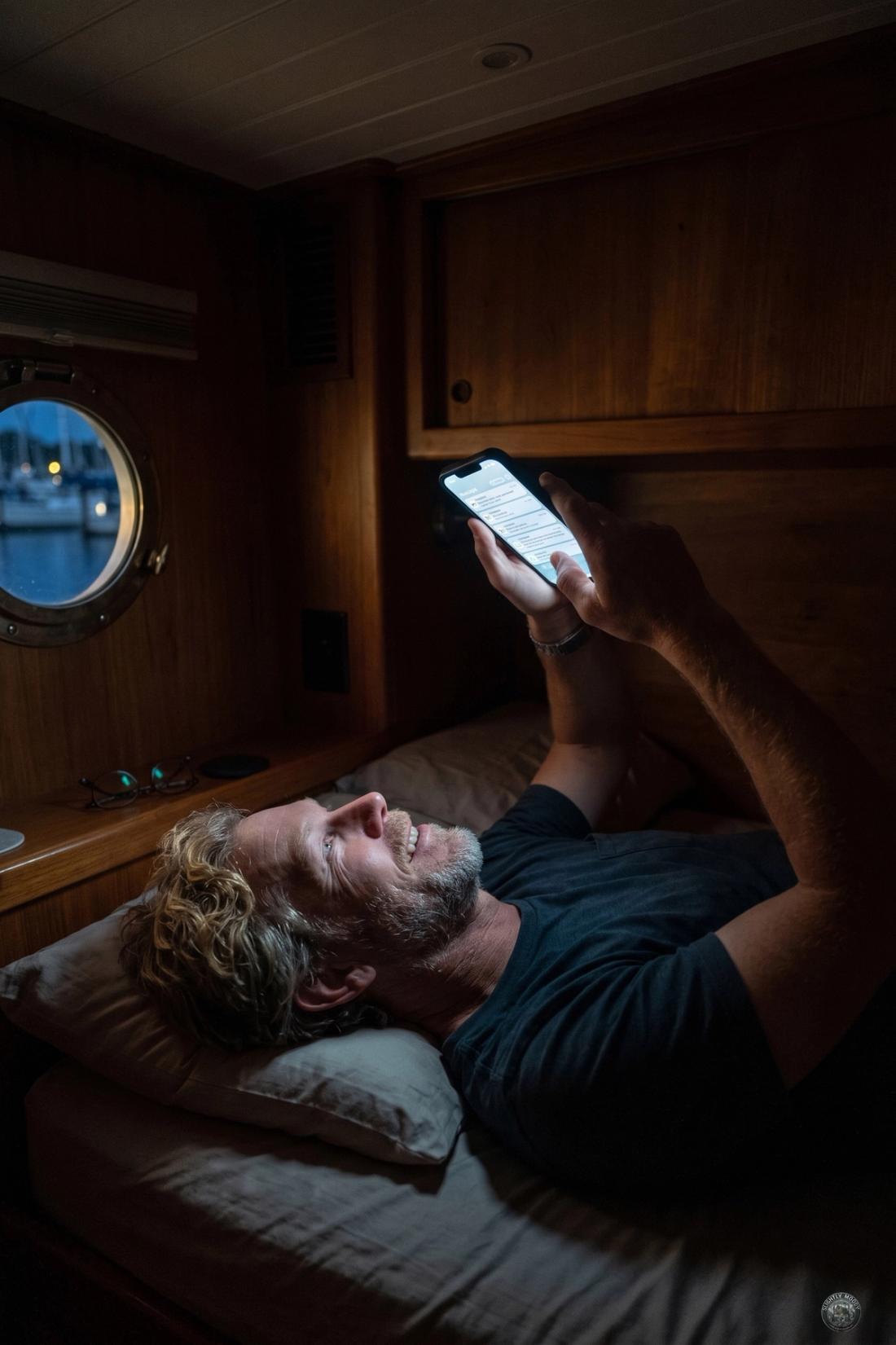
He picked it back up. A comment already, from a college friend's wife: ‘I'll message you!’ And then the messages started, and Dixon lay in the rented houseboat and watched his phone light the ceiling like slow lightning, on and off, on and off, at midnight, at what was three a.m. back east, from people who by every rule of the internet should have been asleep.
‘Denver area? Dec thru March possibly. Full gym in the basement!’
‘Is Vashon Island in your orbit?’
‘My sister's an excellent dog sitter in the Seattle area,’ wrote someone, unhelpfully, offering him competition instead of dogs.
‘What's your comfort level with lake life and a dinghy?’ Dixon, lying at that moment inside a floating house, typed: ‘high, apparently.’
‘Wait. You're looking FOR dog sitting or you DO dog sitting? Because I'm going to Colorado in September and I need someone for my mutts.’
‘Closest airport to me is Reno, about 40 minutes out. Lovely 9-year-old Weimaraner who goes to boarding when I travel and it's a fortune.’ Dixon read that one twice. Reno. The universe had a sense of humor and apparently knew of his recent brush with fame at the Rusty Spur.
‘We need someone 2.5 to 3 weeks, two big dogs and two cats, house in the woods on Tiger Mountain southeast of Issaquah. Neighborhood pool. Great hiking from the driveway.’
‘We're in Columbia, South Carolina. To sell it: walking distance to everything, but we also have a golf cart. You'd share the house with two tiny Yorkies and a cat. They're all pretty demanding,’ followed by the crying-laughing face of a person telling the truth.
‘Interested in Kirkland in December?’
Somewhere in the scroll, a friend from an old job wrote: ‘Look at Trusted Housesitters. I have a couple of friends who swear by it.’ Twenty minutes later, unconnected, a couple he knew from Seattle: ‘If you try Trusted Housesitters I have a discount code. My husband and I have pet sat all over the world with it. We have a gig in Shoreline next week for three cats. WE LOVE IT.’ Two arrows, one direction. Dixon wrote the name down on a pad by the bed.
He answered the thread once, near one in the morning, because people kept asking: ‘For those wondering, my range is anywhere in the US and Canada. I have to be in Portland every fifth week or so, but otherwise I can go anywhere.’ Then he lay back and watched the ceiling flicker.
By 1:40 in the morning he had messages that added up, if even half of them held, to months of squares on the calendar. Denver and Issaquah and Kirkland and a Weimaraner outside Reno, people he knew and friends of people he knew, houses with gyms and golf carts and pools, all of them attached to animals who needed somebody, all of them a long way from each other, which was, he had written it himself, preferred.
He got up, walked into the dark living room, and stood in front of the calendar in his shorts. He didn't pencil anything yet. He just looked at the white wall of it, which two hours ago had been a hundred and forty problems, and felt it turn over into something else entirely. Not problems. Invitations, pending.
He texted Brooklyn, because she was his only real rock.
Dixon: I think I just accidentally solved my life
Brooklyn: It's almost 5am here. Solved it how? Solved WHAT?
Dixon: I solved it with dogs
Brooklyn: …
Brooklyn: …
Brooklyn: …
Brooklyn: Call me tomorrow. This is either amazing or a cry for help and I need to know which.
In the morning he built a profile on TrustedHouseSitters.
The service asked him to describe himself, and he sat with his decaf on the deck and told the truth, which had gotten easier with practice. ‘I'm roaming around the country for a while and I can go anywhere. I'm reliable, I'm clean, and dogs have followed me around my whole life. I've owned homes my whole adult life, so I know how to treat yours. Your house will be better than you left it when you come back and your dogs will be spoiled rotten from all of the attention.’ He uploaded a picture of himself with Magnolia at Little America, both of them squinting into the Wyoming wind. He read the profile twice, decided it sounded like someone he would trust, and pressed the button that made it live.
The first message came inside the hour.
She was a dental hygienist, she wrote, and she was going to Asia, and the trip had been booked for a year, and her sitter had just fallen through, and she was leaving in two days. Two days. Three weeks. Two dogs, easy ones, mostly, she wrote, in a message with the punctuation of a woman typing in a break room between patients. ‘Please,’ she wrote, and then, ‘sorry, I don't mean to sound desperate, but I am desperate. I can’t afford to board them for three weeks and this is my dream trip.’ And Dixon, who had spent a summer learning exactly what desperate-but-fine sounded like, wrote back before he had consciously decided anything.
‘I can be there. Send me the address.’
He put the phone down and looked at the river. Then he went inside and stood at the calendar and penciled a line across three weeks of squares, the first marks on the whole white wall that weren't his son, and stepped back and looked at what he'd done.
In two days he would be in a stranger's house with a stranger's dogs. Three weeks of a life he had invented at 11:47PM on a Tuesday night without even really thinking about what it meant.
The worrying started immediately, and it was thorough, because Dixon was thorough. What if the dogs didn't like him? He lay in the boat that night and actually thought this, a man that dogs had been crossing parking lots to reach for fifty years, and the thought kept him company anyway, because worry doesn't check the record. What if he was bad at it? What if the house had rules he couldn't decode? What if something went wrong with an animal in his care? What if the owner came home from Asia to find he'd failed at the one thing he'd advertised? He had produced events for thousands of people without losing a night's sleep and he was lying in a rocking bed losing sleep over two dogs he had never met.
‘I have no idea what I'm doing,’ he thought, clearly, in the dark.
And then, some time after that, with the river patting the hull and the calendar hanging in the other room with its three penciled weeks, he fell asleep before he could finish the list of everything that could go wrong. Slept hard, slept through the tugboat and barge wakes, slept like a man whose body had finally been given a date and a place to be.
It wasn't rest. Not yet.
But it was close enough to get him to Thursday.
Published July 17th, 2026 from Denver, Colorado
Enjoying the story? Support the work →
All text, images and music copyright (2026), Slightly Moody Creative LLC and Joe English.