The Sit Boy · Chapter 9
West, Eventually

Act II: The Education of a Sit Boy
July 1st, 2024
That first morning, after a few hours of driving, the initial excitement of the departure waned. It started to dawn on Dixon that being free and having a plan were two different things. There’s a fine line between being independently freewheeling in that cool sort of adventurous way and being entirely directionless in life. Sometime that morning, Dixon realized that he was dangerously straddling that line. He could go anywhere, it seemed, but he had no idea where that was.
It really started to wash over him, while gassing up the RAV4 at a Buc-ee's in Alabama. He filled the tank, felt the heat wash over him and briefly contemplated the smell of the brisket coming from inside. He stood there with the pump running, watching the numbers creep up and he understood that when that pump clicked off he would have to pick a direction for his onward journey. Nobody was waiting for him, anywhere. There was no house to go back to and mow its lawn at some nebulous point in the future. Cash didn't expect him in Portland for a couple of weeks. It suddenly felt like he was standing in the middle of an empty white volume and in his head he said “hello” and the echo of it came crashing back at him in waves. There was the whole country, the whole world really. He was alone in it. He had a full tank of gas, a guitar in the back seat he couldn't play, and basically that was the entire situation.
He stood for a while. He listened to the advertisements coming from the little display on the gas pump. He looked around. He smiled at a dog doing his business in the pet relief area. He tapped his foot a couple of times on the ground aimlessly. He considered again the smell of the brisket. He momentarily considered entering a competition to win a trip to Jamaica that an announcer was talking about. This, he thought, was what it felt like to be entirely unmoored.
A man in his late 60s with an immaculately kept F-250 at the next island gave him a look. It wasn’t an unkind look. The look was more one of concern, as if Dixon might be having a nervous breakdown and he was witnessing it.
"You alright, boss?" he asked.
Dixon snapped back to focus. "Oh, yeah, I guess so. I'm just, uh, I’m trying to decide which way to go," Dixon said.
The man considered this. "Well, where were you headed when you rolled out ya’ driveway this morning?"
"That's kinda the thing. Nowhere, really. West, I guess. Eventually," Dixon said trailing off.
The man nodded slowly, the way you nod at someone whose problem is not your problem. "Well," he said. "West's that way." He pointed a direction that presumably was west. Then he climbed up into the cab of his truck and left Dixon alone again.
It was that simple. West was, in fact, that way. But it was not simple at all. In either case, or both cases, as it may be, Dixon got in the car and he went that way.
He talked to the guitar for the first hundred miles, because the dog used to be there and the habit was hard to break.
"Don't get comfortable," he told it, glancing in the mirror at the scuffed case riding on the dog platform in the back. "You're going to have to earn your seat eventually."
The guitar did not respond. He liked the idea of the guitar. He could still smell and taste Marlowe in his mind when he looked at it. But he couldn't play a note on the thing. He'd tried, twice, so far, and produced sounds that made him set it down and apologize to it out loud.
But he liked having it there. It rode where Magnolia had ridden, and that was something.
He pulled over at a rest area and considered the map. After looking dutifully at it, he pointed the car in the direction of Kansas City because he knew that they have good BBQ in Kansas City and that sounded appealing to him. In the bigger picture, it was generally in the right direction. He decided that would be the trip's whole organizing principle: “generally the right direction.” He was typically a planner. He had an eye for details. For once he would not optimize the route. He would drift and see where he ended up. He would let the country decide.
The country decided, for the moment, on Kansas City.
Unfortunately, Kansas City decided that Dixon did not belong in Kansas City, and it decided this quickly.
Dixon had found a vintage motel downtown with heaps of character, and the smell of dust and a ghost or two. He asked the clerk at the front desk and she recommended a bar called the Buckhorn. She said it was a real “KC place,” a place to meet some of the local KC wildlife. Dixon walked there. He opened the door and the bright light from the outside illuminated the dark interior. Dixon was backlit with the sun behind him. All of the KC wildlife took a pause from their beers to crane around and look at him in the doorway, standing there like a lost puppy. He walked inside and took in the scene. Dixon was wearing attire that would be typical for a creative director from Atlanta: khaki shorts, a linen shirt, leather boat shoes without socks, an overtly fancy silver watch, Gucci glasses. It was, he understood the instant the door closed behind him, precisely the wrong outfit for this environment. The room was outfitted in denim and boots and ball caps. The KC wildlife considered him for a hushed moment and then went back to their conversations.
Dixon was used to walking into rooms full of people. He walked into a lot of rooms. But he typically walked in as a man who belonged in the room, or was at minimum dressed for it. He had never once walked into a room as that guy from somewhere east who doesn't know the drill.
He didn’t find the sensation entirely unpleasant. In fact, it was, he found, kind of freeing.
The place he’d walked into, the Buckhorn, had a wall of taxidermy that somebody clearly dusted, which Dixon respected, and a bartender named Judd, according to the three separate men who yelled it while Dixon stood there. Judd was a big man with a beard he'd committed to years ago and a KC Royals cap gone soft from the miles. He worked the bar like he owned every inch of it.
Dixon sat at the bar and addressed Judd as he approached: "Caffeine-free Diet Coke if you've got it. But you probably won't."
"We don't got it," Judd said in one of the deepest voices Dixon had ever heard.
"Sprite, then. Tall glass, lime in it. Make it look like I'm somebody, please," Dixon said with a kind smile and a little nod.
Judd almost smiled. Almost. But he went to work and built the Sprite like a cocktail. Fancy glass, lime, a cocktail napkin and everything, and set it down with precision in front of Dixon. "Where you in from?" he asked in the very, very low voice.
"Well, the last place was Atlanta. But I don't really live anywhere right now." Dixon heard himself say it and decided not to walk it back. "It's a long story, but don’t worry, it's not a sad one, I promise."
Judd looked at him a second. Then he wiped the bar and moved on. He clearly was not available for storytime. Dixon sat with his Sprite and watched the people go about their evening and felt the first real flush of a new thing he'd not felt before. He was nobody here. He had no reputation here, no past, no skin in this game. Maybe he was a man in the wrong shoes and the wrong clothes, drinking something that was not particularly manly, but he was the freest he had felt in two years.
He didn’t talk to anyone else while he was there. He learned a lot by listening. He heard about troubles on farms, unhappy kids and even a scandal or two. He was the ultimate fly on the wall. Before he left, he took a picture of the bar. He captured its dim light, the long sweeping wood form, the wall of bottles. He didn't post it anywhere. He just kept it with the others. He had started to think of the pictures as proof. Proof he had been places, even if he had just been there as a quiet spectator. The photos were the growing memories of the world unfolding around him.
The next morning after a large breakfast that included a slice of ham the size of a pizza, he got back on the road and before long he saw a sign for Route 66 and just instinctively got off the interstate and turned onto it. Route 66 had a magnetic quality that he couldn’t quite explain.
Route 66 had the coolest name any road in America ever had. He'd grown up hearing it in songs, or about it in movies. It was the “Mother Road,” with its neon signs and its diners and the mythology of it, and he wanted to see what the fuss was about. Also, and he admitted this freely, it would make a great story for the twins. Everybody had heard of Route 66. He was going to go live it. He was a man with nowhere to be and a road that promised it was going somewhere. That was a match.
The reality of Route 66 in the 2020s was, in long stretches, mostly a frontage road next to the interstate. The mythology and the maintenance budgets had parted ways decades ago. But there were stretches where it held onto its old charms, where abandoned motels still stood with dead neon signs out front.
There were towns that had the trappings of what anyone would picture as real Americana. One such town had a diner with a counter and eight stools and a woman named Carol who called Dixon ‘hon’ and meant it. Dixon ate pie at Carol’s diner that he didn't really want because a man two stools down said the pie was the only reason to stop in the entire county, and the man was right, and Dixon left Carol a tip that made her come out from behind the counter and give him a hug.
The food along Route 66 was unfortunately a gamble he kept losing. In a diner outside Shamrock, Texas, he ordered the chicken fried steak because the menu called it ‘World Famous.’ It arrived under a blanket of gravy that could only be described as white death, some experiment in lard and heavy cream that should have stayed in the test kitchen. The steak underneath was somehow both overcooked and mushy at the same time. Dixon ate half of it out of respect for somebody's effort, photographed the plate for Google Maps, and left without attempting dessert.
Dixon photographed a few of the old abandoned motels. He couldn't help it. There was a place called the Wagon Wheel, where the formerly illuminated wheel was still there, but its bulbs had long ago gone. The structure sat along the highway rusting against a sky doing something gorgeous but indifferent above it. He shot it in black and white. It looked, on the little screen, like something that knew it had been left behind.
He stopped for the abandoned places, to consider and photograph them, because they were still defiantly standing and he knew that few other people would. Somebody had built them for a future that was promised by this road, but when the road went elsewhere, they stayed, holding onto their little piece of shoulder. That seemed worth the consideration. Worth a picture. It seemed like a form of respect for a promised future that had taken a different exit.
Progress was made on the whole guitar situation in a motel parking lot in Amarillo, by a man named Earl who was not trying to teach anybody anything.
Dixon had taken the guitar outside after dark, because the room was small and the air conditioning was losing the battle to the hot night. He'd reached the point that carrying an instrument around he couldn't play that felt like something he really needed to work on. He sat on a curb by an ice machine and put his fingers where a website had told him to put them and made a sound like a broken screen door.
"That should be a G," said a voice. "If you're trying for a G, that's not it."
The man was maybe seventy, in a white tank top and bedroom slippers, with forearms like braided rope and a Marine Corps tattoo faded and bruised. He had a cigarette in one hand and a dog leash in the other. At the end of the leash was a small gray dog with an underbite, and the dog took one look at Dixon and towed the man across the parking lot to put her whole front half in Dixon's lap.
"Huh," the man said. His voice sounded like gravel in a coffee can. "Peanut don't usually do that."
"They usually do, with me. I don't know why." Dixon scratched Peanut's ears. "You play?" he said looking up at the man.
"Earl," he said, pointing at himself. "Yeah, I’ve played for most of my life. Sometimes in bars, sometimes at weddings. Mostly just because I like it." Earl set his cigarette on the curb and held out his hand for the guitar, not as a request, but rather as a command, and Dixon handed it over. Earl tuned it by ear in about nine seconds, which Dixon had not known was a thing a person could do. Then he handed it back. "Okay. Look. Everybody makes this too hard,” he explained in the instructive tone of a teacher.
He showed him G. He showed him C. He showed him D. He stood there in the parking lot in his tank top and made Dixon do it again. And again. Dixon's fingers screamed. The chords buzzed and died. Earl said "again" with the patience of a man who had nowhere better to be.
"That's it," Earl said, after a while. "That's most songs. Everything you love is probably those three."
"Huh, somebody told me that actually. Back in Nashville. She said ‘learn three chords and steal the fourth’."
"Smart girl." Earl picked his cigarette back up. "What's the fourth?"
"I don't know yet," Dixon said, truly puzzled.
"You'll know it when you need it," Earl said reassuringly. He gathered Peanut, who left Dixon's lap with visible reluctance. "Don't quit because your fingers hurt. That's the part where everybody quits. Push through that part and then you can play forever."
He went back inside. Dixon sat on the curb until his fingertips went numb, playing the same three chords in the same dumb order, and somewhere in there it stopped sounding like a broken screen door and started sounding like the beginning of something.
He played until two in the morning, somehow not disturbing the hotel guests, until his fingertips went shiny and numb. Somewhere under the repetition, words started lining themselves up against the chords in his mind. He let them.
In Tucumcari, New Mexico, Dixon decided to try an AirBnB, the kind where one rents a room in someone’s home, not the kind where you get the whole place to yourself. The type of AirBnB that was actually the real kind, the way they started out, before everyone jumped on the bandwagon of buying places to make them AirBnBs for the money. He thought he might also meet some nice people along the way. He would rent a room in somebody's house for half the price of a hotel. And, this was how Dixon met Rhonda.
The listing said ‘Cozy room in quiet home, close to Route 66 attractions!’ The house was a pink adobe with a yard of white gravel and a bedazzled concrete burro by the door. Rhonda met him on the step in a leopard-print blouse and extremely tight black leather pants. She was sixty-something, with a tower of copper hair and a cloud of perfume that arrived a full second before she did. Her skin was tanned beyond any healthy level of sun exposure. She gave Dixon a hug so deep that it bordered on lewd, yet Dixon, being Dixon, thought that this was a kind of hospitality he had not experienced before. And he enjoyed it.
Inside the home, every surface was covered with porcelain angels. There were, by his estimation, at least three hundred of them. Over the TV hung a framed, signed photo of a country singer Dixon sort of recognized, inscribed ‘To Rhonda. One hell of a night.’ Dixon chuckled at this.
"You're taller than your picture," Rhonda said, approvingly. “Your room’s this way,” she said, letting him pass her, and then she nearly placed her hand on his ass as he walked by. He was entirely unaware of this.
After he settled in, Rhonda fed him enchiladas he had not asked for and he once again marveled at the level of personalized hospitality. She told him about her three husbands in the order she'd divorced or buried them, and he very much enjoyed her stories. Dixon had that gift of letting everyone feel they were the most important person in the world and it was classically in practice all evening. This didn’t necessarily mean that Dixon was interested in Rhonda, but it, as was often the case, was received that way. Rhonda had the best evening of her year. Maybe of her whole decade.
Finally around eleven, Dixon made his way to the guest room, under the gaze of maybe forty angels. He showered in the guest bathroom and came back to his room in a T-shirt and shorts. He got into bed and turned off the lamp.
The bed moved.
The bed moved because someone was in it with him. There was a rustle of movement. Dixon froze for a moment. Then the perfume arrived. Rhonda's voice came out of the dark, about eight inches from his ear.
"I put fresh underwear on," she said. "In case you were worried."
Dixon levitated. There was no other word for what his body did. He came off the mattress, reached for the lamp, missed the switch, knocked an angel off the nightstand, caught the angel, and stood in the middle of the dark room holding the tiny porcelain angel to his chest like a man protecting an infant from a fire.
"Rhonda," he said abruptly. But then followed the name with nothing.
"Mm, hm," she said, pulling the sheets back and patting the mattress to invite him to get back in bed.
"Rhonda. . . you scared the shit out of me," Dixon said, his voice shaking.
"Well, I wasn't going to knock," she said, reasonably. "It's my house."
They negotiated in the dark. Dixon standing, holding the angel. Rhonda propped on one elbow, completely unbothered, topless, a woman who had clearly run this play before with mixed but perhaps occasionally positive results. Dixon stammered through something that can only be described as a desperate explanation of why this wasn’t in his plans. Rhonda listened to the whole thing and then said, "honey, I'm not asking you to marry me. I'm asking you to climb back in here and get lost in Rhonda-land for the evening."
As counterarguments went, he understood the logic. But the idea of entering into the sacred skin dance with the overly tanned, overtly aggressive, highly perfumed woman, wearing panties that said “testify” across the front, was a bit too much for his brain to process. He stammered a bit more.
Rhonda took this with the professionalism of someone who had done this before. She patted the blanket one more time and said "you sure Sweet Cheeks? You’re a good-looking man. You’d make Rhonda very happy." Dixon was sure. She finally gave up and padded back to her own room. Dixon lay there for a long time and considered what the actual fuck he had done to his life.
In the morning, Rhonda made him breakfast in a see-through robe with a sheer black body suit underneath. She made enough food to have fed a road crew, packed the leftover enchiladas from dinner for his cooler, and hugged him, thoroughly feeling him up in the process, at the door.
Dixon gave the listing five stars. He did not write a review. There were no words that would help the next guest either way.
He decided to go back to motels after that. Not because of Rhonda, exactly. Because of the three seconds after the bed moved, when he had been a man alone in a dark house in a strange town with no idea what was happening. His whole life was strangers' rooms now. He was going to have to get better at reading them.
In Flagstaff, he started writing down the words to a song of sorts. It was more a collection of thoughts about things that had happened on the road than a song.
He hadn't really planned to write anything. He'd planned to drink some decaf, eat a green chile thing that sounded amazing on the menu, and then go to bed. But instead, he found himself sitting at yet another bar and started jotting notes down on a napkin. The words started out true, but then drifted quickly into fiction as he started to make things rhyme. This felt good to him. It was sort of, roughly, kind of true, but with artistic license being taken.
The bar was quiet. It was just Dixon and the bartender. Dixon didn’t really notice at first that there was no music on. It felt a bit more like a library than a bar. He was scribbling something on the napkin, when he noticed that the bartender had a very thick book splayed face-down by the register, and Dixon could not leave a face-down book alone. He slid over a couple places closer to her, she was deep in thought reading a different very thick book. She didn’t look up.
Dixon watched her read. He could see she was very focused and he didn’t want to disturb her. She was maybe thirty-five, with dark hair knotted up loosely and a pencil stuck through the knot in the back, the pencil doing all the work of holding her long hair together. She wore jade earrings, small ones, the deep green kind that go nearly blue in dim light. Her dark-brown eyes tracked the words on the page from side to side. Her mouth moved slightly as she worked something out in her head. Running up her right forearm, there was a large tattoo that appeared to be a constellation, fine-lined stars in greens and blues that almost matched the color of the earrings.
"Pisces?" Dixon finally asked, pointing at the tattoo.
She looked up, considered him for a moment and then said, "most people guess it's random dots, or they think I’m super into fishing."
"What, most people around here aren’t astrology nerds?” he said wryly. “Is it your Sun or your Rising?"
"Moon, actually." She narrowed her eyes, half a smile starting. "Okay, that's mildly unsettling. I have never met a man that knows what a Rising sign is."
“Oh, and for a Pisces that would be difficult to bear, I bet. Last sign of the Zodiac. Pisces is just like ‘why haven’t we figured this shit out yet? The big questions, I mean.”
“Fuuuuck, I think I might have just cum a little in my pants,” she said now with red cheeks and a big smile on her face.
Dixon laughed, but not in a belittling way, but rather more in approval. He turned his attention to the book. "OK Ms. Pisces Moon, you're back there reading a book that heavy in a bar," he tipped his chin at the book, "so either the book is an escape or the bar is. Which is it?"
"You don't want to know," she said.
"I asked, so I think I do," he said.
She turned it over. The title ran three lines long. It was the kind of a title in which the subtitle has a colon in it. "It's for my dissertation," she said, a little defensive, like she'd had to defend it before. "I tend bar three nights a week and write four. Or write three and panic four. Depends on the week."
"Oh nice. What's your dissertation topic?" he asked, genuinely interested.
“I’m studying movement in complex systems. It’s in the area of fluid hydrodynamics technically. I’m trying to build a model to calculate how water moves under very specific conditions. I could explain, but I would need a legal pad and colored pencils, I’m afraid.”
Dixon was unflustered by this. His job involved understanding the complexities of how humans navigated through complex spaces. This was something he could talk about for hours. He started to chatter as if holding court with his designers. “I design events. There’s nothing more complicated than how people behave when they are packed into a space. You literally never really know what they are going to do. Imagine if the water you are studying had a brain and made unexplainable choices out of the blue.” He reached out and took her hand. He turned it over and started to trace the lines on her palm. “See, a person is walking down an aisle and they suddenly see something over there and just, boom, they hang a left down this other aisle. Then they see something, like a salesperson standing at the front of a booth, and suddenly they walk right through an exhibit to avoid them.” He looked up at her, still holding her hand, they looked at one another. “I wish people were as simple as water.”
She scoffed and took her hand back. “Well, sir, I’m studying water, and it’s damn complicated.” She turned her head to the side, considering him. “You know, even though you just called my life’s work simple-minded, I still kind of want to hear more.”
Dixon chuckled. “I didn’t mean that your work was simple-minded. I just mean that people are crazy and it has been the bane of my existence to figure out how to guess what they’re going to do. Please, tell me about fluid. I absolutely love fluid, in all the places where it can be found.” They both laughed at this and then they talked for hours, during which not one person came in to disturb them. It was a meeting of the minds, in a most unexpected place. She'd start a thought and he'd finish it wrong on purpose and she’d correct him, and then she caught him doing it and started doing it back.
Her earrings caught the light when she would turn her head. She had a way of saying "no, but" that meant she was taking you seriously, and Dixon had not had a conversation like this in longer than he wanted to admit.
At closing time, she closed out the register and then realized that she had not introduced herself: "Phoebe," she said, holding out her hand across the bar. "Like the moon of Saturn, not the one on Friends. My mother taught astronomy. Hence." She turned the tattooed forearm over, evidence. "Well, I'm off now. I live ten minutes from here and my dog is waiting for me, but I want to keep talking. That's the whole offer. I'm too tired for anything else and I'm not going to pretend otherwise."
"That's the best offer I've had since Nashville," Dixon said and didn’t elaborate further.
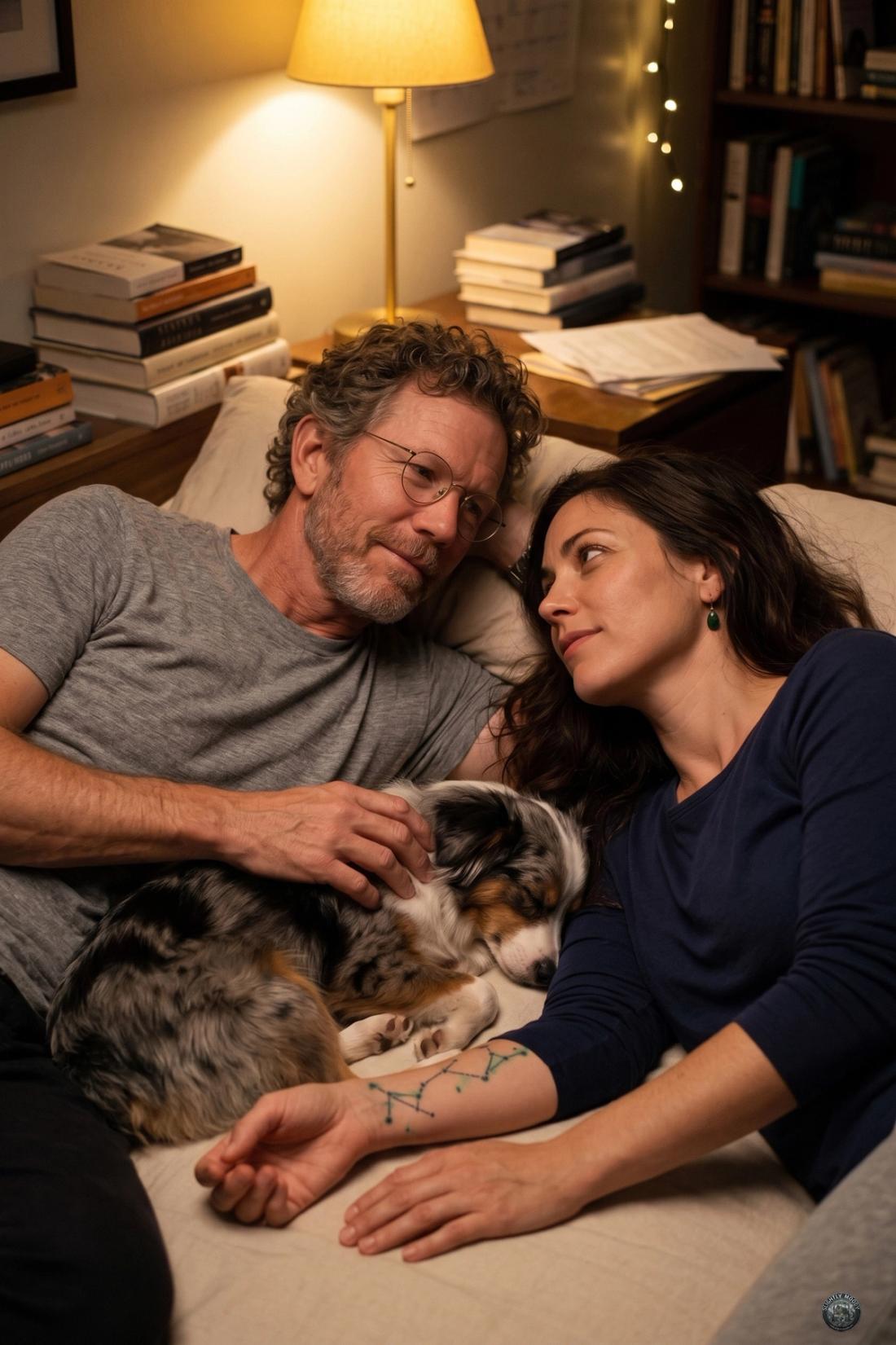
They went back to her place and were greeted by a mini Australian Shepherd named Patches. Patches was delighted to meet Dixon and Dixon never took his hands off her. Phoebe and Dixon remained enthralled with one another. They talked until they couldn’t stay awake any longer. They started to move to the bed, which was in the same room of the studio apartment, and Phoebe said wearily, “Patches insists on sleeping on the bed with me.” This was fine with Dixon. They fell asleep holding one another, with Patches between their legs. In the morning, they kissed goodbye at the door and Dixon drove out of Flagstaff with Phoebe's number in his phone and this new ache he’d started to experience. The ache of a doorway that you’ve peeked inside, but you couldn’t walk through. A near-miss that you will think about anyway.
At lunch, he fished the napkin out of his pocket and scribbled a few more lines of his song.
He added Phoebe to the song. He gave her turquoise earrings instead of Jade.
He didn't decide to. The pen just did it. Turquoise sat better in the line than jade, had the right number of syllables, the right color. But the woman in the song was simpler than the real thing. In the song, she became someone that he had just watched from a barstool and wanted. It was universal and easy to understand. It was more concise than what had really happened, as is often the case in a song. The real woman had jade earrings and was writing a dissertation and was brilliant and strong and amazing and had a great dog. The song woman just had turquoise earrings and existed to rhyme.
Dixon looked at the napkin. He knew it wasn’t true. The song had no room for the dissertation, or the pencil doing the work in her gorgeous long brown hair that he had run his fingers through last night, or for the constellation on her arm. The song had no room for most of her. He was a truthful man, transparent to a fault, and here he was turning a many-hour long conversation about fluid dynamics into a clever line about sex that didn’t happen.
He liked it though. That was the unsettling part. The fiction was better. The fiction was easy. People would understand the fiction better than the reality and he was good with that.
He started to write another line. In it, he was driving a truck instead of an SUV. The fiction was coming easier than the real things.
He spent that night in Needles, California, in a motel where the air conditioner had retired without telling anyone. And Needles is a place where you need air conditioning in the summer. Full stop.
The unit sat in the window and ran all night. Running was all it did. It gurgled and whined and rattled the glass, producing noise, a faint smell of dust, and exactly no cold air. Dixon lay on top of sheets thin enough to read through and absolutely cooked. He threw the sheets on the floor. He flipped the pillow until there was no cool side left to flip to. He put the pillow over his head to block the sound, which trapped the heat, which made him throw the pillow at the air conditioner, which changed nothing. Around two he gave up, went outside and sat on the concrete walk in his shorts and no shirt. It was still 101 degrees at 2:00AM. Across the road a sign blinked GATEWAY TO THE DESERT, on and off, all night, to nobody but him.
Sitting on the sidewalk, he scrolled his phone and found no one it made sense to wake. It was almost morning in Atlanta and he thought about texting Sloane, but he reconsidered. It was almost morning, not actually morning. This was another flip-side of the whole freedom thing. Some nights it was just sitting by yourself on a hot sidewalk, a long way from anyone you knew.
The next morning, groggy from the lack of sleep, he scribbled more notes on his napkin as he considered something that was meant to be the hotel’s ‘continental breakfast.’ He was pretty sure it was canned pears and saltine crackers. He decided to write something about the baking hot experience from the night before. But in the song, he moved the room to Tucson, which he knew everyone would instantly understand to be hotter than hell. He had never actually been to Tucson. It didn't really matter. He liked the idea of writing words that would immediately evoke a reaction in people, whether it had actually happened to him or not. Tucson was hot. Everyone knew it. Enough said.
Not unlike Route 66, the name Death Valley had a ring to it. And Dixon decided to go, because everyone told him not to.
"Not in July," the guy at the gas station said. "Not in that." He nodded at the RAV4, with its cargo box and its bike and its general air of a vehicle that belonged in the suburbs. "People die out there in July. If your air conditioning fails, you're cooked. There's no shade. There's nothing. Why would you even want to go there in the middle of the summer?"
Dixon ignored the question. "How hot does it get?" he asked instead.
"Really fuckin’ hot. Like a hundred and twenty-five kinda hot. A hundred and thirty on a bad day."
“I bet it’s a dry heat,” Dixon retorted. He got into the car and pointed it toward the furnace known as Death Valley.
Actually, he went to Death Valley for three reasons, and he knew all three immediately. Reason one: a man had just told him not to. Reason two: the aforementioned name being similarly attractive to him as Route 66 had been. He felt an irresistible pull like a child drawn to a new toy. And, reason three, he had spent the last year being sensible, and sensible had gotten him an empty house and a bunch of legal bills, and he wanted at least one day on the books that nobody could call sensible. He filled every container he had with water, including a yogurt cup leftover from breakfast. He told no one. He just drove on down into Death Valley and would thus have a great story to tell, or others would tell the story of his demise. Either produced a story.
Death Valley was, he discovered, exactly as advertised.
The temperature gauge in the car climbed past numbers he'd never seen a car report. 116. 119. 122. The landscape turned a hazy white in every direction and shimmered in the afternoon heat. The whole place just seemed to exist as if on another planet. Flat, white, packed salt in every direction with high mountains rising on both sides of a long, narrow valley. There was nobody around anywhere. Clearly everyone else understood the gravity of entering a furnace at its hottest. He drove past a huge vintage thermometer by the empty visitor center. It faintly read 125 degrees Fahrenheit / 51.67 degrees Celsius. That meant it was hot on any scale.
He got out of the car.
The heat hit like when you open a hot oven. It blasted him in his face, singed his skin and made him immediately feel both overcome with heat and shaking with shivering tremors at the same time. He could barely breathe, the air so hot that it hurt his lungs. The ground came up through his shoes like he was standing on a stovetop. He stood for a moment and could feel the strength leaving him, so he quickly took a picture of the thermometer, in the same way a hostage has their picture taken as proof of life. The phone snapped the photo and then began shutting down because it was overheating. He hurried back into the safety of the car.
That was when he noticed his shoes felt wrong.
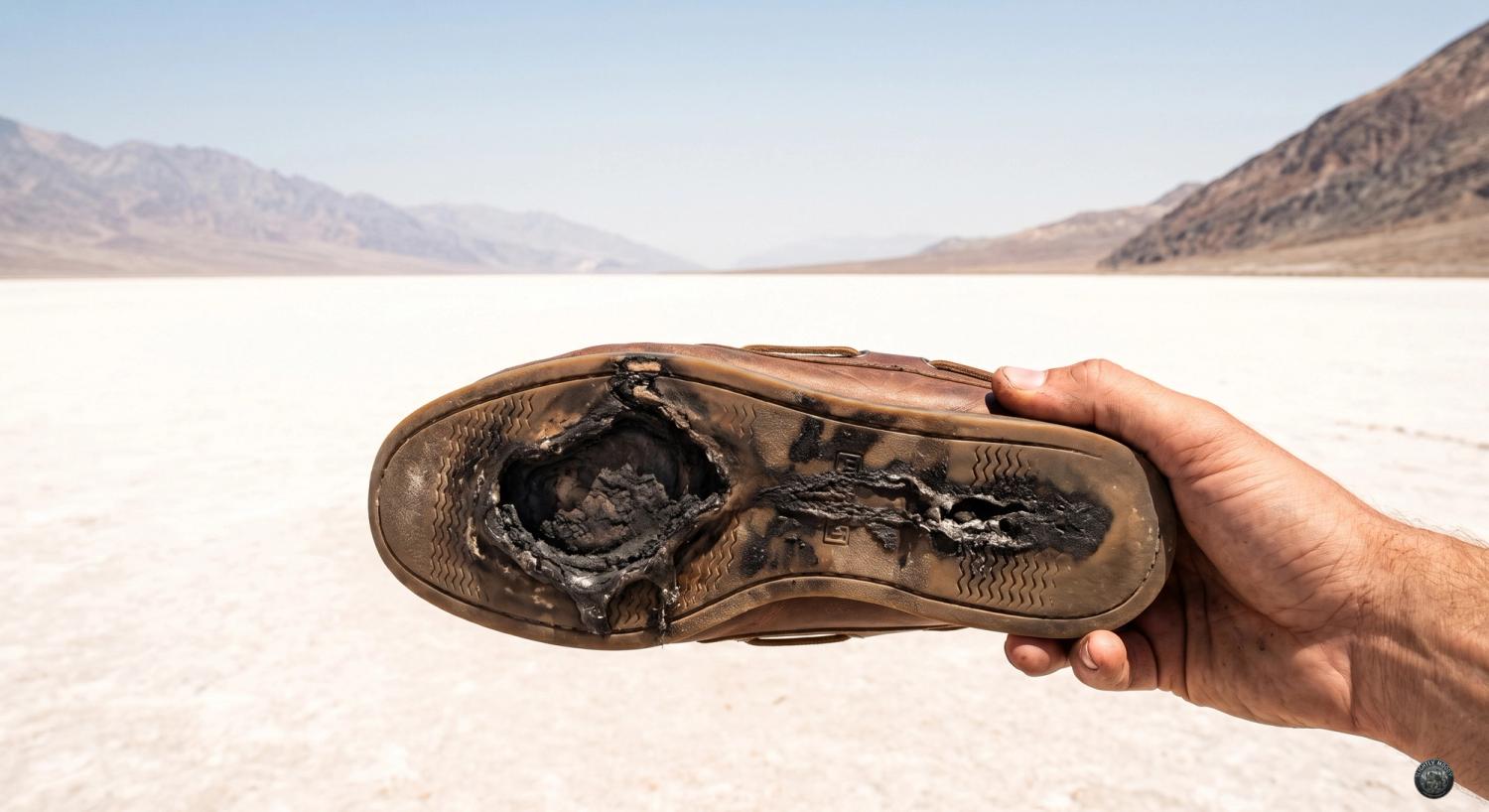
What was wrong was that he could feel the floor mat through his shoes under the balls of his feet. He looked down and could see that there was a round hole in the sole of each of his shoes. His socks now discolored from the black tar of the asphalt. He'd been standing outside for at best ninety seconds and his shoes had literally melted beneath him. And there was now a faint tread-print of Dixon’s shoes pressed into the parking lot of the Death Valley visitor center.
He sat in the car with the AC roaring and laughed until he had to wipe his eyes.
"My shoes melted," he said, to no one, to the guitar, to the salt flat cooking outside the glass. "I drove to the hottest place on earth in July and my shoes melted in the parking lot. What a fucking idiot I am."
He took a picture of the bottom of his left shoe. He sent it to Brooklyn with no caption.
A reply came twenty minutes later, when he came back into range of cellular service.
Brooklyn: I'm going to need you to explain literally everything about this.
Brooklyn: starting with WHY?????
Dixon: Oh hey. Honestly, there is no why. I’m beyond why. That's the whole trip. I’m just at ‘this.’
Brooklyn: Dixon, I swear to god.
Dixon: Really, I’m fine. I survived Death Valley. My shoes didn’t. But I’m good.
Brooklyn: Well that's the realest thing you've texted me in weeks so I'll allow it.
Dixon: Stay cool.
Brooklyn: Not funny.
“I thought it was funny,” he said aloud.
He climbed up out of the valley and headed generally North. He considered that the song he was writing might have just gotten a new verse. And, since he hadn’t died, he could tell the story himself. He kept the shoes on as a reminder of the day’s adventure.
He drove up the east side of the High Sierra in the evening, and the landscape to his right did something to him that he wasn't ready for.
The mountains went vertically up to his left, enormous, the light going gold and then pink on the higher places. But to his right the land fell away into a vast openness, brown and silver and empty, ridge after ridge of it marching off to a horizon that didn't seem to end. He didn't have words for it. It wasn't desert exactly, and it certainly wasn't the open plain, and it wasn't anything he'd grown up with in the lush, green, Northwest. It was just open, on a scale that made the world suddenly feel limitless.
He pulled over. He did that a lot now. He pulled over whenever something asked him to. The landscape now made him stop to consider its vastness.
He stood on the side of the road, the ground running out to the horizon as far as he could see, as the last light of the day went away. He didn't know what to call this place or how to categorize it. It was just there, vast, enormous and waiting, and it occurred to him that it had been there the whole time he'd been living his small exciting life two thousand miles east. He felt that it was wonderful in a way that he had never experienced before. It was nature being beautiful with no interest in whether he, or anyone else, was there to see it.
He took a picture. It didn’t do the place justice. It just looked like land stretching in every direction. Which, on a phone screen, looked like a flat straight line across the screen under an empty sky.
He stood a while longer and watched the sky cycle through a whole spectrum of colors. It reminded him of the sunset that he had seen from the airplane leaving Las Vegas. But now he was here, on the ground, and it was even more beautiful. The sky continued to change and then a tapestry of stars came out and it took his breath away. Finally, in the distance, he heard the call of coyotes and it reminded him that he should probably be on his way. So he got in the car and headed for Reno to find a place for the night. And he drove north along the edge of the enormous empty landscape to his right, without going out into it, the way you walk past an open door and peek in without stepping inside.
By the time Dixon arrived in Reno, he was starving. The first place he saw on the outskirts of town was a country bar called the Rusty Spur, its neon sign promising the best steaks in town. That sounded good enough for Dixon. It was a large place for a restaurant, filled with people and with a small stage at the back and a dance floor the size of an oversized swimming pool. In addition to steaks, this place was apparently serious about music and dancing, of the country-western variety it seemed. Dixon looked at a sign on the wall that announced ‘Tuesday-night open mic’ but he hadn’t the faintest idea that it was actually Tuesday. He wondered if the same nine people showed up every week to play. Dixon made his way to the back and ordered a burger and a club soda. He'd brought the guitar in from the car because he'd gotten paranoid about leaving it where a window-smash could take it, and that was the only reason it was leaning against the booth when a woman named Sharon came by with a clipboard. Sharon had reading glasses on a beaded chain and apparently ran the open mic with the ordered precision of a police precinct.
"You're up after Denny," Sharon said pointedly. She wrote ‘guitar guy’ on the sheet and walked off before Dixon could explain that he knew exactly three chords and had never played anything in front of another human being.
He thought about leaving. He genuinely thought about it. He looked at the door.
Then he thought: nobody here knows me. Nobody here will ever see me again. There is no version of this that follows me anywhere. He could feel that freedom thing again, the Kansas City freedom, the gift of being nobody in a room. The worst thing that could happen was that he'd be bad in front of strangers in Reno, and what was that. Measured against the year he'd had, it didn’t seem that bad.
Denny came and went quickly. Dixon hadn’t made the escape. Sharon called for “Guitar Guy” to come up on the stage. Dixon felt like he was going to puke.
He walked slowly across the room with his guitar. The crowd was thick with cowboys and cowgirls, people in trucker hats, and more denim than he’d ever seen. He was wearing another typical Atlanta-Dixon outfit: shorts, button-down shirt, same fancy watch and glasses. But this time he was wearing boat shoes with holes in the soles. And his straw hat.
He climbed up onto the little stage. The last stage he had been on was in Las Vegas and there he had spoken to thousands of people. This felt much worse. It was personal this time. He couldn’t just say a few words and hand the mic to a performer like Riley. He was the performer this time. He scooched a bar stool up to the microphone, sat on it, and started to strum the guitar lightly. The room had gone silent. He looked down at his fingers and picked a few notes. He looked back up, took a breath and leaned toward the microphone.
“Hey, everybody, I’m Dixon. And. . . honestly, I’m just learning to play, so be kind, ok?” he smiled. A few people yelled encouragement to him. A few others clapped lightly. Anticipation settled over the room. Dixon felt like he was definitely going to puke. He looked back out at the crowd and strummed the same few notes. “See, I’ve been writing this song, so let me try and get it out.” More of the crowd applauded.
He played his three chords and leaned toward the mic and started to sort of sing, but it was more like he spoke the first line:
“Drove out of Atlanta on the first day of July. . .”
He stopped and looked around again. A few more words of encouragement filled the room. “Come on, you can do it man!” someone yelled from the other side of the dance floor.
“Sorry,” he said, still strumming his three chords. “You know, this shit is hard,” he said. The vulnerability lit up the room. More people cheered him on now.
He started again:
“Drove out of Atlanta on the first day of July,
Air so thick I couldn't tell the asphalt from the sky.”
People were clapping and cheering now, but Dixon stopped again. He looked across to the audio booth. A man was standing behind the mixing board, looking at him expectantly. Dixon addressed him, still strumming, “hey, could you give me a beat? I think the guitar is getting in my way.” The man, Rusty, the owner, was flushed with excitement. His aspirations as a DJ were rarely called upon here. This was not only going to be Dixon’s moment, but his as well. He put a finger up as if to say ‘hold on.’
Dixon turned his attention back to the crowd. “We’re going get through this together,” he said with a light chuckle and the audience laughed a little nervously. “While we’re waiting, let me just tell you a little bit of my story. I did really roll out of Atlanta on the first day of July. . . Life happens. She left.” The audience murmured with a shared shock or sadness, Dixon couldn’t tell which. “I dicked around for a year and finally said ‘fuck it.’ I sold everything and hit the road. I guess, you could say, I’m just learning to be free right now. I don’t know where I’ll be tomorrow and I’m getting used to that.” The crowd cheered approvingly. “You know how it is, life happens and you gotta just figure it out.” The crowd cheered again. “I didn’t plan to be here when I walked out the door this morning. I didn’t plan for my shoes to melt in Death Valley either,” he lifted one of his shoes, and the audience roared with laughter. “I’m not where I thought I would be a year ago and that’s. . .well that’s just fuckin’ fine ain’t it!” The crowd was with him.
Rusty caught his attention and gave him a hand signal that meant he was ready. Dixon strummed the chords one more time, stood up from the stool and pulled the hat down low over his eyes. The music came up. It started with a gently repeating picked guitar loop and then, after a few bars, a rhythmic high-hat and electronic snare came in. Dixon felt the beat inside of him. With his left foot, he pushed the stool out from behind him, sending it skittering toward the back of the stage, and then the beat dropped and it was heavy. Dixon went fully into the moment. What came out of him was not quite singing and not quite rapping. It was a punchy combination, each word hitting right before the beat.
Lyrics
[Intro]

[Verse 1]
Drove out of Atlanta on the first day of July
Air so thick I couldn't tell the asphalt from the sky
Everything I owned was in the bed behind the cab
A duffel bag, a guitar, and a life I didn't plan to have
Hit the county line and something shifted in my chest
Like the rearview finally quit competing with what's next
Cranked the window down and let the highway fill my lungs
Felt like the second half of something barely just begun

[Pre-Chorus]
I don't know where I'm headed and I don't much care
Every mile puts a little more distance in the air
Between the man who stayed too long and the man who's finally free
Only thing I'm chasing now is whoever I'm gonna be

[Chorus]
I'm gone by morning, gone before the sun
Gone before the coffee's cold, gone before I'm done
Every town's a stranger and every stranger's got a story
I'm collecting miles like souvenirs
And I'm gone by morning

[Verse 2]
Kansas City looked at me like I was overdressed
Khaki shorts and boat shoes in a bar that knew me best
As "that guy from somewhere east who doesn't know the drill"
But the band was playing covers and the whiskey hit the bill
Sioux Falls had a diner where the chicken-fried was king
The waitress called me "honey" and it didn't mean a thing
But it meant enough to sit there feeling human for an hour
Eating food that fought back harder than a marriage going sour

[Pre-Chorus]
Still a little city in the places I don't fit
Still reaching for a menu like it's something I submit
But nobody's keeping score out here, nobody's taking notes
Just another drifter learning how to stay afloat

[Chorus]
I'm gone by morning, gone before the sun
Gone before the coffee's cold, gone before I'm done
Every town's a stranger and every stranger's got a story
I'm collecting miles like souvenirs
And I'm gone by morning

[Verse 3]
Found a motel west of Tucson where the AC barely tried
Lay on top of the sheets and felt the heat waves off the ride
Ceiling fan clicked circles like a clock that lost its mind
And I smiled, 'cause for the first time I had nowhere else to find
Played a set in some roadside place where nobody knew my name
A girl with turquoise earrings said she liked the way I came
Alive up on that barstool with a beat-up borrowed sound
I was the excitement that rolled into town
And I'd be gone before the next one came around

[Bridge]
Now I won't pretend I don't think about the yard
The neighbors and the mortgage and the life that fell apart
But the thing about a rearview is it only shows you where you've been
And I've been there long enough — I'm not going back again
The road don't care about your credit score
Don't care about your lawn
It just keeps on rolling forward
And it wants you to come along

[Chorus — Final]
I'm gone by morning, gone before the sun
Gone before the coffee's cold, gone before I'm done
Every town's a first date and every sunset's something new
I'm collecting who I am one highway at a time
And I'm gone by morning
Yeah, I'm gone by morning

[Outro]
I'm gone by morning
“Drove out of Atlanta on the first day of July
Air so thick I couldn't tell the asphalt from the sky
Everything I owned was in the bed behind the cab
A duffel bag, a guitar, and a life I didn't plan to have
Hit the county line and something shifted in my chest
Like the rearview finally quit competing with what's next
Cranked the window down and let the highway fill my lungs
Felt like the second half of something barely just begun”
The audience roared to life. They were fully with him and just wanted more. He reached the bridge and Rusty mixed up the music just slightly:
“I don't know where I'm headed and I don't much care
Every mile puts a little more distance in the air
Between the man who stayed too long and the man who's finally free
Only thing I'm chasing now is whoever I'm gonna be!”
The beat absolutely dropped now and the whole place lost its collective mind. Dixon’s chorus could barely be heard over the din:
“I'm gone by morning, gone before the sun
Gone before the coffee's cold, gone before I'm done
Every town's a stranger and every stranger's got a story
I'm collecting miles like souvenirs
And I'm gone by morning.”
People were now high-fiving one another. A girl jumped up on the bar and swung her hips around to the beat. No one could explain what came over them, except that they all collectively could feel that they wanted Dixon to tell his story and they were on his side.
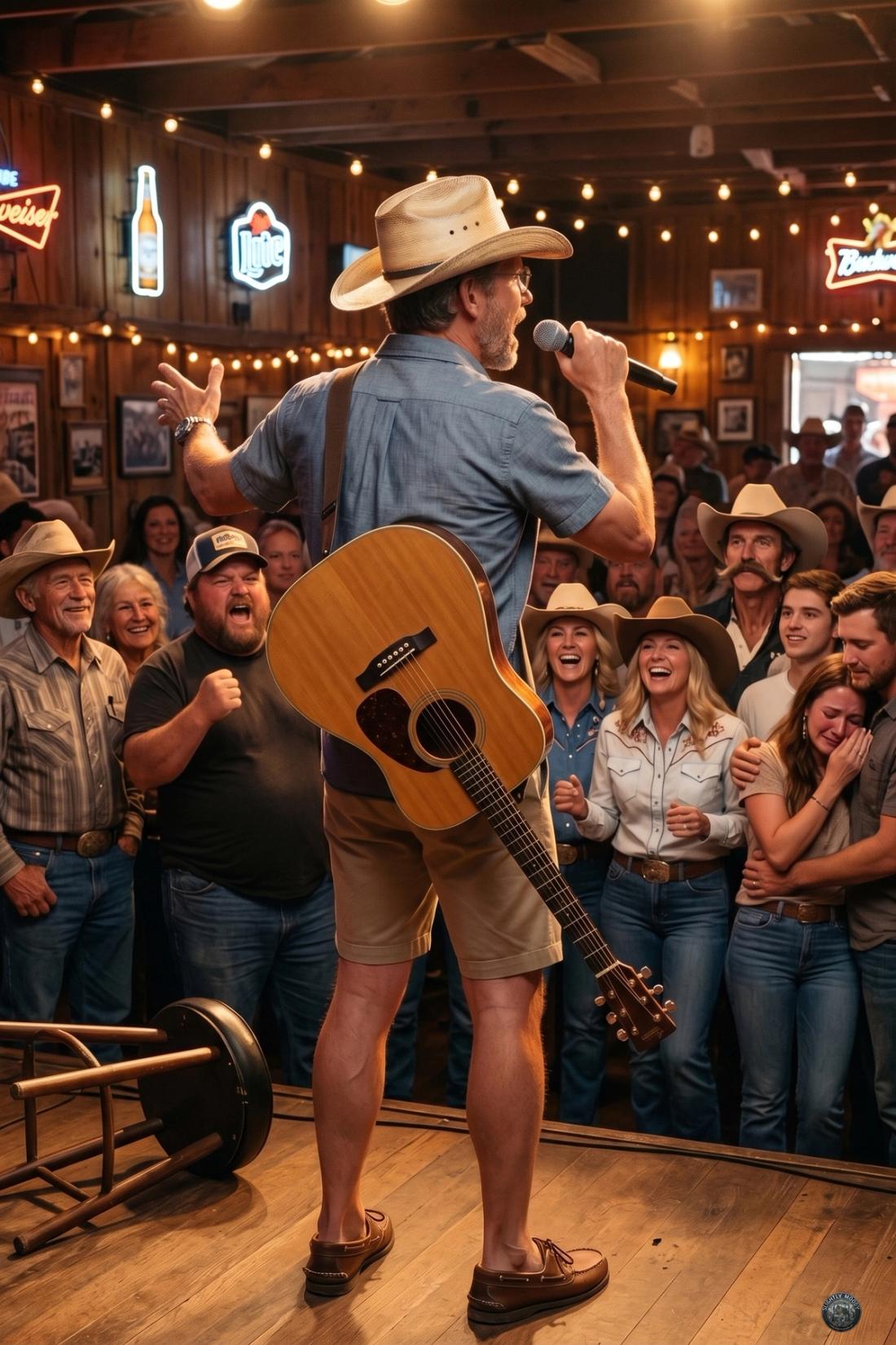
Now he just launched into a series of stories from his travels in his singing-rapping style. He held the microphone securely and preached out to the audience from beneath the brim of his hat with Marlowe’s guitar hanging down his back.
“Kansas City looked at me like I was overdressed
Khaki shorts and boat shoes in a bar that knew me best
As "that guy from somewhere east who doesn't know the drill"
But the band was playing covers and the whiskey hit the bill.”
The crowd yelled and hollered.
“Found a motel west of Tucson where the AC barely tried
Lay on top of the sheets and felt the heat waves off the ride
Ceiling fan clicked circles like a clock that lost its mind
And I smiled, 'cause for the first time I had nowhere else to find.”
More appreciation and yelling. And then Dixon went to his night with Phoebe, in its simplified, fictionalized form:
“A girl with turquoise earrings said she liked the way I came
Alive up on that barstool with a beat-up borrowed sound
I was the excitement that rolled into town
And I'd be gone before the next one came around.”
There it was. The fiction was out there. His memories of the sexy, wonderful, smart girl distilled into a few phrases. The crowd understood the universality of the message and that was all that mattered in the moment. The PhD would have to stay in his memory alone.
And finally, realizing that he had to wrap it up, he looked rearward. He thought about the story he told and in the moment, he penned one more bridge before taking it home:
“Now I won't pretend I don't think about the yard
The neighbors and the mortgage and the life that fell apart
But the thing about a rearview is it only shows you where you've been
And I've been there long enough, I'm not going back again
The road don't care about your credit score
Don't care about your lawn
It just keeps on rolling forward
And it wants you to come along.”
With that, the crowd roared. They understood the story and they loved it. Dixon sang through the chorus one more time and Rusty took the cue, wrapping the music with a final dramatic swell. No one in that bar understood what they were a part of. None of them had heard anything like it before. They just knew that they were for a moment connected to this man and his story and they loved it.
Dixon stood on the stage, took his hat off his head, and waved it to the crowd in appreciation. The crowd cheered for a good three minutes before Sharon called the next performer to the stage. A performer that had no idea how they were going to follow what had just been witnessed in that room in Reno.
Over the course of the evening, Dixon met many of the locals. A man with a gray handlebar mustache and a belt buckle the size of a saucer bought him a club soda and told him his wife had cried. He pointed at his wife. She waved and was, in fact, still crying. A young woman in red leather cowboy boots told him he should do that for real, and when Dixon laughed she didn't, and so she said it again, slower, like he hadn't heard her. Denny shook his hand and said he was so glad he didn’t have to follow that and he didn't know whether to be impressed or mad about the whole thing. Sharon came over and tried to put him down for next Tuesday before he could tell her he'd be in Oregon by next Tuesday.
Dixon stood at the bar for a while and more people came to talk with him and he told them his story in the detail they wanted now to hear. With the adrenaline still going, this man in shoes with holes in the soles had just learned that the thing he had long made for a living and the thing he was apparently going to do next were coming into relief against one another. He'd made a big group of strangers feel something. He understood that his story had some kind of mystical draw about it. It spoke to people about adventure and freedom, even while it mostly just scared the shit out of him.
The song danced around in his head on the way to a motel he had found for the night. He thought about Marlowe and her three chords. He had a fourth chord now. He'd stolen it, the way she said. He had stolen it from Rusty and the crowd. Now he needed to figure out what to do with it.
He called Sloane the next afternoon, as he crossed the Oregon state line, because the thing he needed to tell her was too big to text and she was the only one who'd understand how big of a deal this was to him. After a couple of rings, she picked up. "You're alive," she said. "I was starting to wonder."
"Guess what?” he said like an excited kid. “I played a song last night. In a bar. In Reno. I got up on a stage and I did a song. One I wrote. Well I sort of wrote some of it before and some of it during, but I think it made sense. I mean, I can't really sing so I kind of talked it over a beat and the whole place lost their minds, Sloane, I don't know what happened." He said all of that without taking a breath.
There was a pause. He imagined her catching up with what he’d just said.
"Wait. . .What do you mean. . .you performed? You? I’m very lost,” she said in puzzled amazement.
"Well performed might be a stretch. If it was performing, it was performing badly. And I mean, my shoes melted in Death Valley, it was like a whole crazy thing." He took a breath. “I seriously don’t know what just happened.”
“What happened to your shoes?" She paused. She had many questions. "Dixon, do you understand what I told you in Atlanta? I said learn the guitar and send me something real. And you call me from the middle of nowhere to tell me you got up cold in front of a room and the whole place loved you." Her voice changed a little. The teasing had gone out of it and something sharper had come in, the thing in her that knew this business, that could hear a real thing through the phone. "That's the whole job. That reaction. That’s the dream that people in music spend decades chasing. And somehow you did it in some country-western bar in Reno on a Tuesday, because you didn't know you couldn't."
Dixon considered this. "It was probably just the novelty of it. A drifter with a crazy story. A guy in burnt shoes."
"Stop. Don't do the thing where you make it small." She paused. "Record it. Next time you do it. Just record it on your phone. I don't care how rough it is. I want to hear it. I'm not being nice, I don't have time to be nice, I want to actually hear it." She did actually want to hear it. She had started to care about Dixon. And she loved music. The two pieces had made a new conjunction in her mind.”
"Okay," Dixon said, sensing the seriousness in her voice.
"Say that you'll send it to me."
"I'll send it." He looked out at the hills. "I have to figure out how to do it again first. I'm not sure how I did it the first time,” he said with a laugh.
"Nobody ever is," Sloane said. "That's the part nobody tells you. Now go see your kid." She hung up and Dixon was once again alone with his thoughts. And he was now thinking about how he was going to record his song.
He reached Portland in the long northern light of late July. The city was green and crisp after the brown enormity he'd driven up out of. He felt the sensation of arriving at a place that he’d once called home and where he’d find Cash and Magnolia soon waiting for him. He took a breath of the fresh evening air. It had been two and a half weeks since he had left Atlanta. He had gone nowhere in particular, on purpose, and somehow arrived everywhere he'd needed to. He'd been nobody in Kansas City and a curiosity in Reno. He'd talked all night with a wonderful woman he'd probably never see again. He'd melted his shoes in the hottest place in the country and kept the shoes as a souvenir. He'd actually learned three chords, as instructed, and come away with the start of a song, if he could reproduce it again.
He had also, in the quiet rooms, in the long silent stretches, started to feel the underside of all that freedom. The night in Needles, on the concrete sidewalk at two in the morning, with a phone full of people it made no sense to wake. The freedom was real and it was wonderful. It was also, some nights, just a man alone outside a motel, melting slowly in the heat, watching a neon sign blink for nobody but him.
He tucked the feeling away, pushed it under a pillow alongside the growing collection of pictures. The dead motels, the open land, Death Valley, the empty hotel rooms and the signs and wonderful light of the western skies. All the things that were still out there, a long way from everything, continuing to exist right now, but not likely being contemplated by anyone other than him.
But all of that was for later. Right now there was a door to a condo, and behind it was a kid that he loved and a dog who would lose her entire mind when she heard his voice.
He parked. He sat for a second. Then he went to go be somebody to someone again, at least for a few weeks, before the road took him back again.
Published July 12th, 2026 from Grand Junction, Colorado
Enjoying the story? Support the work →
All text, images and music copyright (2026), Slightly Moody Creative LLC and Joe English.