The Sit Boy · Chapter 8
The Last Day of June

The house did not want to let him go cleanly. Houses never do. They wait until you think you're done and then they show you the parts you missed.
Dixon had come back from the road thinking the hard part was behind him. The hard part, he'd assumed, was the deciding. He had decided. He had sold the furniture and the art and the good knives and the bed, and he had driven the dog across the country and handed her to his son, and he had come home to an empty house with the whole enormous yes already said. What was left was just paperwork. Just tidying. He could be out in a few days.
He was not out in a few days.
What was left, it turned out, was everything that hadn't sold, which was more than he remembered, scattered through the rooms like the tide had gone out and left things stranded. Boxes half-packed and then abandoned. A floor lamp nobody wanted. Three framed posters leaning in a hallway. The contents of a junk drawer multiplied somehow across an entire kitchen counter. The detritus of a life was apparently not the life itself, which sold, but the widows and orphans around it, which did not.
And the yard had gone feral while he was gone. Two weeks of Atlanta June, sun and afternoon rain in alternating shifts, had turned the lawn into something with ambition. The jasmine on the back fence had thrown out runners in six directions. There was a tree limb down by the creek. Dixon stood at the kitchen window on his first morning back and looked at the yard and understood that he was going to have to mow it, by himself, in the heat, a thing he had successfully avoided thinking for the entirety of the way across America and back.
"Of course," he said, to the empty kitchen. The refrigerator hummed back at him. It was the only thing in the house that answered anymore.
The mowing nearly killed him as it always did.
The electric mower was not powerful enough to cut cleanly through the long grass, so Dixon had to move it up an inch and go over it multiple times. The batteries only lasted 20 minutes each at best, so there was a whole conveyor of batteries being charged while the others were in use. They got so hot they needed to cool down before they would recharge, this adding more time to the process, keeping Dixon longer out in the Hellish Atlanta heat and humidity. He was so wet that his shirt was hanging on him like a sad dirty dish towel. Several times, he had to stop in the shade of the one good oak and drink the warm water from the hose, all good reminders of how much the back yard had been a prison to him over the years.
It took him three hours to do what the neighbors’ hired teams did in forty minutes. He did it badly. He left a strip down the middle he didn't notice until he was done, and he ran over a sprinkler head, and he discovered muscles in his lower back that he was fairly sure were new. But he did it. He stood in the cut grass afterward, filthy and triumphant, and felt the specific stupid pride of a man doing a labor that he hated for the last time. As he walked back into the garage he muttered, “good riddance” to the yard and gave it the middle finger for good measure.
Then he went inside and the air conditioning was working and he stood directly in front of a vent for ten full minutes and did not move.
That was a good day. He stood in the cold air and enjoyed it while it lasted.
He met Bagley because of the mowing, in a way. The racket of his swearing had brought the neighbor out.
Her name was Priscilla and she lived two doors down and Dixon knew her the way you know neighbors after a few years, which is to say warmly and almost not at all. She came across the yards while he was coiling the hose, and she had the slightly desperate brightness of a person about to ask a favor they're not sure they've earned the right to ask.
"You're back," she said. "I saw the car. Listen, this is going to sound insane."
"Most good things do," she said wearily.
"My mother's in the hospital in Charlotte. It's not, she's going to be fine, but I have to go, tonight, and my husband Raj is in Singapore until Friday, and the kennel we use is full, and. . ." She stopped. "Do you still have Magnolia?"
"I don't," Dixon said. "Magnolia lives in Oregon now. It's a long story." He didn’t say anything about Puddles who she seemed to have noticed had gone missing.
"Oh." Priscilla's face did something complicated, the hope and the etiquette fighting. "Then you probably don't want to. . ."
"What's the dog?" Dixon said with a renewed warmth in his voice.
The dog was Bagley.
Bagley was a Bernedoodle, which Dixon had understood in theory to be a medium-sized cross between a Bernese Mountain Dog and Poodle and discovered instead to be a small horse in a perpetual state of joy. He was enormous. He was black and white and brown and shaggy in every direction, with a head like a bear cub and a tongue that operated independently of his mouth. When Priscilla brought him over that evening, he took one look at Dixon and decided, instantly and permanently, that this was the greatest man who had ever lived.
He put his paws on Dixon's shoulders. Standing, he was nearly Dixon's height.
"He's friendly," Priscilla said, unnecessarily.
"I gathered," Dixon said looking into his eyes. They had a moment in which they seemed to communicate something. Dixon could feel his happy energy. Bagley could feel Dixon’s calm and protective energy. In an instant, they decided they would get along great.
"He's a lot. I know he's a lot. He's good though, he's so good, he just. . ." She handed over a leash, a bag of food the size of a large child, and a list. "He sleeps on the bed. I'm so sorry. He won't sleep anywhere else. We've tried. You'll see."
“Well, I don’t have a bed, so we’ll have to make do,” said Dixon looking past Bagley at the empty house. They both laughed and Bagley went off to explore the large empty rooms one by one. “We’ll be fine, don’t you worry. There’s little nothing for him to damage and if he pees on the floor, I really don’t care anymore,” he said with a grin.
Priscilla understood that Bagley would be fine, but left for Charlotte in tears anyway. Dixon stood in the empty house with a hundred pounds of stranger's dog leaning the entire weight of itself against his legs, looking up at him with an expression of total uncomplicated love, and he thought: ‘Well. Okay. Hi.’ He rubbed Bagley behind the ears, which he loved.
Here is what Dixon had not expected about having Bagley around: the house got better.
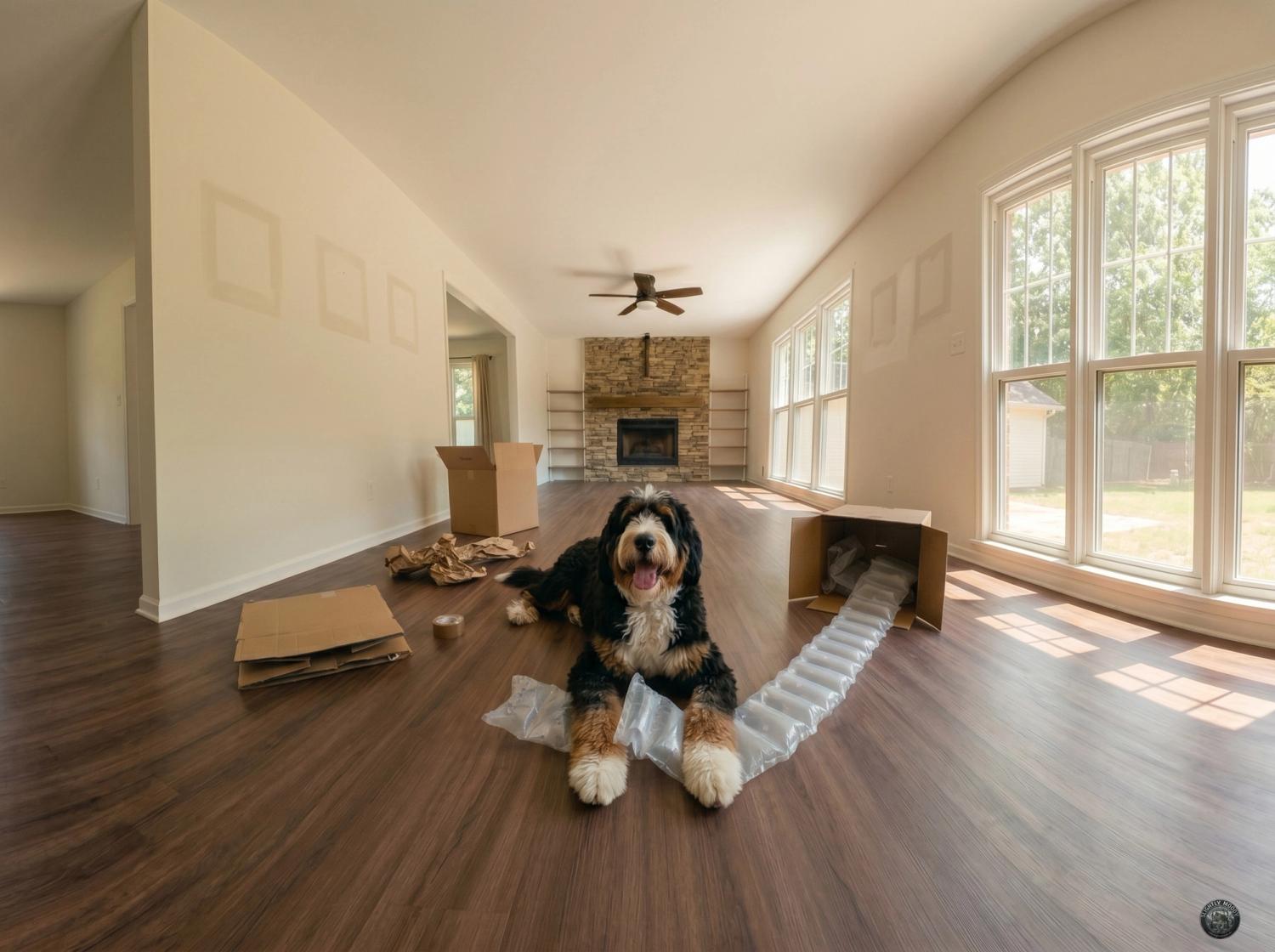
It had been a tomb for a week, an echoing box he was disassembling, every footstep loud on the bare floors. Now it had a dog in it. A ridiculous dog, a dog that knocked a box of cables off a counter with one wag, a dog that followed him from room to room and supervised the packing with grave attention and tried to help with the yard by attacking the rake. The empty house full of dents and orphaned junk was, with Bagley in it, no longer empty. It was just a house where a guy was cleaning up, with his dog, except the dog wasn't his.
Dixon noticed he was talking again. He'd gone quiet after Portland, in the car, in the hotel rooms. Now he was narrating to Bagley the way he'd narrated to Magnolia, except Bagley actually responded, with his whole body, to everything. "We're doing the garage today, Bags." Tail. "I know. I'm excited too." A spin. "You can't help with this part, it's chemicals." Devastation, then immediate recovery.
At night Bagley took up two thirds of the air mattress Dixon had bought to replace the bed he'd sold, and snored like a chainsaw, and pinned Dixon's legs under his bulk, and Dixon slept better than he had in weeks. He did not examine why. He just slept, with a dog that wasn't his, in a house that was barely his anymore. In the morning the dog was thrilled, astonished every single time that Dixon still existed.
He took a lot of pictures of Bagley. He posted exactly none of them, because they were not for anyone. They were just his.
The freezer situation, when it came, fascinated him.
He'd been avoiding the kitchen, because the kitchen contained the freezer, and the freezer contained food, and the food was the kind of problem that didn't fit any category. You couldn't sell a half-eaten bag of frozen peas. You couldn't pack it. Throwing it all away felt obscene, the waste of it, the small daily evidence of a life abruptly interrupted. There was a lot in there. Meat he'd bought in bulk. There was also a standalone freezer in the garage on top of the kitchen one, both of them full, plus a pantry with the accumulated cans and grains and half-used everything of a few years of living here.
Brooklyn was the one who told him about the group.
"Post it," she said, on the phone. "They’re called the ‘Buy Nothing’ crowd. Or, just post it on your neighborhood page. Say you've got a freezer of food, free, first come. Watch what happens."
Dixon was skeptical. He photographed the open freezer and wrote a short post. Moving, everything must go, free food, freezer and pantry, message me. He put it on the local page, set the phone down, and went back to taping a box.
The phone buzzed in ninety seconds.
It buzzed again. By the time he picked it up there were four messages, and the first one just said ON MY WAY, and eleven minutes later a pickup truck was in his driveway and a man was at his door with a stack of coolers and the focused energy of a professional.
The man's name was Dale. Dale did not waste time. Dale walked into Dixon's kitchen, assessed the freezer the way a mover assesses a piano, and began transferring its contents to his coolers with a speed and economy that Dixon found genuinely beautiful to watch. The meat. The peas. The mystery containers. All of it.
"You’ll want the garage freezer too I bet?" Dixon asked.
"Everything you got," he said earnestly.
He paused by the pantry, and looked at Dixon, and Dixon understood the question being asked and said, "knock yourself out," and Dale knocked himself out. He took the cans. He took the rice and the flour. He took the half-bag of pasta and the open box of cereal and the three-quarters-full jar of peanut butter and a bottle of olive oil with maybe an inch left in it. He took things Dixon would have been embarrassed to offer and Dale was not embarrassed to accept. He took a jar of capers that had come, Dixon was certain, from the last house.
It took twenty minutes. When Dale was done, the kitchen was bare. He shook Dixon's hand with real warmth, said "you're saving my month, brother," and drove away. Dixon stood in his stripped kitchen and felt like he'd witnessed something. Not charity, exactly. A whole economy he'd never known was running underneath the one he lived in, where a three-quarters jar of peanut butter had value, where a man would arrive in eleven minutes for a freezer of someone else's frozen peas and consider it a windfall. He'd never once thought about guys like Dale and this really fascinated him.
Bagley watched the whole thing from the doorway, deeply invested, certain that some of this food might be given away to Dale. None of it was. He recovered immediately.
The antique clock was the thing Dixon didn't know what to do with.
It had been his father's, and it had sat on a high shelf in the den for as long as Dixon could remember, and it had never once, to Dixon's knowledge, told the correct time. It was an old schoolhouse clock from the late 1800s. It had dark wood, a face of fading paint, with some kind of eagle worked into the top of it. It had come to Dixon when his father died, along with the watch and the pennies and the bad luck. Dixon had carted it around from house to house for years and never known what to do with it. Now it sat on the bare kitchen counter looking at him, because everything else was gone and there was nowhere left for it to hide.
He didn't know if it was worth anything. It might be worth thousands. It might be worth nothing. His father had owned exactly one thing that turned out to be valuable in his entire life, and it had been an accident, and he'd sold it too early. So Dixon took the clock to a man in Decatur.
The man had a shop in a strip mall, a hundred clocks on the walls all ticking slightly out of sync of one another. Occasionally the clocks burst into a chorus of song at the top of the hour or on the halves. He took Dixon's clock in both hands the way you'd take a baby. He looked at it very carefully, opening the front glass door, inspecting the back, and then went very still.
"Where'd you get this?" the man asked.
"It was my father's. He collected a lot of antiques. Other than that, I have no idea where it came from," Dixon said with a shrug.
"Do you know what it is?" he asked, his voice almost quivering.
"I was hoping you'd tell me."
The man set it gently on the counter and looked at Dixon over his glasses. "It's a commemorative edition schoolhouse clock. It’s from the 1870s. They made these to honor the veterans, for. . . our side." He turned the face toward Dixon and tapped the painted eagle, the small worn banner beneath it. "It's a Civil War commemorative clock. This eagle, this motto. It's a memorial piece. People bought them to remember our sacrifices during the war."
Dixon looked at the clock. The clock looked back, having never told correct time in its life.
"Now, which side?" Dixon asked, his Northwestern upbringing rushing into conflict with his current physical location in the deep South.
The man gave him a look that indicated he shouldn’t need to ask. “Our side, of course,” he said.
Dixon groaned, out loud, a real groan, and put his face in his hand, and the clock man’s face turned slightly sour. Of course. Of course it was. Of course his father, a man who had lost money on every investment he ever touched, a man whose luck was so reliably terrible that he carried pennies to improve it and passed the habit to his son, had owned, displayed proudly in the den for forty years, and almost certainly never once understood, a clock commemorating the losing side, at least to people outside of the South, of the American Civil War.
"Is it worth anything?" Dixon asked, into his hand.
"To the right person? You bet! It's not in great shape though. The mechanism's shot." The man shrugged. "It needs to be restored. At the moment it's more of a conversation piece. It would be a great way for the next generation to learn about our cause.” Dixon groaned again even more loudly. “It's a thing you keep because it's a piece of your family history, not because of the money."
"That tracks," Dixon said. "That is extremely on brand for my father."
Dixon walked back out of the clock shop with his shameful clock. He couldn't have said why. He'd just driven a dog three thousand miles because he couldn't give her away to strangers, and now he couldn't junk his father's terrible clock either, the clock that didn't work and commemorated something he certainly did not want to commemorate and was worth, the man had gently suggested, less than the gas it took to bring it in. He wrapped it in a moving blanket and it went in the pile of things to keep, which was a very small pile, and which now consisted almost entirely of his son's bedroom furniture and a broken clock.
The storage locker was Brooklyn's idea, and Brooklyn came to help fill it.
"You can't keep nothing," she'd said. "I know that's the plan. The grand romantic plan, Dixon owns nothing, Dixon is free. But someday you might have a wall again, and you're going to want one thing to put against it, and you'll be glad past-you wasn't a maniac about it."
So he rented the smallest unit they had, a concrete closet on the third floor of a climate-controlled building off the interstate, and into it went the things he could not sell and could not throw away. Cash's bedroom set, the whole of it, the bed and dresser and desk, enough to furnish a one-bedroom apartment someday if there was ever an apartment. A box of photographs. The broken clock. Almost nothing. A one-bedroom's worth of maybe.
Brooklyn helped him carry it up, and they worked well together the way they always had. When it was done they stood in front of the little concrete room and looked at the small stack of it, his entire retained life. Brooklyn put her arm around his waist.
"This is insane," she said. "You know that."
"Everybody keeps telling me."
"I'm not telling you to stop. I'm just telling you it's insane." She leaned her head on his shoulder. "I’ve got your dad’s watch and the baseball cards and your important papers. I’ll keep them safe for you. But it’s just so weird that you have no ‘place’ to call home. Just little bits of stuff here and there."
"That's not the worst thing in the world."
"No. It's not." She straightened and looked at him, and her eyes had filled with tears, and she was not a woman who cried easily and she was not quite crying now but she was close. "But you have to call me. I don’t want the glossy version. No more of this 'I'm great, I'm in Spokane’, fucking bullshit. I want the real you. You call me when it's bad, you understand? You don't get to disappear into America and only send the ‘bright stuff’. I'm not Cash. I get the real story."
"Okay," Dixon said.
"Say it."
"You get the real story."
She held him then, in the storage unit, for a long time, and Bagley, who had come along and was not technically allowed in the building, leaned against both of them and made it a group hug, and Dixon thought that of all the things he was leaving in Atlanta, this was the only one that was going to actually hurt.
He pulled the locker door down and the lock clicked shut, closing the last door to his life in Atlanta.
He put the key to the storage locker on the key ring for the RAV4. The ring had gotten strange lately. He'd left the office key behind when he stopped going to the office in person. He was about to leave the house keys behind for good, the front and the back and the garage and the mailbox, all of it handed to a real estate agent who'd hand them to whoever bought the place. The pool and tennis court keys went back to the community association. The keys of permanence being replaced with keys to things more temporary. The key ring was filling up with the keys to a different kind of life. There was the key to the storage locker and a key for the extra space cargo carrier he bought for the top of the RAV4, because he still had too many t-shirts. There was also a key for a new bike rack, because somewhere in the last month he'd decided that a man seeing America should have his bike, which he planned to ride at some abstract point in the future.
Three new keys. The house keys would be gone soon. He stood in the parking lot of the storage place and looked at the ring in his hand and felt the trade of it, weight for weight, the keys to rooms exchanged for the keys to things that moved.
Sloane he handled by text, which was its own small grief.
He'd been carrying a thing about Sloane since Vegas, a low hum of possibility he hadn't done anything about because his life had been a moving target. He'd half-thought, not planned, just half-thought, that this last week in Atlanta might be when he found out what the thing was. She was here. He was here, for once, for a few more days. Two bodies in motion that might collide.
Dixon: I'm in town till the end of the month. Wrapping up the house. Any chance you're around? Would be good to see you before I vanish to points unknown.
Sloane: Ugh. Dix. Your timing.
Sloane: I'm flying out Thursday. Wedding in Napa, this whole thing, four days. I'm seeing someone, it's new, he's in the wedding, it's a whole situation.
Sloane: I didn't want to tell you over text like this.
He looked at the phone for a while. Bagley put his enormous head on Dixon's knee.
Dixon: That's great. Really. I'm happy for you.
Sloane: Are you though?
Dixon: I'm trying to be. I do want the best for you.
Sloane: That's the most honest thing you've said to me in a month.
She called him that night. The talked for a little. It was mostly chit-chat and was maybe a little sad for Dixon. He didn’t say that he wanted very badly to see her, to kiss her again, to maybe take things a little further. All of that had been answered by a calendar and a trip to Napa. She told him to actually learn to play the guitar and not just drive around with it like a prop. She told him to send her something when he made it, whatever it turned out to be, and that she'd find the right ears for it when it was real. And that part, the music part, did not feel like a door closing. That part felt like a different door, propped open, in a hallway he couldn't see the end of.
"Go," she said. "Drive. Be the saddest man in the most beautiful places. You're good at it."
"Thanks. I love ya’, you know," he said, easily, the way you can say it when it's settled into the right shape.
"I know. Same. Now go."
He painted the back porch on the twenty-ninth and the garage floor on the thirtieth, and the air conditioning died on the twenty-eighth, in between, with exquisite timing.
It just stopped. The hum he'd been living inside, the only voice the house had, went silent at two in the afternoon on the hottest day of the month, and the heat radiated through everything within the hour, and Dixon stood in the oven-like temperature of his stripped house and laughed, because what else. He was a man who would once have made a call. He'd had a guy for things like this. This time he watched a video, and drove to a hardware store, and bought a capacitor that the video swore was the usual culprit, and went out to the condenser unit in the side yard in the worst heat of the day with a screwdriver and Bagley supervising from the shade.
It worked. That was the absurd thing. He swapped the part the way the video showed him, sweating, swearing gently, certain he was about to electrocute himself in the side yard and be found by a real estate agent, and the unit kicked back on with a shudder and cold air moved again, and Dixon stood there holding a screwdriver and a dead capacitor and felt like he'd performed surgery. Bagley celebrated as though Dixon had personally invented winter.
He fixed the air conditioning in a house he was leaving in three days, for the benefit of a buyer he'd never meet. He had certainly decided he was not buying a $12,000 air conditioner for a house he was leaving behind. But it made sense to fix it if he could and he did it himself. He kept noticing this about the new version of himself, that he was the lone figure that could take care of things now, and that the noticing was its own small reward.
The garage floor was the last job.
He'd saved it for the end because once it was painted he couldn't park on it, and once he couldn't park on it he was basically gone. So on the morning of the thirtieth he moved everything out: the racks, the shelves, the cubbies. He swept the concrete, taped the edges, and got down on his knees with a roller and a tray of gray epoxy paint to do the final task of his Atlanta life.
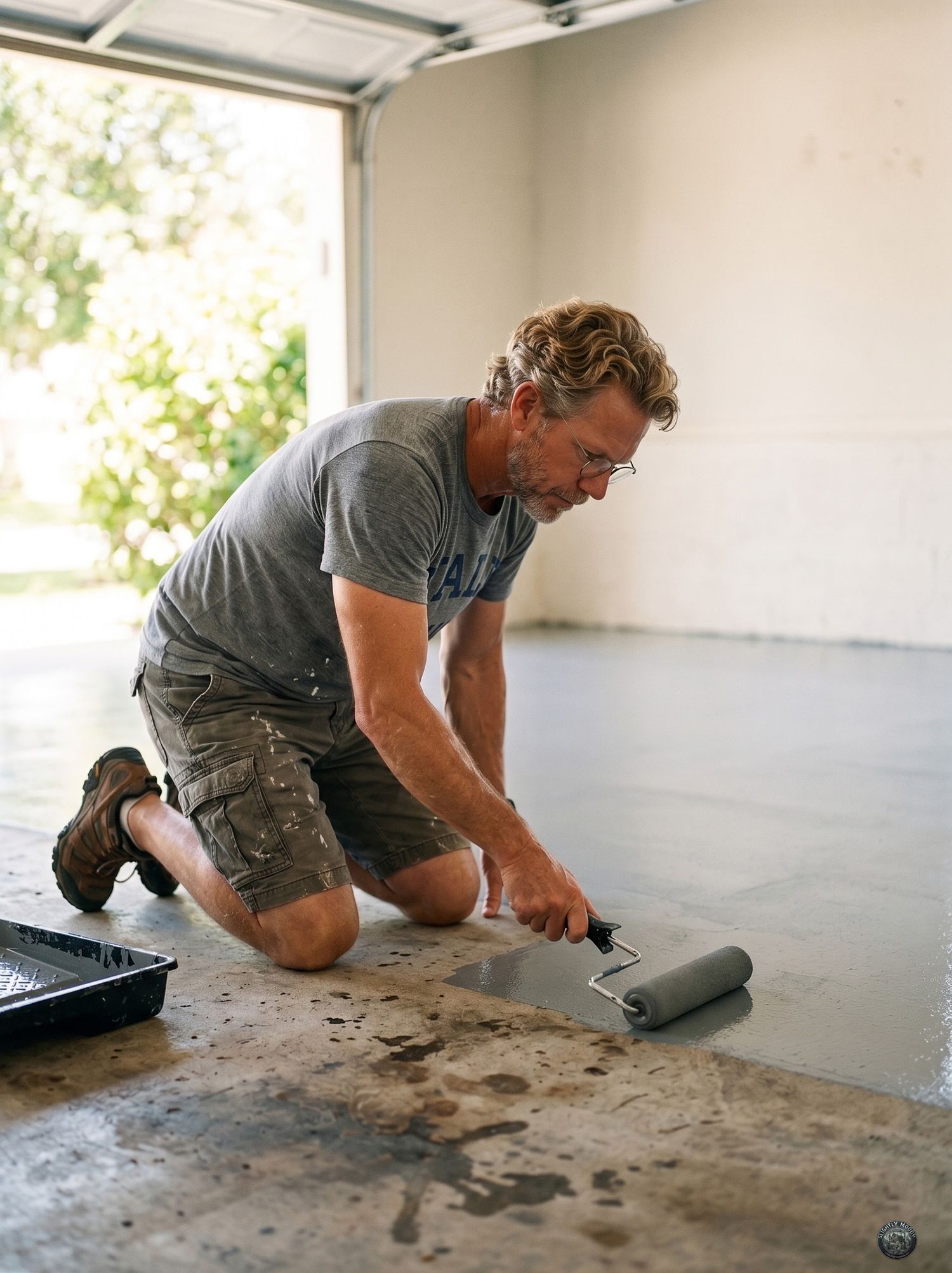
It was meditative work, painting a floor. You start in the back corner and you paint yourself toward the door, careful not to trap yourself, laying the roller down in long even strokes, and the gray went down over the stains of fifteen years, the oil spots and the paint drips and the ghost of a bicycle that used to lean there. The whole history of the garage disappearing under a clean coat. Bagley lay in the doorway in the only cool spot, watching, occasionally thumping his tail.
Dixon worked backward toward the door and thought about nothing, which was rare for him, and then thought about the date.
The thirtieth. The last day of June.
He stopped, the roller resting in the tray. He did the arithmetic the way you do when something arrives sideways. June was the sixth month. June thirtieth was the last day of the first half of the year. Which meant tomorrow, the day he was leaving, the day he pointed the car west with no house behind him and no idea where he was going, tomorrow was the first day of July. The first day of the second half of the year. The first day of everything after.
He was, of course, a superstitious man. He had the whole penny thing. But he had been carrying, since that video call in his office what seemed a lifetime ago, a sentence he had not been able to put down. The first phase will wrap up by the middle of 2024. Mama Honu had said it with the cheerful finality of a woman who didn't keep track of time and didn't need to. He'd thought, at the time, that she meant a new job. A bigger role. Some promotion he couldn't yet see. He had not understood that she meant this: the house empty, the dog in Oregon, the furniture gone, the man on his knees painting himself out of a garage on the last day of the first half of the year.
The middle of 2024. He was painting the floor on the last day of it.
He didn't take it as proof of anything. He took it as permission. The kind you give yourself and then assign to the universe so it feels less like a choice you could lose your nerve on. Tomorrow was the first day of the rest of it, and the rest of it was not here, in this garage, in this city he'd never quite belonged to. The rest of it was out west somewhere, down a road he hadn't driven, in places he didn't have names for yet.
He finished the floor. He painted himself right out the door and stood in the driveway in the heat, and the gray dried behind him, clean and blank and ready for someone else's stains.
Priscilla got back on the first, in the morning, just as he was loading the last of the car.
The RAV4 sat in the driveway with the cargo carrier bolted on the back and the bike on the rack and the guitar laid across the seat where the dog used to ride, and Dixon was wedging the final bag into the final gap when Priscilla pulled up, home from Charlotte, her mother stable, her gratitude enormous.
And Bagley, who had spent six days as Dixon's shadow, who had slept on his legs and supervised his labor and celebrated his every return as a miracle, saw Priscilla's car and forgot Dixon completely.
He lost his entire mind. He launched himself across the yard, all hundred ridiculous pounds of him, and hit Priscilla at the knees, and rolled, and wriggled, and made the sounds a Bernedoodle makes when its actual person comes home. Dixon stood by the loaded car and watched. The dog he'd grown attached to in six short days transferred his devotion back to its rightful owner without a single backward glance.
It was exactly what Magnolia had done to him at Cash's door. It should have been funny. It mostly was funny. But it caught him somewhere he wasn't braced for, the second time in a month a dog had loved him completely and then trotted off the instant something different arrived, and the wanting that left behind was real, and Dixon stood in his driveway and felt it plainly and didn't say a word about it to anyone.
"He was an angel," Dixon told Priscilla. "Genuinely. Best company I've had in weeks."
"You saved me." She hugged him, and Bagley leaned on both of them one last time. "If you're ever back. . ."
"I don't think I'm going to be back," Dixon said. "But thank you."
She took it the way neighbors take the strange news of a life unmaking itself, with a small sad nod. She gathered her dog and went home. Bagley looked back over his shoulder exactly once, at the door, and then was gone inside, and the yard was quiet.
Dixon stood alone in the driveway of the house that was no longer his, beside the car that was now the only home he had, and missed a dog he'd known for six days.
He noticed the feeling. He didn't push it away and he didn't name it. He just stood with it for a second, the want of a dog's company, the specific empty-handed quiet of handing one back. Then he got in the car.
He left the house keys on the kitchen counter, all four of them on a paper ring, where the agent would find them. The bare counter, the silent fridge that Dale had emptied, the dents in the carpet. He stood for a moment in the front hall of the empty house and did not feel much of anything he could put a word to, which was, he thought, probably the right amount to feel about a place he'd been brought to like a houseplant and was now leaving like a man.
He pulled the door shut behind him and did not lock it, because the keys were inside, and there was nothing left in there to take.
The car was loaded. The carrier was full. The bike was on the back. The guitar was on the seat. The ring in his pocket had a storage key and a carrier key and a bike key on it and not one key to any door he could sleep behind.
He backed out of the driveway. The house slid away in the mirror, brick and empty, the jasmine he hadn't managed to kill still throwing its runners along the back fence, getting on fine without him.
At the end of the street he stopped, though there was no one behind him.
West was to his left. He'd worked it out the night before, lying on the air mattress with the house ticking as it cooled. There was no real destination. Just west. That was the part he kept pressing on, the part that should have scared him more than it did. He had a full tank of gas and a loaded car and a guitar he couldn't play and a country in front of him and absolutely nowhere he had to be. No dog. No house. No job to be anywhere for, just the laptop and the calls he could take from anywhere there was a signal. No one waiting for him anywhere. The most unanchored anyone could be.
He turned left.
It was the first day of July, the first day of the second half of the year, and Dixon Davie drove west out of Atlanta for the last time with everything he owned in his little red Hybrid SUV. He was driving in a direction toward nothing in particular. This new direction, which was not really a direction at all, seemed to be the only direction he would be going for the foreseeable future.
Lyrics
[Intro]

[Verse 1]
I've been standing in this driveway for the better part of a year
Looking at a life that fits on paper but doesn't fit in here
The lawn is cut, the bills are paid, the neighbors think I'm fine
But there's a version of me pacing in the back rooms of my mind
He's restless and he's tired of being told where he should stand
He's ready to stop holding everything that was never in his hands

[Pre-Chorus]
I can't explain it and I can't make it make sense
But something's pulling at the edges of this white picket fence

[Chorus]
There's somewhere west of me
That I haven't been yet
A version of my life I haven't lived yet
I don't know the road and I don't know the name
But I know if I stay here
I'll just keep feeling the same
There's somewhere west of me
And I think it's time I went

[Verse 2]
I used to think that restless was just something you outgrow
You buy the house, you plant the tree, you learn to just say no
To every voice inside your chest that says there's something more
But I've been saying no so long I don't know what the yes is for
The man I see each morning in the mirror plays his part
But somewhere underneath the routine there's a stranger in my heart

[Pre-Chorus]
He's not angry and he's not afraid
He's just done pretending that the comfortable is the same as being saved

[Chorus]
There's somewhere west of me
That I haven't been yet
A version of my life I haven't lived yet
I don't know the road and I don't know the name
But I know if I stay here
I'll just keep feeling the same
There's somewhere west of me
And I think it's time I went

[Bridge]
I'm not running from this life
I'm just listening to the one that's calling
And I don't know if I'm brave or if I'm foolish
Or if there's any difference when you're falling
But I'd rather be the man who tried the road
Than the one who stood there staring at the door
I've been somebody else's version long enough
I want to find out what I'm for

[Chorus — Final]
There's somewhere west of me
That I haven't found yet
A life that's waiting past the county line I bet
I don't know the cost and I don't know the toll
But I know if I don't go
I'll never know my soul
There's somewhere west of me
Yeah, I think it's time I went

[Outro]
Dixon's feelings at the moment of departure render into song. From the album Somewhere West of Me.
– End of Act 1 –
Published June 18th, 2026 from Park City, Utah
Enjoying the story? Support the work →
All text, images and music copyright (2026), Slightly Moody Creative LLC and Joe English.