The Sit Boy · Chapter 14
Barolo and Chablis

This chapter is dedicated to Barolo and Chablis. In early 2026, one passed away and then the other within a few weeks, the second perhaps from a broken heart. Siblings that spent every day of their lives together, they were funny, big, lovable dogs and all who met them will keep them fondly in their memories.
The GPS said he had arrived.
Dixon did not think he had arrived. He was in a narrow private lane off a quiet street in Laurelhurst, and it was raining the way it rains in Seattle in the fall, which is steadily and without any drama at all. On both sides of the lane there were garage doors. Lots of them. They were dark wood with frosted glass panels, with small lamps between them, set into tall shingled walls with windows high up. It looked like a row of townhomes. It looked like a row of townhomes with no front doors.
He checked the listing on TrustedHousesitters again. It had five photos. One was a tight shot of a kitchen island with a bowl of apples on it. One was a bedroom with a four-poster bed and a window with a view full of water. The other three shots were of two enormous Boxers. The description said guest suite, two sweet seniors, one axolotl, and the owners had written that the dogs mattered more than anything else in the house.
He had assumed a nice condo on the lake. Maybe a slightly larger townhome. One of these, he supposed.
He parked at the end of the lane and got out and walked it in the rain. He walked it slowly, reading house numbers where there were house numbers, and there weren't many. The properties were lengthy. The houses on the lake had significant frontage. He tried a wooden gate that turned out to be a recycling enclosure. He said "sorry" to it, out loud, and then felt sheepish about talking to it.
Then, from somewhere behind the garage doors, something howled.
It wasn't a bark. It was a long, rising sound that went up and up and held there. Then a second voice came in alongside it, lower, like a harmony. Dixon stood in the rain with his hood up and listened with his mouth a little bit open. Then he followed it. It led him to a non-descript door tucked between two of the garages, with a keypad beside it and a small brass number he had walked past twice.
The owners had sent him a code through the app. He punched it in. The lock whirred and with a loud click, the door was unlocked.
He pushed the door open and found himself looking into a dimly lit room. And there, sitting on the floor, moving as if tiny little earthquakes were flowing up and down their bodies, he saw the two dogs.
They were in a mudroom about the size of his first apartment, and they were huge. Both of them. They were old, too. He could see it in the grey around their muzzles and in the careful way they held themselves up. They finished the howl together, the way a choir finishes a hymn, and then they came over and leaned on him. One on each leg. It was a lot of dog. Dixon put a hand on each of their broad, square heads and stood there dripping on the floor.
"Hi guys," he said warmly. "You must be Barolo and Chablis."
They blinked at him once together and then turned and led him inside.
The mudroom opened onto a hallway, and in the hallway there was a set of brushed steel doors. Dixon assumed it was a pantry. Then he saw the silver panel with a button next to it. The button had an upward arrow on it.
"That's an elevator," he told the dogs.
Neither of them seemed to think this was remarkable.
The hallway opened into a kitchen. And the kitchen opened onto the lake.
One whole side of the room was glass. On the other side of the glass there was a long deck, and past the deck a lawn that ran down to a dock, and past the dock was Lake Washington, grey and wide under the rain, with the dark line of the Eastside along the far shore. There was a boat tied up at the dock under a fitted cover. There were two jet skis up on a lift. At the very end of the dock there was a little thatched hut with a row of bar stools lined up in front of it.
A tiki bar. The house had a tiki bar.
He turned around slowly and took in the kitchen. He recognized the bowl of apples. He did not recognize anything else. The island was about as long as a sailboat. There was a Wolf range with red knobs, and a Sub-Zero, and wide-plank wood floors that seemed to go on in every direction. Somewhere, music was playing, soft jazz that just seemed to be leaking out of the walls in every room.
He went back out to the elevator and pressed the up arrow. The doors opened. He stepped in, and both Boxers stepped in right after him as though this was simply what you did, and they all rode upward together. There were four floors. He got off at every one. On the top floor there was another deck with a glass railing and a hot tub, and a view that went all the way down the lake to the south. He could see a long, low bridge lying flat across the water. Beyond it, very faintly, behind all the rain, there was the lower edge of something enormous and white.
"Is that Rainier?" he asked the dogs. They looked at him expectantly, but offered no answer.
He rode back down to the kitchen. Then he rode back up again, just to be sure it was real. The dogs rode with him both times, patiently. Somewhere around the third floor Dixon started laughing, alone in an elevator with two old dogs, and understood that he was completely delighted.
There was a note on the island, propped against the apples. It was on a card with a picture of two Boxers on the front, and it was long.
Welcome!! We're so glad it's you. First, sorry about the photos. We keep the listing vague on purpose. We showed the whole house once and got forty messages from people who wanted to "host a small gathering." You were the only person who asked about the dogs' hips. That's how we knew.
Barolo is the big guy with the white face. Chablis is the girl with the mask. They are both very good and very old and very gassy, and we apologize in advance. They have beds. They won't use them. Their food is in the pantry, two scoops each, morning and night. S'more is in the tank in the den. He's easier than the dogs.
Boat keys are in the drawer by the fridge if you want to take her out. Alarm code is on the back of this card.
Oh, and they howl. Only for people they really love. If they haven't yet, give them a few days.
Love, B & C (and their people)
Dixon read the last part twice. He looked down at the dogs. They were lying on the kitchen floor now, side by side, watching him read.
"You didn't wait," he said. He felt chosen. He didn't look for a better word.
It appeared he had been given two wines to look after, and of course he didn't drink. But he did know dogs.
Dixon did know a lot about wine. He had drunk plenty in younger days. It had been almost fifteen years since he stopped drinking as a New Year’s resolution. He knew Barolo was red and serious and Italian. He knew Chablis was white, and French, from the north end of Burgundy. He knew this because in his twenties, in Lyon, he had once listened to a man at the next table describe a Chablis as tasting of "wet stones," and Dixon had thought about that phrase, on and off, for years. He loved the picture it painted in his mind.
Barolo was the bigger of the two dogs. This was a little like saying one of two refrigerators was bigger. He was a male, and his face had gone almost completely white, and his lower eyelids drooped and showed red underneath, so that he always looked like he had just been told something sad and was taking it very well. Chablis was fawn, with a dark mask, and she had a small wart on her lip that she seemed entirely at peace with. She was also huge. She carried it more lightly. They were littermates, born together and named as a pair, and they had never spent a day of their lives apart, and by the end of the first day Dixon could not picture one without the other.
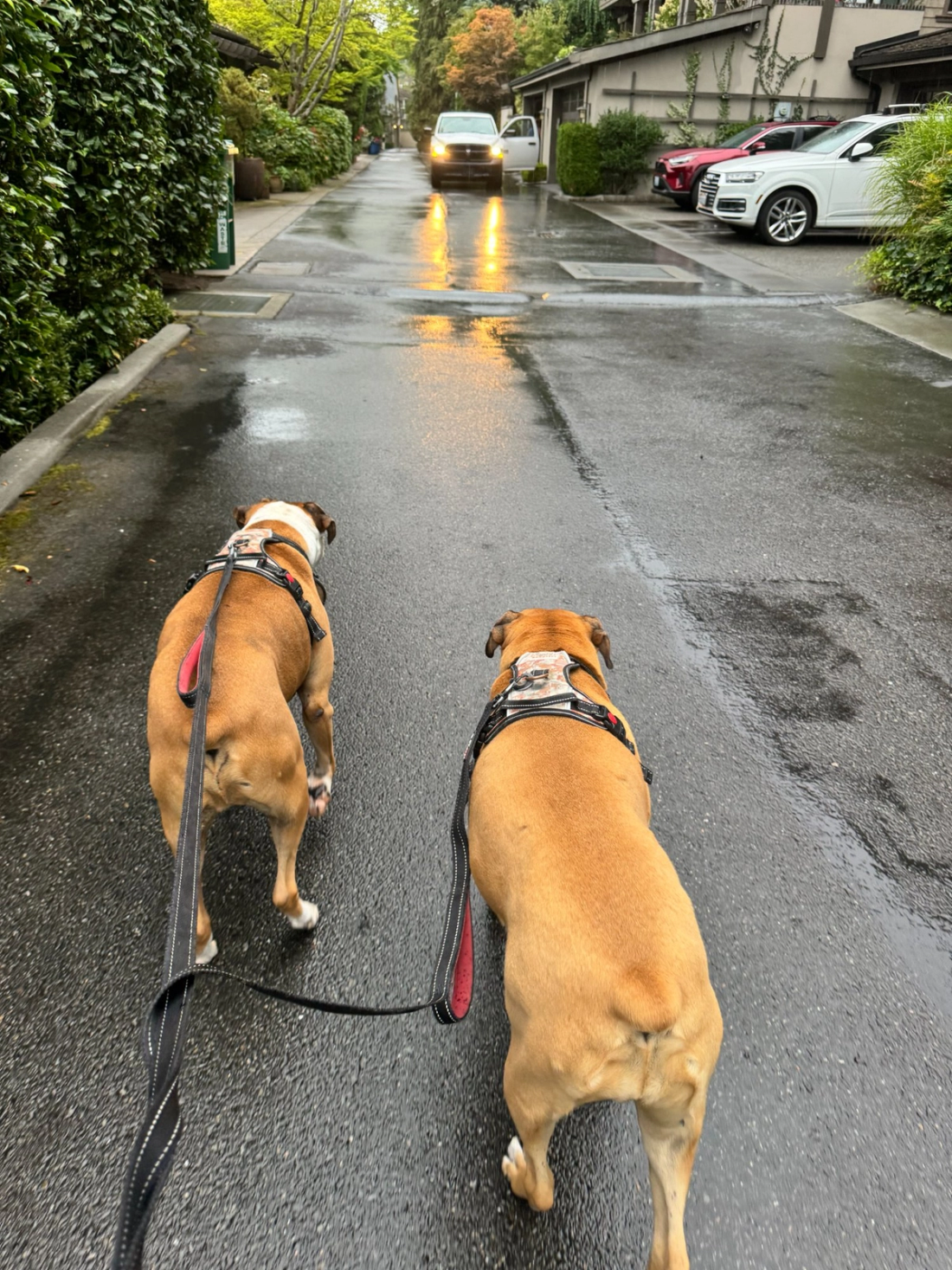
They did not so much walk. It was more of a waddle. The first afternoon, when the rain let up, he clipped on their leashes and took them out the side door and down the lane of garages. They made it all the way to the end of the lane. They stood there and considered the street. Barolo then led Dixon to a place where the water came up to the grass. He gently waded in and sniffed at the air. It was as if he was in his happy place. This lasted for maybe ten seconds, then he climbed out of the water and they both turned around, without discussing it, and walked Dixon home.
That was the whole walk. Every day.
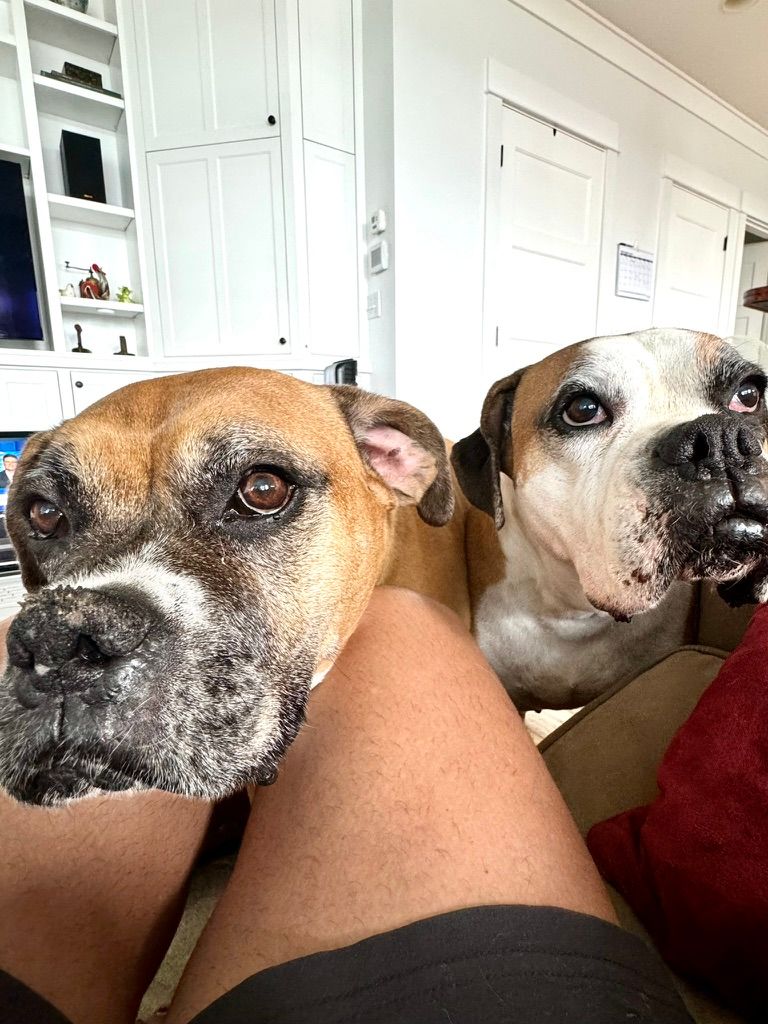
That evening he sat on one of the big couches in the den, next to S'more's tank, and both dogs came over and put their heads in his lap. Two big square heads side by side, heavy as bowling balls. Barolo let out a long sigh. Chablis closed her eyes. Dixon put a hand on each of them and felt, for a minute, completely and totally at home in a house he’d only been in for a matter of hours.
Then Barolo farted.
It was long and it was low and it went on for longer than seemed possible for one dog. Barolo did not move. He did not open his eyes. He carried himself through it with total dignity, the way a man might stand very still through the national anthem.
The smell arrived about four seconds later.
"Oh," said Dixon. "Oh, buddy. Oh no."
Chablis opened one eye and looked at Barolo. Then she closed it again. She had clearly been through this before.
Dixon sat there breathing through his mouth, laughing, and thinking about the note. Only for people they really love. “Your mom said you howled for people you love. Who’s this special treatment for then?” he asked, chuckling.
Neither of them answered. He scratched the white fur behind Barolo's ears and kept breathing through his mouth.
The dogs’ food generally lived in a small white container underneath the dog bowls. Generally. When it ran out, the small container needed to be refilled. The next morning at breakfast, Dixon found that the container was almost empty.
The rest of the food lived in the pantry. It was housed in a forty-pound bag with the Kirkland Signature label on it, the same as the dog beds they refused to use, and the same as a jar of cashews on the shelf above it that was roughly the size of a fire hydrant.
Dixon read ingredient labels. He always had. He read this one standing in the pantry in his socks while two Boxers stood behind him breathing on the backs of his knees. He was not a veterinarian. He had no training to voice an opinion.
He did, privately, begin to develop a theory though. He looked down at the dogs. “Is this what’s giving you guys gas?” he asked. They blinked at him, otherwise unmoving.
He hoisted the bag up onto his hip to pour. It was almost full and very heavy, and as he tipped it, the bottom seam let go.
Forty pounds of kibble came out all at once. It went across the pantry floor, and across the kitchen floor, and under the island, and under the Sub-Zero, with a sound like hail on a tin roof.
The dogs were in it before the sound stopped.
“Oh shit!” he yelled. “Oh my!”
Dixon got down on his knees and started gathering the kibble, first with his hands, then with a dustpan and a little brush. He swept some kibble into a pile. Barolo ate the pile. He swept another pile. Chablis ate that one, delicately, from the edges in. He tried sweeping faster. They ate faster. These were two very old dogs who needed a full minute to decide whether the end of the lane was worth it, and now they were moving like something from a nature documentary.
"Back off you beasts! This is not a buffet," he chided them.
Barolo looked up at him with kibble on his white chin. It was a buffet. They both knew it.
In the end he got the vacuum out of the hall closet. The dogs followed the vacuum, staring at it, with the look of two dogs who had been robbed. That night he measured out their two scoops each, very precisely, and they looked at him like he had lost his mind. And for the rest of the sit, any time he so much as touched the pantry door, both of them materialized behind him with the speed of two young wolves and the innocent faces of two old men.
After all the action with the dogs, he went to introduce himself to S'more, the axolotl.
S'more lived in a big tank in the den. He was pale pink, almost white, with feathery gills that stuck out on both sides of his head and waved slowly in the water, and a wide mouth that turned up at the corners. Axolotls' faces just look like that. Dixon knew it wasn't really a smile. He smiled back anyway.
"I'm Dixon," he said, bending down to the glass. "I'm watching the dogs."
S'more drifted over to the front of the tank and hung there, gills moving, looking at him with two small black eyes.
"And you, I guess," said Dixon. "If you want."
S'more sank slowly to the bottom of the tank and stayed there. Dixon decided that was a yes.
The first week went like this.
The jazz he'd heard on the first day was coming from a whole-house sound system, and it was coming from every room at once, including the elevator. He could not find a way to turn it off. There was an app, and the app wanted a password. There was a panel in a closet with a column of blinking blue lights, and he pressed nothing on it, because it scared him. He lived for three days inside a set of very tasteful saxophone solos. On the fourth day he finally found the password in the owners' house manual. It was a real manual, bound, with colored tabs. He stood in the kitchen and held it for a moment with something close to love. He recalled the fiasco at Janet’s where there had been no manual at all.
The hot tub on the top deck had a control panel with more buttons than the dashboard of the RAV4. He got it to bubble. For a while, he could not get it to stop bubbling. It was worth the fiddling. He sat in the tub, looking out at the lake and felt like he was in a dream.
On the second night the alarm panel by the garage door chirped at him. Six weeks ago that small, polite chirp would have ruined his evening. Now he walked over and read the panel and turned over the owners' card and punched in the code, and his pulse didn't change at all. Lorna had taught him that. He thought about her fondly, and about her mug.
He cooked on the Wolf range. The red knobs made him feel like he was on television. He made salmon, because he was in Seattle and it seemed like the thing to do, and he ate it standing at the end of the island looking out at the lake, with two Boxers sitting on his feet in case anything fell. Barolo watched the salmon go from pan to plate to Dixon's mouth with the saddest face in the Pacific Northwest. It was a tremendous face. It belonged on a stamp. Dixon knew exactly what was happening, and gave him a piece of the crispy skin, and loved him, and was a little embarrassed by how fast that had happened.
On the third morning he went out to the RAV4 and dug around in the very back until he found a green bag. It was a big tube-shaped bag with IRONMAN 70.3 printed on the side, from a race that felt a long time ago, and his running shoes were in it. He had gotten pretty inconsistent with his workouts since he’d been on the road, what with all the travel, the packing, the lying out under the sky on rocks. He needed to get back to it. So he sat on a bench in the mudroom and laced up the shoes while both dogs watched him with deep suspicion. He looked at them, gave them each a pat on the head and said, “don’t worry, I won’t make you come with me. I know you don’t want to come.” He gathered his things and then turned back to them again. “But, I promise, I will be back.” The dogs looked relieved.
He ran out the lane and over to the Burke-Gilman Trail, out past the University of Washington and back. He stopped in at the UW track and did a few repeats in the empty stadium. It was only a few miles, but it felt glorious. He felt alive. He came back through the side door soaked and red-faced and happy, and both dogs got up off the rug and waddled over to him as though he'd been away for months at sea.
That was the morning he met one of the neighbors.
The man lived across the lane. He was out in his driveway in a fleece vest with a bucket and a chamois, standing over a dark green Porsche 911 Turbo S. He was not exactly washing it. The car was already spotless. He was moving around it slowly, wiping at spots only he could see, then stepping back to look at the whole of it. It was obviously going to rain within the hour, and that was obviously not the point. A man like this had people for the things that needed doing. This was a man spending his morning admiring something he still couldn't quite believe he got to own, and Dixon, currently living in a house with a tiki bar, formerly the owner of a fast little toy in Atlanta, understood him completely. The man lifted his chamois at Dixon in greeting.
"Morning! She running okay?" he called out, and he nodded past Dixon toward the lake. Toward the boat.
"Oh. Yeah, sure," said Dixon, who had not touched the boat. "Great, I think."
"You get the skis out much this summer?" he asked, draping the chamois over his forearm like a sommelier.
"Not as much as I'd have liked," Dixon said, which was true, in its way.
The man nodded, satisfied, the way one man with a boat nods at another man with a boat. He went back to admiring his Porsche.
Dixon went inside and stood in the kitchen, still sweating. Since July, everywhere he went, people had looked at him and seen a guy between things. A guy with a car full of stuff and no address. Nobody ever guessed that he wasn't broke, and that he had chosen this.
And here, in the one place where a stranger had finally looked at him and guessed right, he was the guy watching the dogs.
He didn't correct him and that felt ok.
His room was the one from the listing. The four-poster bed, and the window, and the water. The bed was a king. The mattress was the kind people write reviews about. The sheets were cool and heavy and smelled faintly of cedar.
He had slept on a lot of surfaces since Atlanta. The rock, of course, outside of Bend. Myriad hotel beds. The campervan shelf. Just last week, he had decided that a bed was not a luxury.
This bed was a luxury. It was the best bed of his life.
The dogs had their beds too. Several of them. Two in most rooms. They were round and enormous and plush. Two of them sat in the corners of his room. The dogs opted to lie down on the floor instead, one on each side of his bed, close enough that he could hear them breathing.
They would gently fall into their slumber and then their bellies seemed to come alive.
It went on all night. It came in waves, and the waves came from both sides of the amazing bed, and there was no pattern to it that Dixon could find, although around two in the morning he did try. He got up and opened the window. The lake air came in cold and clean. It didn't help. He got back in bed. He put a pillow over his face.
He lay there in the best bed he had ever slept in, in the dark, with a pillow over his face, and he laughed until the bed shook. Barolo lifted his big white head off the floor and looked at him with those sad red eyes, and farted again.
"This is the bed," Dixon said into the pillow. "I finally found the bed. And I can't breathe in it."
“But, you’re worth it.”
Some mornings the lake just appeared to be gone.
The fog came up off the water in the night, this time of year, and some mornings it simply stayed. The first time, he came down at dawn to feed the dogs, and the far shore wasn't there. No Eastside. No Bellevue towers. There was a dark ceiling of cloud, and under it a soft grey wall of fog where the land should have been, and the flat water in front of that, and that was the entire world.
He poured the two scoops twice and stood at the island with his decaf while the dogs ate, watching the fog not move.
Then the sky cracked open.
A seam opened somewhere behind all that grey, low at the waterline, and light spilled through it. It ran across the water in a long line of gold and lit the fog from underneath, and the whole world out the window became three things. The blue. The gold. The burning fog between them.
Dixon knew exactly how long moments like this last. He had spent twenty years building one-minute moments for other people. This one was free, and nobody designed it. His big camera was two floors up, and the light would be gone before the elevator even opened. He grabbed his phone off the island and shot it right through the kitchen glass. Four frames, a half-step between each one. There was no fifth. The seam closed, the gold went out, and the lake went back to being grey, as if nothing had happened at all.
Behind him the dogs were still eating. The whole thing had taken less than a minute.
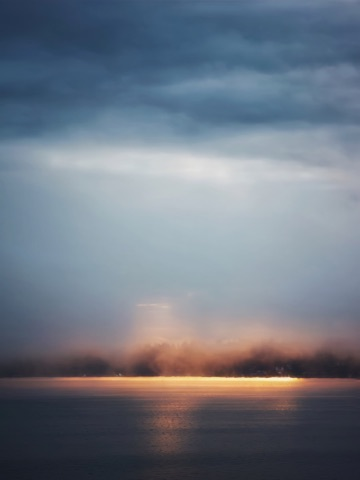
He looked at the phone. He went through the four frames once, fast, and then again, slowly, and then he sat down on a stool because he needed to sit down. He was not a man who got shaky over his own photographs. He was shaky now. Chablis came over and put her chin on his knee, because she could tell something had happened to him.
All four. Not one keeper out of forty, the way it usually went. Four out of four. And they weren't pictures of anything. There was no mountain in them, no shore, no dog, no person. He had never taken a photograph that wasn't of something. These were pictures of light arriving, and that was all they were, and he knew, sitting in a stranger's kitchen in his socks, that they were the best photographs he had ever taken. Not among the best. The best. He was certain of it the way he was certain about spaces that didn't exist yet. That certainty was his oldest gift. It had just never once pointed at something of his own before.
He named them right there at the island, before the dogs had finished their bowls. He had never named a photograph in his life. These needed names the way paintings need names. Smoke on Water, one through four. It was fog, not smoke, and he knew the difference perfectly well, and it didn't matter. The name was right. He hummed the riff, which he had never learned to play. Barolo lifted his head and considered the humming, and then put it back down.
Number three was the one. He couldn't have told you why in words. Something about where the gold sat in the frame.
He knew these were special. He just didn’t know what to do with them yet.
A few mornings later he woke up before seven and went down to the dock in a sweatshirt with the Nikon and a mug of decaf.
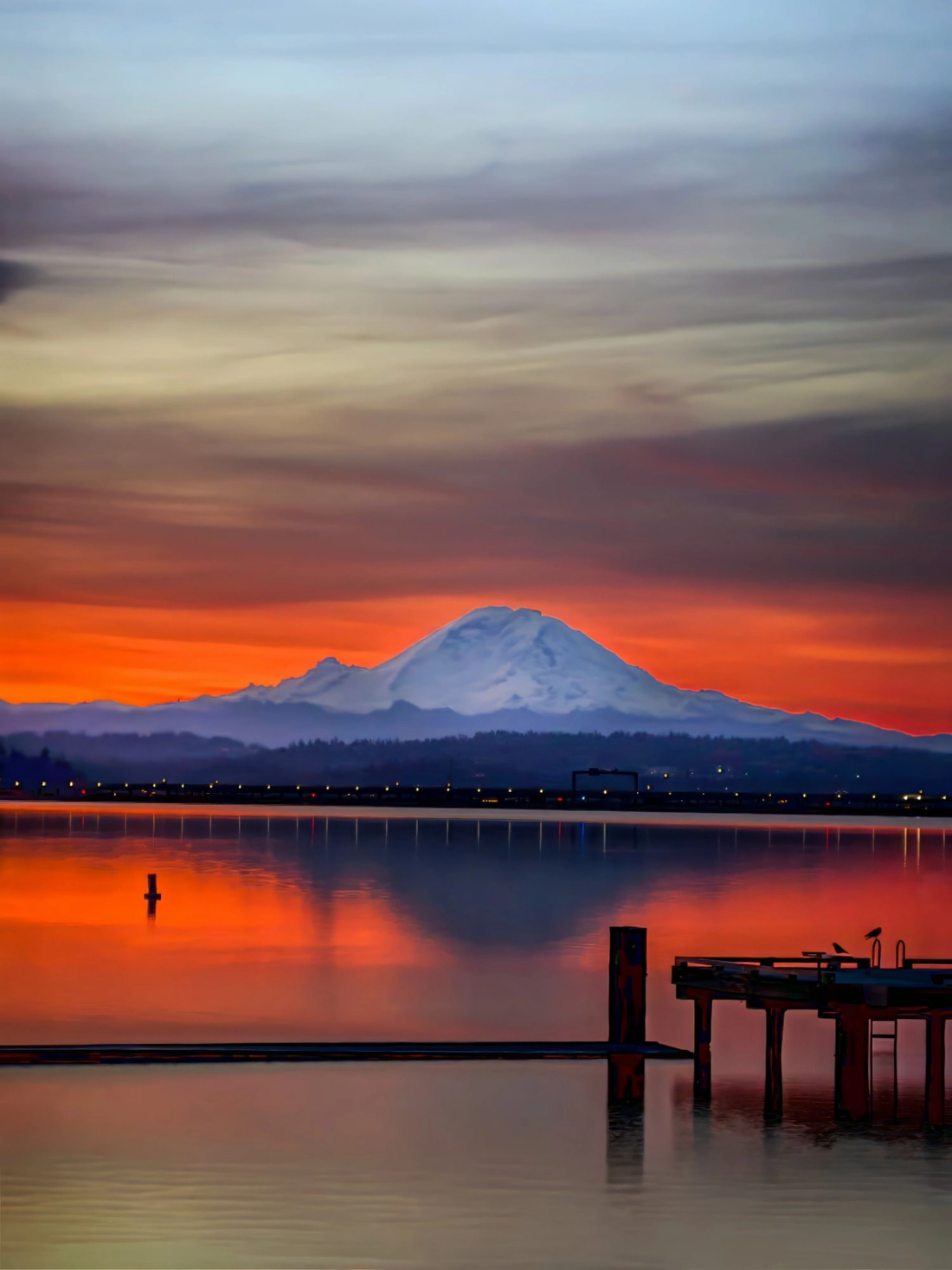
Rainier came up first. It was pink, and then it was white, standing enormous and alone at the far south end of the lake, over the long flat line of the floating bridge, where the headlights were already moving. Across the water the Eastside went red and then orange, and the towers of Bellevue stood up black against it. A line of crows went across the frame. He loved the pale colors spread across the world. He was starting to notice this more. How immersive color can be in the sky, but often only for a few moments. He resolved to make sure to capture it whenever he could.
He spent a few afternoons that week driving around the city with the camera while the dogs slept off their breakfast.
A woman at the grocery store told him about the trolls. An artist had built giant trolls out of wood and placed them around the edges of the city, and Dixon hunted them the way he hunted Diet Caffeine-Free Coke, with total commitment and a slightly unreasonable sense of victory every time. He found one in West Seattle and one in Ballard. He found the old concrete one too, under the bridge in Fremont, crushing a real Volkswagen Beetle in its hand, although that one seemed to be by another artist. He drove out to Issaquah and found one there too.
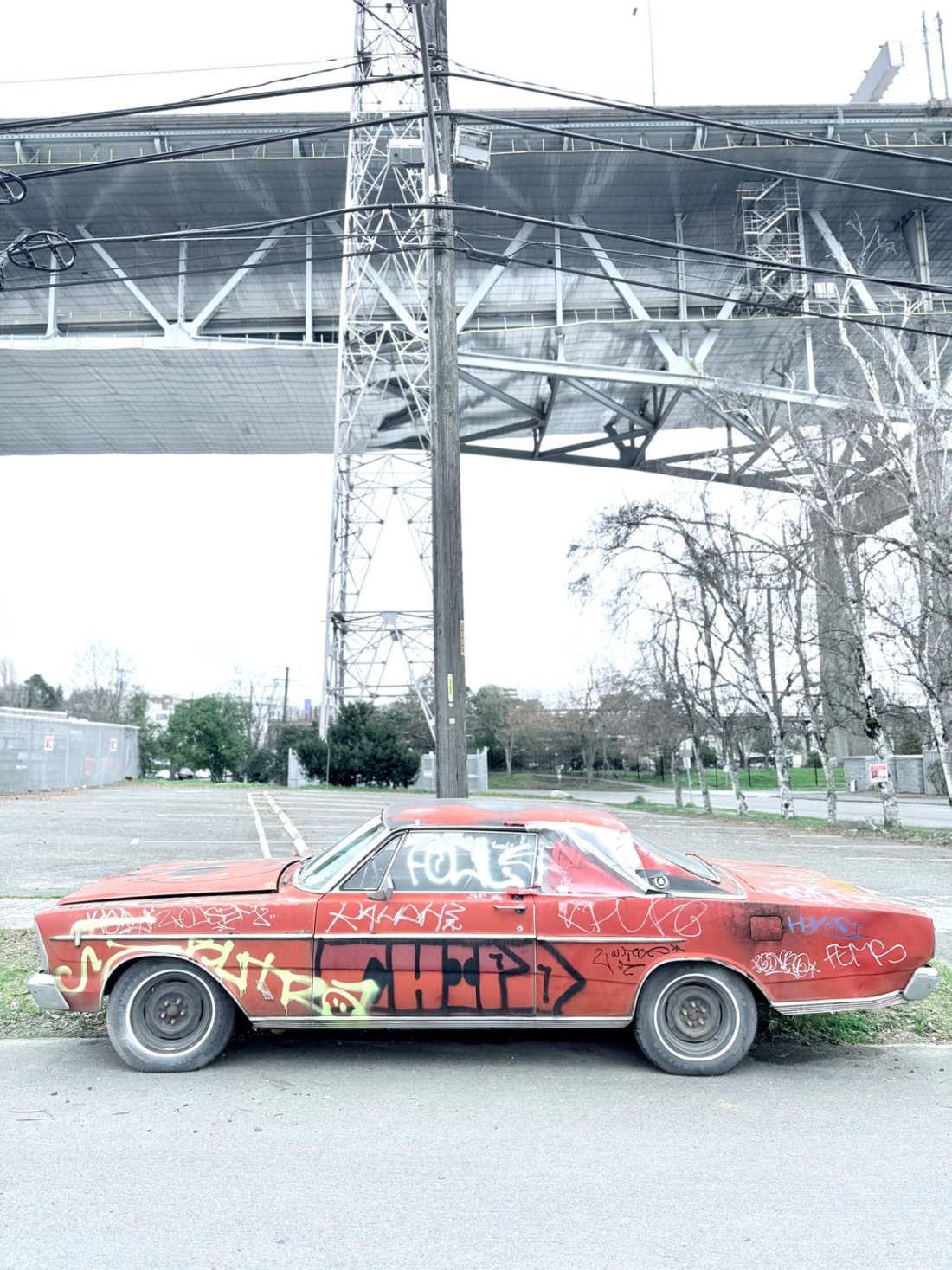
Under a different bridge he found a red car that had been abandoned for a long time. It was covered in graffiti. Someone had sprayed ‘HELP?’ down the side of it, with a question mark and an arrow. That night he processed it pale and washed out, almost white, giving it a moody look that he felt took him back to his early years exploring with his camera here in Seattle. The rusted towers at Gas Works he made into black and whites, and they looked right that way, dark and haunting.
He didn’t really know what to do with any of them at this moment. He could just feel something changing in the way he saw the world, how he captured it, how he held it.
On Wednesday of the second week, Sloane texted seemingly out of the blue.
Sloane: Riley's playing MoPOP tomorrow night. Sky Church. There's a ticket at will-call under Mr. Dixon.
Sloane: He asked me to make sure you'd be there. (He really asked. I'm not just saying that.)
Dixon read it a few times. It was warm. It also sounded a little careful. A little bit crafted. Like the words had been poured over a few times. Maybe he was reading something into it after the last time they texted.
Dixon: I'll be there. Thank you, Sloane.
He thought about adding something. He didn't know what it would be. He sent it as it was.
The Museum of Pop Culture sat at the foot of the Space Needle, in a building that looked like somebody had dropped a pile of giant melted guitars and left them where they fell. The monorail ran straight through the middle of it. Dixon walked all the way around it once in the dark. He did not understand it at all, but he liked it very much.
Inside, on the way to the hall, he passed a tower of guitars. There were hundreds of them, bolted together into a huge twisting column that went up past the second floor. He stopped and looked up at it for a long time. He had one guitar. Marlowe had given it to him in Nashville. It was in the back of the RAV4 right now. He was fairly sure that every single guitar in this tower would have beaten him the same way that one had.
The woman at will-call ran her finger down a list. "Name?"
"Dixon," he said. Then, because it felt important to get it right: "It might be under ‘Mister Dixon’, I think."
She found it. It said exactly that. MR. DIXON. She smiled at it, and then at him, and handed him the ticket. Walking away, he was absurdly happy about a piece of paper. Both syllables, and a Mister besides.
Sky Church was a big dark hall with a very high ceiling and an enormous screen along one wall, and a few hundred seats set out in rows. It was most of the way full. People were milling around expectantly and talking amongst themselves.
Then Riley came out and the audience hushed.
He was in a dark blue suit, with a bow tie and a light brown fedora, all of it immaculate, the way it had been on the footbridge in Las Vegas in the heat. He sat on a stool with one guitar and one microphone, and for a moment he didn't say anything. He just looked out at all of them, and smiled, and the whole room leaned toward him. Dixon had seen that happen before. He had seen a whole carnival lean toward this man.
“Y’all are pretty quiet,” he said with a grin. “Let’s make some noise!” he shouted and the crowd went wild for him.
Riley played for an hour and a half. Old songs, church songs, a song about a river that went down to the Gulf. Near the end he played "Carnival of Everything." When he got to the line with Dixon's name in it, he lifted his chin and touched the brim of his fedora, out toward the dark, not at anybody in particular. Dixon, halfway back, felt the hair on the back of his neck stand up and he blushed a little. He was so proud it embarrassed him.
After the show, a young man with a lanyard found Dixon in the lobby. "Mr. Riley would like to see you, if you have a minute," he said, and he walked Dixon back through a door and down a hallway to a small room with a couch, a mirror, a bowl of clementines, and Riley James, sitting with his jacket off and his bow tie still perfectly tied.
"Mister Dixon, sir," Riley said. He stood up, slowly, and opened his arms.
"Mr. Riley, sir." Dixon hugged him, and Riley hugged him back hard.
They sat. Riley asked about the road, and Dixon told him some of it. The houseboat. The dogs he was staying with now, who howled when they loved you. Riley laughed at that, a big warm laugh that filled up the little room. Then Dixon told him, a little awkwardly, looking at his hands, that he had been trying to write songs.
"Is that right?" Riley said, leaning back into the couch. He was pleased, and he let it show all over his face.
"I can play a little," said Dixon. "A man named Earl taught me three chords in Amarillo, and I've been practicing. But I can't play and sing at the same time. My hands and my mouth won't do it together. So I kind of . . . cheated."
"Well, show me how you cheated," said Riley, and he held out his hand.
Dixon found "Gone by Morning" on his phone. The version from Janet's kitchen. He handed it over with both hands, the way you'd hand someone something that might break.
Riley held the phone up close to his ear and closed his eyes.
Dixon watched him listen. He watched him the whole way through. The loop, and the beat, and Dixon's own voice, talking more than singing, telling the story of a man with a truck and the yard he left. And then that moment when Juno came in, howling.
Riley's eyebrows went up at the howl. He didn't open his eyes. He smiled.
When it ended, he sat with the phone in his lap for a moment. "Who's the dog?" he asked.
"Her name’s Juno. I was watching her in Portland. Obviously, she wasn't supposed to be on it," Dixon said, and he smiled down at the phone.
"Oh, she was supposed to be on it," said Riley, and handed the phone back. "Now tell me about that beat."
So Dixon told him the story of the bar in Reno, and Rusty's track, and the loop rebuilt on a laptop in a stranger's kitchen. It all came out in a rush. He kept expecting Riley to stop him.
Riley didn't stop him. When Dixon finally ran out of words, Riley leaned forward with his elbows on his knees.
"You know who's from here? From this town?" he asked.
Dixon thought about it. "Hendrix?"
"Jimi Hendrix." Riley said the name slowly, with respect. "They got a whole room of him in this building. You see it yet?" Riley asked.
"Not yet," Dixon said, a little sheepish. "I came straight in to hear you."
"You go see it. . . Now, that young man was left-handed. And back when he was coming up, you couldn't just walk in someplace and buy yourself a left-handed guitar. So you know what he did?"
Dixon shook his head, although he had some idea.
"He took a right-handed one and turned it over. Upside down. Strung it back up the other way and played it like that." Riley gave one big, slow shrug. "People told him that was the wrong way to hold it, but it didn't sound wrong to nobody."
He let that hang in the air for a moment.
"Mister Dixon. Everybody's going to want to tell you the right way to get a song out. Learn it proper. Sing it proper. Play it like so-and-so plays it. And you can do all that, if you want to." He reached over and tapped the phone in Dixon's hand with one long finger. "But this here is your way. It came out of you like this because this is the way you could get it out. The song doesn't care how it got here. It just wants out."
Dixon found that he couldn't say anything.
"Find your way," Riley said, more quietly now. "Not my way. Not anybody's. Yours. You play what's in your heart." He smiled. "If it turns out you do it by talking, that's all right. That’d be more than all right."
"Thank you, Mr. Riley," Dixon said. He was more moved than he had been in months, and his voice came out shaky because of it. They gave one another a big hug and this time it was Riley who needed to get back to work, so Dixon said goodbye to him.
On his way out, he stopped under the tower of guitars again and looked up. It didn't look the same now. He had a new appreciation for the way each of the people that played those guitars found their own way and that’s how they stood out enough to be here.
In the parking garage he sat in the car for a little while and then texted Sloane.
Dixon: The concert was amazing Sloane. And he listened to my song. The whole thing. Thank you for tonight. For all of it. I am really grateful.
Three dots came up. They went away. They came back. They went away again.
Then a single red heart.
He looked at it for a while. It made him happy, and it worried him a little, and he decided to carry both of those things home and let it be for now.
The next morning he went out to the RAV4 in the rain and started carrying things in. All of it. Every bag and box and bin. He rode it all up in the elevator, trip after trip, with both dogs riding along to supervise, and he dumped it out on the four-poster.
Shirts. So many shirts. T-shirts from races and conferences and a charity 5K he did not remember running. Dress shirts. Dress pants, several pairs, for a life full of meetings he didn't have anymore. Belts. A fleece vest, which, after the neighbor, he could no longer wear in good conscience. Hats that were not the straw hat. A sweater he'd bought in Paris a very long time ago and had never once worn in Atlanta, and he certainly didn’t see himself wearing it now in his new road life.
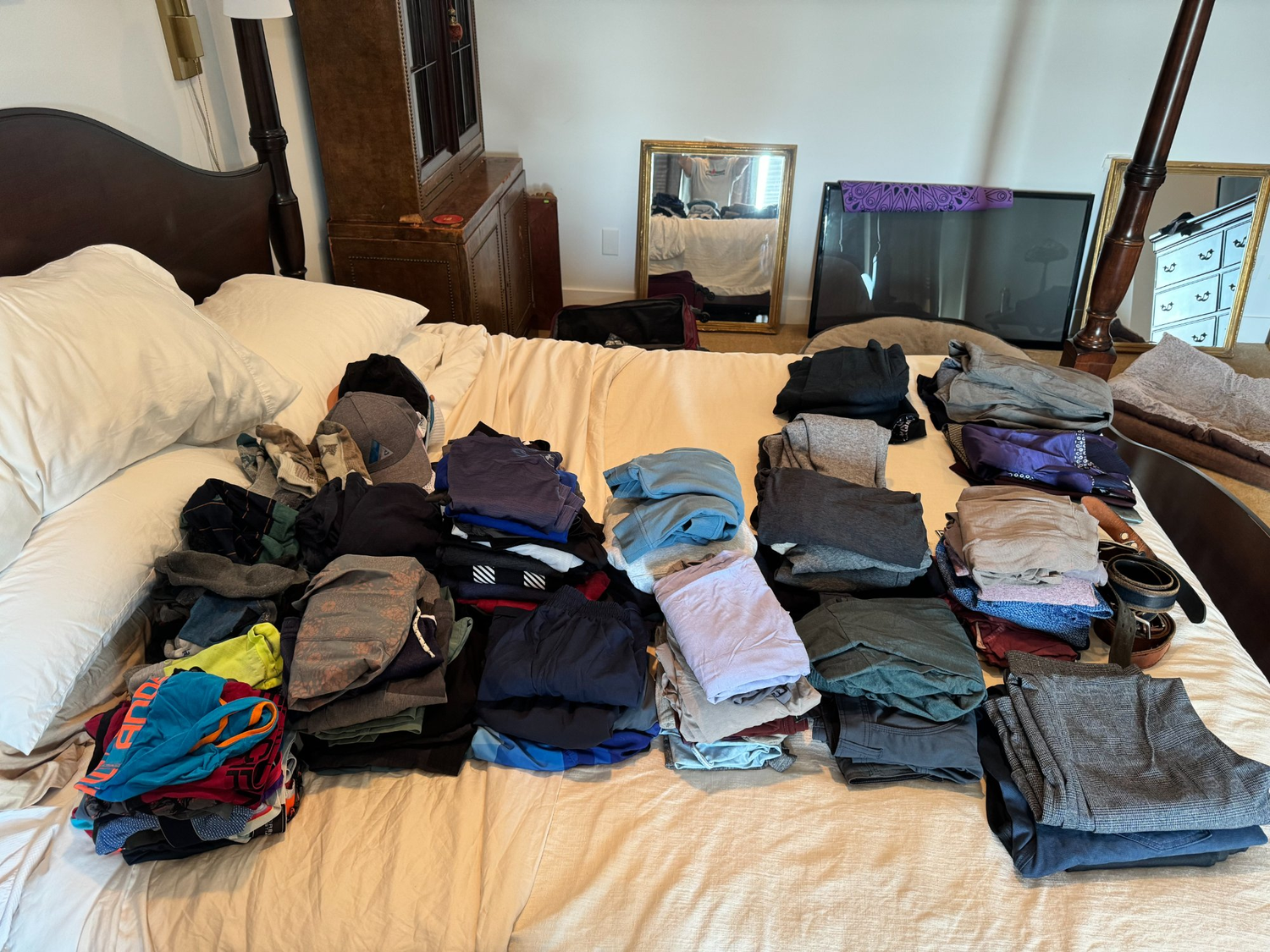
He made piles. A keep pile. A maybe pile. A pile for Goodwill.
Last time, in Portland, he had asked himself the question from the houseboat. Had he reached for it even once? Then he had paid a storage company to keep the things for him. The key was on his ring right now.
This time he asked the same question and meant it.
Mostly, he had not reached for any of it.
The dogs helped. At some point both of them had managed to get up onto the bed, which he did not see happen and could not explain, and they had arranged themselves across the Goodwill pile. Every time Dixon picked something up and hesitated, Barolo seemed to be lying on it. A pair of pleated khakis. The fleece vest. A long-sleeved shirt from a conference, with the lanyard still in the front pocket. Barolo farted on each one in turn, with his eyes closed.
It made the decisions a lot easier.
At the very bottom of everything, under the bins, were three race bags. The green one had his running shoes in it, still a little damp. The orange one had his bike shoes and his goggles and a wetsuit he hadn't zipped up in over a year. The light blue one was the dog bag he'd started in Portland, with the slicker brush and the lavender oil. It was getting full.
He didn't have to think about the bags. The bags stayed.
So did Marlowe's guitar. The Nikon. The straw hat. The envelope, which he did not open, and did not need to.
He took eleven bags of stuff to the Goodwill. A young man in an apron took them from him at the donation door without looking inside, one bag after another, and said "Thank you so much" to each one. Dixon said "You're welcome" to each one too. It felt like it should have taken longer.
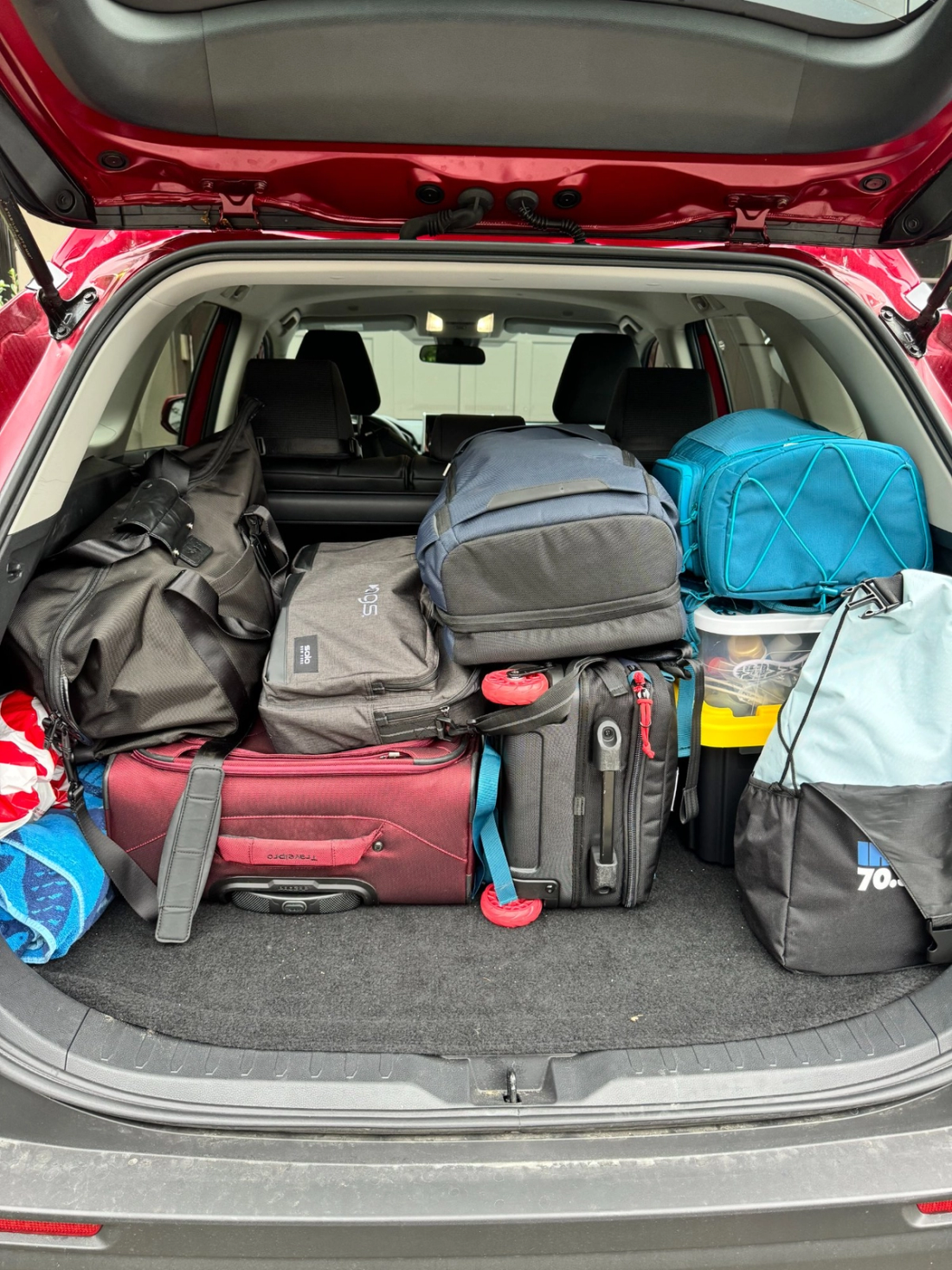
Back in the parking lot he opened the hatch of the RAV4 and looked in.
He could see daylight. Through the gaps between the bags that were left, he could see all the way to the front seats, and out through the windshield to the rain on the other side. He hadn't been able to see through his own car since Atlanta.
He stood there for a minute in the parking lot with the hatch up. He felt lighter. It was not a metaphor. The car was actually lighter.
That afternoon was the first real sun in days. He made a big salad and carried it down the lawn to the tiki bar. The dogs came too, slowly, one step at a time, and lay down on the warm boards of the dock.
He sat on a bar stool under the thatch with the sun on his face. The lake was flat and blue. The mountains were out. The two old dogs were asleep at his feet.
"I don't think I’m gonna want to watch somebody's dog in a condo anymore," he said to them. "Not when I can do this. For free."
Chablis opened one eye. He decided it meant agreement.
Since the night of the Facebook post, he had said yes to almost everything. But people kept asking. He could be a little bit picky now. The thought made him feel slightly guilty, and then, sitting there in the sun, not guilty at all.
He got out his phone and started reading the listings differently.
There was one in Park City, Utah. A big house up on a hillside, with mountains all around it, two dogs, and dates in the fall. He sent a message. They wrote back within the hour and wanted to do a video call. The call went fine. He booked it for three weeks. Another three weeks blocked out on the calendar and this time in another large home. This suddenly felt very right.
He was still on the dock when the Phoenix people happened to write to him. They were the ones who'd been penciled on his calendar since Portland. They asked if he could start early and if he could possibly come straight from Seattle.
He could, so he decided to do it.
He opened their full listing and looked at it again. It was yet another big house, much bigger actually, this time on the side of a desert mountain, with a pool that ran right out to the edge of the view.
He thought about the big paper calendar. It had been almost all white squares in August. Now it said Phoenix and Park City and a two-day work trip and Knoxville at Thanksgiving. And of course, his visits with Cash, in Portland, every fifth week.
It was filling up. He thought for a moment he might need a more complex system to manage all of this.
Mama Honu had told him, a long time ago now, that his life was going to change. She had not mentioned a tiki bar or all of these new dogs and new places. He filled in the Park City details, at the kitchen island in Seattle, and he thought about her, and he smiled.
The owners' flight landed at noon on Saturday. They had asked him to give the dogs their breakfast and head out whenever he was ready. They would be home by one.
He fed them their two scoops. He walked them down the lane of garages and back, which as always was the whole walk, and which they managed with great seriousness. He rode the elevator down with his last bag, and the dogs rode with him one more time. On the way down it came to him who the elevator was really for. He left the boat keys in the drawer by the fridge, exactly where they'd been the whole time. He wrote a note on the back of the owners' card. It was short. It said thank you. It said the dogs were the best dogs. It said that if they ever needed someone again, he hoped they would ask him.
Then he knelt down on the mudroom floor between Barolo and Chablis.
They leaned on him, one on each side, the way they had on the first day. It was still a lot of dog. He put a hand on each of their big square heads.
"I will come back," he told them. "If they ask. I will."
Barolo put his head back and howled. Chablis came in underneath him, lower, in harmony, and it went on and on, down the hallway and into the kitchen and out over the lake for all Dixon knew, and he knelt there between the two of them with his eyes stinging and let it go right through him. He wasn't sad, exactly. He was full. Full of the three weeks, and of the two of them, and of gratitude that he had gotten to be the man kneeling on this floor.
When it ended, there was a pause.
Then Barolo farted. And then, as though they had rehearsed it, so did Chablis.
Dixon laughed. He laughed out the side door and down the lane. He was still laughing when he got into the car, and he had to sit with his forehead on the steering wheel for a minute before he could start it.
The car was light. He could see out the back window, all the way to the side door and the small brass number he had walked past twice on the first day. He pulled out of the lane of garages, past the man with the Porsche, who lifted a hand, and Dixon lifted his hand back.
Then he pointed the car south toward Phoenix.
Published from Hood River, Oregon October 2nd, 2026
Enjoying the story? Support the work →
All text, images and music copyright (2026), Slightly Moody Creative LLC and Joe English.