The Sit Boy · Chapter 2
The Leaving

She left. And then it was quiet.
Not because she was a noisy person — she wasn’t — but more like the silence after a wave crashes on the shore and the echo dissipates and there are a few long seconds where the ocean just breathes before the next set arrives. That kind of quiet. The kind that isn’t empty but held, the way a room holds the shape of a sound that’s just left it.
Dixon was standing in the kitchen. He didn’t remember walking to the kitchen. He had been somewhere else in the house when the front door closed — not slammed, just closed, with the particular carefulness of a person who has made a decision and does not need drama to confirm it — and now he was in the kitchen, standing at the sink, looking at her coffee mug.
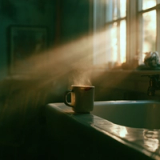
The mug was sitting in the stainless steel sink, unwashed, with her lip gloss still shining on the rim in a shade he could have named if anyone had asked, though no one was going to ask. Below the lip gloss, printed in bold letters, was her name above the logo of a local realtor — the kind of promotional mug that real estate agents leave on your doorstep in a gift bag with a refrigerator magnet and a note that says Thinking of selling? Call me! She had kept the mug. She had used it every morning. She had not taken it with her.
He picked up the mug and dropped it into the trash can under the sink.
Then he stood there for a moment, looking at the mug sitting on top of a banana peel and a wad of paper towels, and he reached in and plucked it back out and put it in the recycle bin by the back door. There were better uses for that cup than a landfill. The Pacific Northwest kid in him — the one who had been composting and sorting recyclables since before Atlanta even had a recycling program, the one who mowed three-quarters of an acre with an electric push mower because the ice caps were melting and someone had to care — could not, even in the first five minutes of his marriage ending, throw a metal coffee cup into the regular trash.
This, he thought, was either a sign of deep character or profound emotional dysfunction. He was not, at this moment, equipped to determine which.
The house was enormous around him. He had known this before — had known it every time he walked up and down its three flights of stairs, every time he mowed the yard, every time the air conditioning bill arrived in August like a ransom note from the Georgia climate — but he had not known it the way he knew it now, standing in the kitchen alone, the refrigerator humming its low, indifferent hum, every room in the house doing exactly what it had been doing five minutes ago, as if nothing had changed, as if the architecture had not received the news.
Lyrics
[Intro]

[Solo piano, simple chord figure, room tone, the sound of a house that has just gotten quiet]

[Verse 1]
There's a man inside the doorway
And the doorway doesn't know
That the life he held against it
Has been told to let it go
He is standing in the hallway
He is standing in the rain
That is falling in the kitchen
Of the house that used to know him

[Pre-Chorus]
And the question he can't ask aloud
The one he keeps inside
Is whether he was something taken
Or something left behind

[Chorus]
She didn't take the silence
She didn't take the years
She didn't take the person
Who had carried both their fears
She walked out the doorway
And he just stayed in place
And the thing she left behind her
Had a face she used to love
The thing she left behind

[Verse 2]
Now the work is his to carry
Every wall and every weight
Every choice she made together
He is making now too late
There's a lifetime in the closets
There's a marriage in the walls
And the man inside the hallway
Has to answer when it calls

[Pre-Chorus]
And nobody tells the one who leaves
The one who walks away
That the one who stays behind the door
Is the one who has to pay

[Chorus]
She didn't take the silence
She didn't take the years
She didn't take the person
Who had carried both their fears
She walked out the doorway
And he just stayed in place
And the thing she left behind her
Had a face she used to love
The thing she left behind

[Bridge]
But somewhere in the breaking
Of the man against the wall
A small forgotten quiet
Started rising through it all
Like a key inside a pocket
He'd forgotten he had on
Like a road outside the window
He had not been looking on
Maybe being left behind
Is the way that you get free
Maybe everything she didn't want
Was the everything of me

[Final Chorus]
She didn't take the silence
She didn't take the years
She didn't take the person
Who had carried both their fears
She walked out the doorway
And he just stayed in place
And the thing she left behind her
Had a face she used to love
The thing she left behind
The thing she left behind

[Outro]
The thing she left behind
She had taken one bag. One. A person’s entire presence in a life, reduced to whatever would fit in a duffel. The rest was still here. He could see it from where he stood — her jacket on the hook by the back door, a pair of Birks in the coat closet, a stack of mail on the counter that included something addressed to both of them in the way that banks address things to both of you, the bank not yet knowing yet that two lives had just split.
He walked through the house. He didn’t mean to — he didn’t have a destination — but his body moved through the rooms the way bodies do when the mind has temporarily suspended operations, and each room delivered its own small report. The living room: a throw pillow, the one with the quote about home that she’d bought at a boutique in Savannah, still sitting on the couch as if holding her place. The bathroom: her toothbrush. Standing in the cup next to his like a pair of parentheses with no sentence between them. The bedroom: the closet doors open, a few hangers empty, the rest still full. She had taken almost nothing. She had left almost everything.
He opened a drawer in the bedroom dresser that was hers and looked at its contents. Underwear. A scarf from a trip they’d taken — he couldn’t remember where, only that it had been cold and she’d bought the scarf in a shop they’d wandered into and he’d said it looked nice and she’d said “you think everything looks nice” and he’d said “that’s because I’m a Libra” and she’d said “that’s not how that works” and they’d both been right.
He closed the drawer.
In the hallway, he passed photographs. Framed, mounted, curated — a timeline of the life they’d built, or the life they’d performed, or both, depending on which version of the story you believed. Trips. Events. A candid shot of the two of them at someone’s wedding, laughing at something he couldn’t remember, looking like people who had figured it out.
He kept walking.
In the guest room, the closet held boxes she’d never unpacked from the last move. Her high school yearbook was in one of them — he knew this because he’d helped her carry it, and he’d made a joke about her senior photo, and she’d said something back that was funny, and the box had gone on a shelf and never been opened again. That yearbook was still there. Her childhood photographs were still in a box in the garage. Every object that connected her to who she’d been before they met was still in this house, and she had walked out with one bag, and what do you do with a person’s past when they leave it in your care without instructions?
He stood in the guest room surrounded by the things she’d decided weren’t worth carrying and tried not to notice that he was one of them.
Dixon didn’t know what to do with any of it. He would not know for months.
He went back to the kitchen. He opened a drawer — not a specific drawer, just the one nearest to where he was standing, the one that every kitchen has, the one that accumulates the sediment of daily life without anyone deciding it should. Inside: pennies. A lot of them. Dixon picked up pennies everywhere — sidewalks, parking lots, airport floors, the gap between couch cushions in other people’s houses — because his father had been superstitious in the way that some people are, deeply and without apology, and the superstition had passed to Dixon the way eye color passes, not by choice but by inheritance. One penny was one day of good luck. A nickel was five days. A dime, ten. The luck stacked. He kept a running tally in his head that he never shared with anyone because it sounded, even to him, like something a person should probably discuss with a professional. But the pennies worked. Or they didn’t work, and the belief that they worked worked, which was functionally the same thing.
The pennies were in the drawer, next to a handful of dead batteries, three charging cables for devices he might not still own, a twist tie, and a rubber band that had lost its elasticity and its will to live. This was one drawer. This was one drawer in a kitchen that had twenty-two drawers and cabinets, in a house that had five bedrooms and four bathrooms and an office with shelves that were too white and a garage with an electric mower and a yard with two creeks and three-quarters of an acre of grass that would continue to grow.
He closed the drawer. He felt sick. Not dramatically sick, not the kind of sick that announces itself and demands attention, but the low, persistent nausea of a man staring at a problem so large that his mind refused to render it at full resolution. Like trying to comprehend the national debt, or the distance to the sun, or the number of Saturday mornings he had spent mowing a lawn he’d never liked in a city he’d never chosen.
Because that was the thing. He hadn’t chosen Atlanta. He was here because of her job. His own work was remote: a laptop and a phone and the ability to feel what a room would do to the people inside it, and that gift worked from anywhere. His son Cash was in Portland, had been in Portland for years, living with his mother. Dixon had no family here. No roots. No reason to be in this house or this city or this state because the person who had brought him here had just walked out the front door with one bag and a level of decisiveness that said that she would not be coming back.
Where was he supposed to be?
He thought about Portland. He could move near Cash. But they’d lived apart for a decade, and Cash was finishing high school, and in two years he might not even be in Portland — he’d be at college, or traveling, or doing whatever teenagers do when the world opens up and their parents’ geography stops mattering. Moving to Portland to be near a son who was about to leave Portland had a circularity to it that even Dixon’s Aquarius Moon couldn’t romanticize into logic.
He thought about staying. Just staying here. In this big house with its big yard and its too-white shelves and its kitchen full of drawers full of things that didn’t matter. He could enjoy it. He could spread out. He could convert her office into something, and her closet into something, and fill the silences with music and dogs and the quiet satisfaction of a man who has an entire house to himself and doesn’t have to share the remote or negotiate the thermostat or hang the toilet paper in any particular direction.
But the astrologer’s voice was in his head. This is just the beginning. There will be more. She hadn’t said his wife would leave. She hadn’t said anything that specific. But she had said that nothing would look the same, and Dixon was standing in a kitchen that looked exactly the same as it had this morning, and that sameness — the aggressive, indifferent sameness of a house that doesn’t know its story has changed — was somehow worse than if the walls had crumbled.
As he looked around the kitchen, his life felt too big and too heavy to carry away to someplace else. But somewhere in the small of his back or the edges of his heart, he could feel the change that the astrologer had promised pressing against the walls of this house like water behind a dam. He could stay. He could hold his ground. He could grip the edges of this life with both hands and refuse to let it move. But water doesn’t care about hands. Water finds the cracks. And the longer you hold it back, the more it has to say when it finally comes through.
He also knew that things that are too heavy to carry away become someone else’s problem.
Dixon was the someone else now. He was going to have to be the one taking care of the things that were left behind. Dixon included.
And besides all of this Dixon hated moving. Hated it with a visceral, gut-level dread that he could not explain to people who found it a manageable inconvenience. Generally when faced with a move in his life he had been useless. Not unhelpful — useless. The sight of an empty cardboard box produced in him a paralysis that was comic in retrospect and genuinely debilitating in the moment. He could design an experience for ten thousand people across three continents, but he could not look at a kitchen full of drawers and cabinets and decide what went in which box and what got donated and what got thrown away without feeling like the task was specifically designed to break him.
Now he had an entire house around him that was decidedly not in boxes. All of it. Every drawer, every closet, every shelf. Every formerly shared object that now was exclusively his problem. And he knew, somewhere in the part of his mind that processed information he wasn’t ready to act on, that he would have to deal with all of it on his own.
He sat down at the kitchen table. The house hummed. The office glowed. And all of this stuff was going to have to be dealt with, but not today.
The trip to Portland had been planned for weeks. Dixon went to Portland every six weeks or so to spend time with Cash. Thankfully, a neighbor — the kind of neighbor who existed in suburbs specifically to watch dogs on short notice and had opinions about your lawn care schedule — offered to watch the dogs, Puddles and Magnolia, while he was going to be away. Dixon packed a bag, noted the immense amount of stuff still in his closet after he packed the bag, and took a Lyft to the airport.
He was going to tell Cash. He had decided this on the drive — that he would sit his son down and explain, calmly and with the steadiness that was his gift, that things at home had changed. He had rehearsed the opening line. He had thought about the follow-up questions Cash would ask and the answers he would give and the tone he would maintain, because Dixon could design an emotional experience, and this was going to be an emotional experience, and he was going to get the lighting right.
He did not tell Cash.

Lyrics
[Intro]

[Verse 1]
Hey son, I've got some news to share
I'm gonna tell it to you straight because I know that's only fair
Tara's gone — she left without a word
Didn't say goodbye to me, and I know that must sound absurd
She didn't say goodbye to you, and that's the part that stings
But some people leave in silence, son, that's just the way it rings

[Verse 2]
Now I've got to go away a while, I'm not sure where I'll be
Somewhere out beyond the basin, trying to find a part of me
You won't see the house again or play out in the yard
I know that's a lot to hear, and I know that change is hard
But there'll be new places, son, new ground beneath your feet
And every mile I travel out, I'm closer to complete

[Chorus]
So don't be scared, don't be scared
I know it feels like everything just came apart
But you're the strongest thing I've ever known
And you're the best thing in my heart
I might be underneath the western stars
Trying to find where I belong
But you and me, that's the one thing, son
That'll never come undone

[Verse 3]
You've always been the bravest boy, much braver than your old man
Smart enough to know this hurts, strong enough to understand
She might have torn some things apart when she walked out that door
But she can't take the love I have — that isn't hers anymore
That's ours, son, that's just ours, built before she came
And it'll still be standing long after I forget her name

[Chorus]

[Verse 4]
My daddy roamed the oceans, and he still always loved me
Now I'll be roaming the basin, chasing who I'm meant to be
I'll sleep out under canyon walls and wake up to the sky
And I'll think of you each morning, son, before the sun gets high
Keep being good to your friends, keep doing what you do
And anytime you miss me, kid, I'm only a phone call through

[Bridge]
I won't pretend this doesn't hurt
I won't pretend I've got it figured out
But I have walked through wreckage before
And I know what the other side's about
Sometimes the road is how you heal
Sometimes the leaving is the start
And I'll carry you with me every mile
You're the truest thing I've got, you're the map inside my heart

[Verse 5 — The Compass]
Now when you're lying in your bed and the night feels way too wide
Look up at the compass that I painted on your ceiling, let it be your guide
Remember what it says underneath — not all who wander are lost
And your old man might be wandering, but I'm worth the cost
I'll be southwest of you, son, out where the desert meets the sky
And every time you trace that compass, know I'm underneath the same moonlight
So point your finger to the southwest, whisper something if you want
I swear I'll hear you on the wind, son, all the way from where I'm at

[Chorus]
So don't be scared, don't be scared
I know it feels like everything just came apart
But you're the strongest thing I've ever known
And you're the best thing in my heart
I might be southwest underneath the stars
Learning how to find where I belong
But you and me, that's the one thing, son
That'll never come undone

[Outro]
Just look up at that compass, son
And know I'm never really gone
Southwest of you, beneath the stars
Your old man's just finding who he is
The song "Hey Son," is written much later, but relates in part to this portion of the story.
He didn’t tell him because the moment he saw his son — seventeen, taller than the last visit or maybe just standing differently, with that easy grin that was Dixon’s grin on a younger face — the words rearranged themselves in his chest and none of them would come out in the right order. It wasn’t real yet. If he said it out loud, it would become real. He also knew he would cry. He was definitely prone to crying. If he kept it inside, on the other hand, it was still just a thing that had happened in Atlanta, and maybe — and he knew this was not rational, knew it the way you know the penny thing is not rational but you pick up the pennies anyway — maybe she would come back. Maybe the bag was temporary. Maybe the wave hadn’t finished yet.
Cash knew something was wrong. Cash always knew. He had his father’s intuition, the same ability to read a room, to feel the temperature of a conversation, to sense the distance between what someone was saying and what they meant. They had been through this before. When Dixon had left Cash’s mother, Cash was three, and he had navigated that transition with a grace that surprised everyone except Dixon, who had decided that his son would be fine and had then made sure, with the full force of his Virgo precision, that this was true.
“You good, Dad?”
“I’m ok, son. There’s just some things I need to work out.”
Cash looked at him for a beat longer than the words required. Then he nodded and said, “Want to get Indian food?” and Dixon said yes, and they got Indian food, and they talked about school and a video game Cash was playing and whether the rain would ever stop in Portland, and underneath all of it — the Tikka Masala and the easy laughter and the comfortable silence of two people who love each other without needing to perform it — they both understood that something had shifted and that Dixon would share it when he was ready and that pushing would not help.
Cash did not push. Out of respect for his father’s privacy, and also out of the particular wisdom of a young person who has already survived one parental split and knows that the adults will figure it out because the adults always figure it out, even when figuring it out looks from the outside like falling apart.
The sky train at Atlanta’s Hartsfield-Jackson International Airport runs on a track between the terminals, and the doors open and close with the mechanical indifference of a system that moves two hundred thousand people a day and does not care about any of them.
Dixon was standing in the train on his way out of the airport when he saw it: a penny. Sitting in the door track of the train, wedged in the metal groove where the doors slide shut, heads up, catching the fluorescent light.
One penny. One day of good luck. Sitting right there.
He looked at the gap. He looked at his fingers. He looked at the digital sign that said the train was now departing. The penny was in the track, in the exact groove where the doors closed, and getting it out would require either very thin fingers or a willingness to lose the fingers he had, and Dixon was a man who needed his fingers for storyboards and the occasional kerning adjustment that no one else would notice.
He left the penny.
He stood on the train as it carried him to baggage claim and thought about what it meant — or didn’t mean — to leave that penny. For him anyway. The way he stacked his good luck days. Was this tempting fate to leave a penny behind like this? He went through the list in his mind and couldn’t recall finding any pennies lately. His rational mind, the Virgo part, said it meant nothing. It was just a coin in a track. It was one cent of United States currency in a mechanical groove, and the universe did not communicate through loose change found in public transit systems.
His father’s mind, the part of him that turned the car around for black cats and stayed indoors on Friday the thirteenth, said something else entirely.
The Lyft driver was playing something soft on the radio — R&B, maybe, or gospel, something with the warmth of a music genre that believes things will work out — and Dixon was watching Atlanta scroll past the window when his phone rang.
His boss. The tone was the particular kind of upbeat that corporate executives deploy when they are about to tell you something they have already decided is good news regardless of your opinion on the matter.
“Dixon, great news. We’re moving you to the integration team for the acquisition. New division, more ‘sphere’, whole new group of people. This is going to be great for you.”
Sphere. Dixon let the word sit in his mouth like a piece of food he wasn’t sure about. More sphere. He understood this was meant to convey expanded influence, broader scope, the kind of professional growth that looked excellent in a year-end review. The acquired company was based in Detroit.
Detroit.
Although the world was suddenly his oyster so to speak, he was not moving to Detroit. He was absolutely not moving to Detroit. The universe could communicate through pennies in train tracks and through astrologers in Hawaii and through every other channel it preferred, but it was not going to communicate through a corporate acquisition that landed him in Detroit. No. That was a bridge too far.
“Congratulations,” his boss said again, with the cheerful certainty of a person who has just given you a gift and does not need to see you open it. “This is going to be great.”
Dixon thanked him. He hung up. The Lyft made a turn. Atlanta continued to exist outside the windows, green and humid and completely unaware that one of its residents had just lost a wife, gained a promotion, and been assigned to a city he would never live in, all in the span of two weeks, and that an astrologer in Hawaii had predicted the whole thing and he hadn’t really believed her because the shelves were full and the lawn mower was charged.
The garage door went up and the space where his car should have been was empty.
Dixon sat in the Lyft for a moment, looking at the empty parking space. His convertible — the fast one, the one he loved, the one Cash learned to drive in, and the one that gave him a particular thrill on a random Tuesday afternoon — was gone. In its place was the Land Rover Discovery, parked where it always was, looking solid and British and fundamentally unreliable in the way that only a vehicle with excellent engineering and terrible quality control can manage.
There was a note on the back window of the Land Rover. Not on the kitchen counter. Not on the door. On the back window of the car, as if the Land Rover itself were the messenger and deserved to know first.
The note said she had decided it was better to take the Audi and leave the Land Rover. He would understand.
Dixon stood in the garage and read this twice. His little fun car — the one he’d driven, the one that started every time and didn’t make sounds that required interpretation — was gone. In its place, a Land Rover Discovery that she had convinced him to buy after he’d sworn, decades ago, after owning one the first time, that he would never own another one. “Maybe you’ll have a different experience this time,” she’d said. He hadn’t. The thing had spent more time in service bays than on roads. The waiting room of the Land Rover service department had the feel of a therapy group, its aggrieved owners sharing their tales of blown engines and strange noises. There was a clunking sound in the rear axle of what was now his car, that three different mechanics had failed to diagnose, and every time he drove it he could hear the clunk saying to him: you knew better and you didn’t listen.
An unreliable and unwanted vehicle had been left-behind. Which was, if you thought about it — and Dixon tried not to think about it — a pretty concise summary of the whole situation.
He walked into the house. The neighbor was in the kitchen — the neighbor who was watching the dogs, who was now standing by the counter with the expression of a person who has information they’re not sure they should share and has decided to share it anyway because the silence is worse.
“So, she came by while you were gone,” the neighbor said quietly.
Dixon waited.
“She picked up Puddles. And some things from her closet. Those shoes she loves — you know the ones.”
Dixon knew the ones.
“I wasn’t sure if I should. I mean, she had a key, and she said it was fine, and I didn’t want to…”
“It’s fine,” Dixon said.
The neighbor left. The house was quiet again. Not the wave-crash quiet of that first afternoon, but something different now. Something that had settled, the way sediment settles after a storm, everything landing in a new configuration that would take time to read.
Puddles was gone. The little dog with the ridiculous name. A dog named by a little boy as little boys are prone to name their dogs. She had come for the dog and the shoes. Not the yearbook. Not the photographs. Just the dog and the shoes. Perhaps these were the things that fit in a convertible sports car, alongside whatever else she had decided constituted a life.
Magnolia was sitting on the couch, looking at Dixon with the patient, slightly worried expression of a dog who has noticed that the household headcount has decreased and would like some information about the timeline for its restoration.
Dixon sat down next to her. She climbed into his lap immediately, the exact place she typically liked to be, and he put his hand on her back and felt her breathing and looked at the living room, which was the same living room it had been three weeks ago, the same throw pillow with the quote about home, the same photographs on the wall, the same everything, except that the everything was now his, all of it, every drawer and every shelf and every object that had once belonged to them and now belonged to a man sitting on a couch with a dog who was looking at him as if to say: what now?
He didn’t know.
He thought, for a moment — and he would be embarrassed by this later, but he was not embarrassed by it now — that maybe she would come back. Maybe the bag and the car and the dog and the shoes were a statement, not a conclusion. Maybe this was the kind of leaving that has a return built into it, the way some storms circle back.
He knew she wouldn’t.
He knew it the way he knew things professionally. He knew it the way he could walk into an empty room and feel, in his body, what it would become. He could feel this room becoming something he didn’t want it to become. He could feel the future of this house: the estate sale, the strangers with price tags, a woman named Brenda from Marietta who would sell his brass telescope for eight dollars. And he could not stop it. Because this was not some event he was designing. This was simply happening to him. And his gift, his extraordinary, specific, irreplaceable gift for seeing what a space would do to the people inside it, was, for the first time in his life, pointed at his own life, and what it showed him was a room getting emptier.
The air conditioner hummed. Magnolia breathed softly. Outside, the lawn was growing. The mower was in the garage, batteries on the charger, ready to be put to work. The white shelves were still glowing in the late afternoon light, and every single thing in this house would soon be too heavy to carry with him when he left.
Somewhere in the airport, in the door track of a sky train, a penny sat heads-up in the fluorescent light, waiting for a hand that wouldn’t come.
One penny. One day of good luck.
Dixon could have used it.
Published April 24, 2026 from the road in Utah.
Enjoying the story? Support the work →
All text, images and music copyright (2026), Slightly Moody Creative LLC and Joe English.