The Sit Boy · Chapter 4
Bobby's Parade

It had been twelve weeks since the door closed and the house fell silent.
Twelve weeks, and Dixon had packed exactly one drawer.
The drawer in question was the same drawer he had opened on the day she left and it now lived in a labeled cardboard box in his office, sealed with packing tape, waiting for instructions Dixon had not yet provided. The other twenty-one drawers in the kitchen were as they had been. The garage was as it had been. The basement waited for his attention. The closets continued to be full. Dixon was not quite ready to face the mountain of challenges ahead of him and he seemed to be the only thing in the house that was, somehow and in some way, very lightly different. His brain was grappling with the dual ideas that his life had radically changed, but that there was much more to come.
It was a Sunday in October, and Sundays were the worst for him. Sundays were the days when normal people did things like going out to a fancy brunch or making plans to see other people, or staying in and reading the news, or, at the very least, making a list of things they planned to accomplish in the coming week. Dixon did none of these things. Dixon stood in his enormous kitchen and looked at his sous vide machine, which had not been used in eleven of the twelve weeks. He looked at the smoker on the upper back deck, which had developed a sad thin layer of dust. He looked at the espresso machine, with all its levers and gauges, which he had bought on a whim in case he had company. But he’d had no guests, so it sat unused in its brand new Italian fanciness. This stirred some deep feelings in him about why he had added to the already long list of items that might sometime soon need to find new homes.
He didn’t even have the lawn mowing to do, because it was October and his normal weekly backyard rituals were on hold until next spring when the grass and the flowers and bushes would start to grow again. This was a classic Atlanta irony. There are times when it is cool and pleasant, even cold, and those are definitely not the times when things grow. At this very, extremely, quiet, moment, he wouldn’t have minded pushing the mower around the yard and changing its batteries and swatting at a few bugs on his neck.
He most certainly did not think about the garage. The garage held horrors he was not ready to face.
Magnolia was resplendent in her fall fluffiness. Dixon was allowing her coat to grow out in the cool weather. She still seemed to have all of her normal cat-like ambition. She was on the kitchen counter in violation of approximately four house rules, rules that probably no longer existed. She was watching Dixon think. Magnolia was an excellent watcher of thinking. She did not interrupt. She did not offer suggestions. She simply observed, with the patient confidence of a creature who has determined that her human will eventually feed her and that the rest is just all human stuff.
“I have to get out of here,” Dixon said to her.
She blinked.
“Yeah,” he said. “I think so too.”
The pub on West Paces Ferry was the kind of place that had committed completely to its concept and then doubled down. Dark wood. Union Jacks. A chalkboard listing things called “puddings” that turned out to be desserts. A man behind the bar who spoke with a heavy Manchester accent who Dixon strongly suspected had been born in Sandy Springs or one of the other Atlanta suburbs. The patio was the size of a small parking lot, scattered with low couches and outdoor armchairs grouped in conversational arrangements, bordered by string lights that came on at dusk regardless of the season, because Atlanta’s relationship to “outdoor” was a year-round commitment.
Dixon had discovered the place a few weeks earlier. What had kept him coming back was the non-alcoholic beer list, which was extensive and included a Belgian-style witbier that was, against all reasonable expectations, very good. He had discovered over the past three months that there is a real shortage of places for adults to go alone in public without it involving alcohol or American football. Coffee shops were one option, but Dixon could only consume so much decaf, and people seemed to relish the privacy provided by their headphones and laptops. The pub was the option he liked, because the people were social and he could sit with what at least appeared to be a beer in front of him, helping him visually fit in with the crowd. He had somehow become a regular.
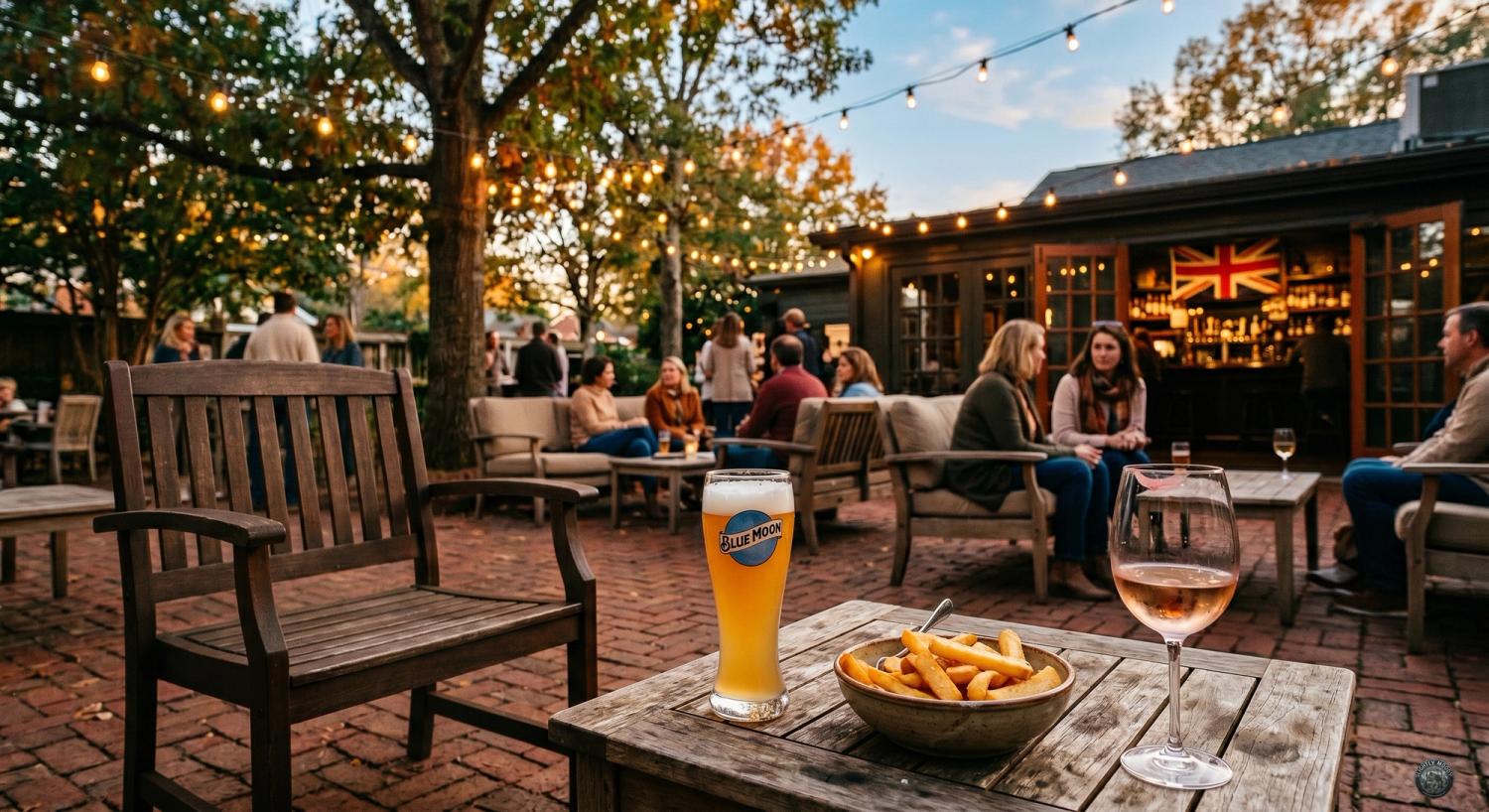
He took a couch in a remote corner of the patio, ordered the witbier and a bowl of what the menu confidently described as “proper chips,” and tilted his face toward the sun. He had a book in his bag. He had no intention of opening it. He was just here. Just out. Just adjacent to other people, trying to feel a part of something.
“Excuse me, do you mind?” said a kind female voice.
He opened his eyes and saw a young woman gesturing to one of the armchairs facing him, indicating that she wanted to sit in his seating pod, which of course, was not ‘his’ by any means, but the politeness touched him.
She was standing at the edge of his cluster of furniture with the careful smile of a person preparing to be told no. Mid-twenties, maybe twenty-eight. Long flowing curls that had been arranged to look like they had not been arranged. The kind of makeup that had clearly required forty minutes and was meant to suggest the absence of makeup. A light-blue linen jumpsuit. Brown tortoise-shell sunglasses pushed up into the curls. Atlanta embodied in a person.
“Lots of groups around,” she said, gesturing vaguely at the patio. “Sometimes it’s hard to find a place to fit in at places like this, you know?”
Dixon did know. “Of course,” Dixon said, smiling at her warmly. “Welcome to my little corner of the world. Make yourself at home.”
She settled into the armchair opposite him with the practiced ease of someone who had practiced ease. She set down a glass of rosé. She held out a hand.
“Heather.”
“Dixon.”
“Dixon,” she repeated, with the small surprise of a person registering an unusual name. “Like the Mason-Dixon line.”
“Yeah, sure, like that. Yes.” To Dixon this was a tell that she was from the South. The Mason-Dixon line is burned into the memories of a certain set of traumatized white Southern families. He suspected that someone in Oregon or California would not have so quickly made that pairing with his name.
“I love that. That’s a real name. People around here are all named, like, Kayden or Todd. I’m Heather and that’s bad enough.”
He smiled, which surprised him a little. He had not smiled in a way that involved actual face muscles in some weeks, and the muscles felt like they were doing something they had been forced to remember.
What followed was a conversation that Heather drove the way a competent driver drives a manual transmission: smoothly, with confidence, hitting every gear at the right speed. Where was he from? The Pacific Northwest. Oh she’d done a year at Reed before she transferred. Did he have kids? One son in Portland, who was actually thinking about going to Reed. Oh that was so cool. What did he do? Live events. Like, concerts? Sort of. Sometimes. Usually bigger and more involved. Definitely not weddings. Amazing. Did he like art? Yes, very much, he was a designer by profession. Amazing. Was he single?
This made Dixon catch his breath very slightly. He cocked his head to one side and then looked off into the distance a bit. He didn’t quite have an answer at the ready.
“My circumstances,” he said haltingly, “have recently changed.”
She held his eyes. She did this thing where she kept her eyes on his for a beat longer than strictly necessary. The beat where conversation could become something else. The beat where a person communicates to another person that they have noticed them as a person. Dixon had not realized until she had taken that beat how much he had missed being seen.
Dixon felt, somewhere underneath all the rubble of the last three months, a small, stupid flicker of interest. He felt his face do something. He felt a part of himself that he had assumed was on a long sabbatical, raise its hand and say, oh, hello, I’m still here, I was just over here in the corner sulking.
And then Heather looked over his shoulder, lit up, and waved with her whole arm.
“MOM. Over here,” she said loudly enough that most of the people in the patio looked to see whose mom was being hailed like a New York City taxi.
Dixon, internally: excuse me what?
A woman came across the patio toward them at a clip that could be described as an extremely athletic walk and might honestly have been a low-grade jog. She was in her mid-fifties. She had excellent posture. Her outfit was “SoulCycle,” but her immaculate blowout suggested she had not been cycling recently. She was beaming about two settings higher than would be suggested by seeing one of her own offspring.
“Hi sweetie, big line at the bar inside,“ she said, arriving at the chair next to Heather’s and lowering herself with that easy nature of a Southern woman who was used to entering rooms easily. “Hi, I’m Jennifer,” she said with her hand outstretched to Dixon and making very direct eye contact with him at the same time. She was looking into his eyes the way one looks at a slice of cheesecake or a cold beer on a hot day. Like she wanted to gulp him down.
“Hi. . . Jennifer,” Dixon said. He was processing. He was processing this whole scene very slowly.
“Mom, this is Dixon,” Heather said brightly. “He’s single.” She practically winked at her mom.
There was another long beat, but this time between the three of them and only two of them seemed to be on board.
“His circumstances have recently changed,” Heather added, with heavy emphasis on the last word and with the helpfulness of a person spelling something out for a third-grader.
“Oh,” Jennifer said. “Oh my, recently you say?” She gave her a concerned look. In a much lower tone, directed solely at her daughter, she added “We talked about this honey.”
Heather’s shoulders lowered a little bit, after being chastised . . . by. . .her . . . mom. “I was just confirming, Mom.”
Turning back in Dixon’s direction and resuming the whole eye-contact thing, she said assuredly and firmly, “Recently is fine. Recently is, of course, totally fine. I love your watch.”
“Thank you,” Dixon said.
“Okay I’m gonna go get a drink,” Heather said, already in motion, “and you guys are gonna chat. Mom, behave. Dixon, it was such a pleasure meeting you. Have fun you two.” She walked away with the unhurried pace of a person who had completed an assignment and maybe felt deserved a little more recognition for her work.
Jennifer tilted her head. “She’s a piece of work,” she said warmly. “But she means well. So tell me about yourself.”
Dixon said something about himself. He could not, later, remember exactly what. His brain was running diagnostics on the previous ninety seconds and not paying attention to the sentences his mouth was producing. He had not, he now understood, been the person Heather was approaching. He had been the target of Heather’s assignment. He had been screened, cleared, and presented to the actual client, her mom. He had walked into a transaction without realizing he was the merchandise on display. He rolled the word ‘mom’ around in his brain.
Jennifer, to her credit, was lovely. She had been divorced for six years. She was a pediatric dentist. She had a Tesla and a beach house on the 30A. She did not need anything from anyone, which she said several times with great pleasantness in case Dixon was uncertain about it. Dixon liked her. Dixon was not, he was absolutely sure, within one minute, going to date her.
He stayed for about twenty minutes, because he had been raised properly, and then made an excuse to leave. He did not get Jennifer’s number, or her email, or her Instagram handle. He just departed and then he drove home in the Land Rover, which made the clunk on the entrance ramp and the clunk again on Roswell Road. He really did not know whether to laugh or cry, and so he did neither, and instead he texted Bobby.

Lyrics
[Intro]

[Spoken]
They tell you to get back out there. They forget to mention you're not sure where you went.

[Verse 1]
There's a door I cannot reopen
And a silence in the hall
There's a stranger in the mirror
Who almost answers when I call
I rehearse the easy answer
For a question no one asks
Just a few well-chosen syllables
To soften where it cracked

[Pre-Chorus]
And the night is full of faces
And the faces turn to look
And I wear a borrowed smile
Like a sentence from a book

[Chorus]
Tell 'em my circumstances have recently changed
Tell 'em the version that you knew has been rearranged
Pour me something pretty, point me toward the floor
I'm back among the living and I'm not too sure what for
My circumstances have recently changed
My circumstances have recently changed

[Verse 2]
Caught somebody's eyes across the room
Held a beat too long
And a piece of me I thought was buried
Raised a hand and said still strong
Then the part of me that knows the world
Whispered careful what you find
'Cause the looking always feels like love
When you've spent the season blind

[Pre-Chorus]
And the world is full of mirrors
And the mirrors full of light
And I'm telling them my story
Like it isn't mine tonight

[Chorus]
Tell 'em my circumstances have recently changed
Tell 'em the version that you knew has been rearranged
Pour me something pretty, point me toward the floor
I'm back among the living and I'm not too sure what for
My circumstances have recently changed
My circumstances have recently changed

[Bridge]
I'm not the boy I used to be
I'm not the man I'll find
I'm somebody in the middle
Trying not to lose my mind
I've been a half-remembered chapter
In a story I forgot
But I'm stepping through the doorway now
With whatever I have got

[Final Chorus]
Tell 'em my circumstances have recently changed
Tell 'em the man you used to know has been rearranged
Pour me something pretty, point me toward the floor
I'm back among the living and I'm gonna find out what for
My circumstances have recently changed
My circumstances have recently changed
Welcome to the show
Welcome to the show

[Outro]
Tell me about this parade idea. How would it actually work.
The three dots started immediately. Then the three dots stopped and his phone started ringing.
“Okay,” Bobby said, “first of all, I’m putting Brooklyn on. Brooklyn, you there?”
“I’m here,” Brooklyn said.
“Brooklyn is here. Dixon, you’re on speaker. Tell us everything.”
He told them everything. He told them about Heather and Jennifer and the SoulCycle outfit and the rosé and the moment he had remembered what interest felt like and the moment he had realized the interest had not been pointed at him. He told them how he felt and they listened in the way they listened, which was Bobby interrupting six times and Brooklyn not at all.
When he was done there was silence on the line.
“That,” Bobby said, “is the most Atlanta thing I’ve ever heard.”
“It’s actually kind of sweet,” Brooklyn said. “Heather. What a sweet kid. Trying to find her mom a single man over fifty. It’s apparently very hard. I have read studies. . .”
“It’s not sweet, Brooklyn, it’s unhinged.”
“Bobby.”
“Dixon, listen to me. Listen carefully. We need to take control of this situation. We cannot have you wandering around Atlanta being ambushed by the wing-women of the single ladies. That is just not going to work. What you need. . .”
“. . .Bobby. . .”
“What you need, Brooklyn, hold on, what you need is the parade.” He gestured grandly in the air in a manner that no one on the line could actually see. He landed on the last words like they meant: ”trademark, copyright, all rights reserved, limited usage granted, by Bobby, for Dixon’s sole usage. And this was all my idea.”
“Oh god. Here we go” Brooklyn said emitting great exasperation toward her brother.
“A parade! I called this; I called this at brunch!” he said even more animated now. “What you need is choice. You need a big sampling of what’s out there. You need hot, weird, tall, short, smart, smarter, an actress, a trainer, maybe a comedian or something, somebody who knits, a . . . a . . . a novelist! Think of the single scene. . .like a buffet. I mean, how can you possibly choose until you taste a few of the dishes in front of you.” He was very pleased with this analogy.
Dixon thought about the amount of food that gets wasted at buffets. In his self-effacing mind, he didn’t really want to risk being tossed away with the remnants of the too soggy caesar salad or the overly salty salmon. But he did get the analogy.
“Bobby, that is the worst dating advice I have ever heard,” Brooklyn said. “Dixon, do not listen to him. Dixon, what you need is to date with intention. Women are not objects to be sampled. You date one person at a time. You date with a clear sense of who you are and what you want. You meet a person of quality . . .”
“Quality?” Bobby said. “Brooklyn just said quality?“ He said this with a tone that was just a hair shy of mocking.
“. . .and you let it unfold the way these things are supposed to unfold.”
“What does ‘quality’ mean?” Dixon asked. He was really asking, because he wanted to know what she had in her head when she said it.
“It means,” Brooklyn said, “an established person. A person with a life. A person with a job and a home and a sense of who they are.”
“You mean older,” Dixon said.
“I mean established.“
“Older,” Bobby translated. “She means older.”
“I mean,” Brooklyn said evenly, “that the women your age in Atlanta who have figured out their lives are the women in their late forties and fifties, and they are extraordinary, and you should be open to them.”
Bobby said: “Older is correct, what Brooklyn is saying is older. I am open to that, by the way. I am open to anything at this point. My buffet analogy still holds. You should sample older, AND YOUNGER! Dixon, you should be open to anything here. What I am opposed to is doing this slowly. We don’t have time to do it slowly. You are back on the market, baby and the market is competitive and you need to move.“
“For God’s Sake, Bobby. Sometimes I can’t believe we came out of the same womb.”
“Brooklyn, listen, I’m not saying he runs out and fuckin’ gets married. I’m saying he goes to the parade. He rides on some of the floats. Maybe he even has a little fun for a moment. He’s suffered, remember? The parade is for meeting people, he learns from the parade, and then he dates with intention. The parade is the training montage.“
“That is not what intention means, Bobby.”
“Guys,” Dixon said.
“Yes,” they said simultaneously.
“What if you both just. . . picked people for me,” he was already feeling this was a bad idea as the words came out of his mouth, but he continued on. “I’ll make a dating profile on some apps and you can pick some people for me. And I will go out with them.” He stopped talking. He could sort of feel the room spinning. He knew this was going to be a bad idea, but he also agreed with Bobby. Time was of the essence. He was under pressure to figure out what to do with the house and where to live. He needed to get a move on. And he didn’t even have the lawn to mow on the weekends. He was in. Yes, he felt sick, but he was in.
A moment passed. The twins each processed the challenge with the speed, and the desire to win, of two truly competitive people.
“I’m in,” Bobby said.
“I’m in,” Brooklyn said.
If they had been in person, they probably would have forcefully shaken hands.
“Oh lord,” Dixon said.
Writing the dating profile was its own experience.
Dixon sat at the kitchen island with his laptop open and Magnolia in his lap and discovered, as he scrolled through the prompts the app provided, that he did not know what to say about himself. He knew what to say about himself professionally. He had been writing professional bios for twenty years. Those came out of him fully formed. Dixon Davie is a creative director with two decades of experience designing immersive live event experiences for. . . No. Not that. That was not what these prompts were asking.
What did he like to do on weekends? He liked to do mostly solitary things. He ran and rode his bike. He liked to walk and hike. He liked to take pictures of things. He liked to sit somewhere quiet with a coffee. He liked art, and movies, and reading. All of this made him, at least to himself, sound a bit like a recluse.
What was he looking for? He did not know what he was looking for. Definitely not a Scorpio.
He typed: Honestly not sure yet.
He deleted it. He typed: Curious to find out. Scorpios need not apply.
He left it at that.
He answered the rest of the prompts the way a person fills out a form at a doctor’s office: accurately, briefly, with the suspicion that the nurse will ask you the same question herself later. He uploaded three photographs that the twins had vetted by text. He set the age range and immediately reconsidered it. He had already set the lower limit at an age that was far too low. Dating someone younger was a stereotype that he was willing to participate in if there was interest on the other side. It was the upper end that he was looking at with suspicion. He initially set this ten years younger than himself. He did this because he was constantly being told that he looked and acted much younger than his age. He had the musical taste of a teenage girl for one thing. He moved the upper limit slider up to five years younger. He blinked at the screen. He asked for Magnolia’s opinion. She didn’t seem to have one. He moved it up again to ten years over his age and then stopped fiddling with it.
He was thinking, with a growing degree of self-awareness, about whether he might in fact want what Brooklyn had euphemistically called “established.” He would very much like a person that would be a true partner. A person with whom to be equals in all things and adventures big and small. And the thought that they might be financially secure didn’t sound too bad. A someone with a house and maybe a large pool. Yes, a pool would be nice. He thought that lying by a pool in Buckhead, maybe while someone else worked, didn’t sound too bad. He’d always been the responsible one. He was frankly somewhat tired. Maybe he could be the +1 for a change. Why couldn’t that be a thing? He had always been wildly progressive and the idea of turning gender-role stereotypes on their heads rang very true with him. Why couldn’t he lie by someone else’s pool in this next chapter? That could maybe be a thing. Then he reached the ultimate point in this thought train: I am a person who is currently considering becoming the kept partner of a wealthy older woman, which is a sentence I would not have imagined six months ago, and which I am, for the record, not laughing at right now.
He left the upper bound where it was, with ample room for an older, potentially wealthy woman, to potentially share her pool with him.
There was one more thing. He typed it into the message he had drafted to Bobby and Brooklyn, because he wanted them to know going in.
One ground rule: For me, dating with intention means not moving too fast. I’m not ready for sex yet. It’s just too soon. So if that’s a problem for someone, that’s a hard stop. Pass them by.
Bobby: Fuuuuuccckkkk!!!!
Brooklyn: Good for you. I respect that.
Bobby: OK, I will deal with my disappointment in my own time. But man, some of these women are going to lose their minds. You’re a catch dude. Let’s do this.
Dixon didn’t know how to respond to that. But Bobby was correct. Some women were going to lose their minds, just not in the way Dixon imagined. Dixon might too.
The first pick went to Brooklyn, by virtue of a series of coin tosses and some Rochambeau.
“She has a doodle,” Brooklyn said brightly. “His name is Theo. He’s the same size as Maggie. You already have a thing in common. It’s a good starting point.”
Her name was Caroline, not Carolynn, Dixon was warned. She was a financial analyst at a consulting firm whose name was three initials which was enough for Dixon. She suggested they meet at a place in West Midtown called Bark + Bourbon, which was — and this was a real thing and Dixon could not stop thinking about how real it was — a singles dog park with a full bar and four flat-screen televisions tuned to college football. Atlanta, Dixon thought, so, so very Atlanta.
He arrived with Magnolia under his arm. He was wearing a nice hoody, which had a pass-through pocket in the front. This is where Dixon had stashed some of Moo Moo’s favorite treats. Dixon called Magnolia Moo Moo sometimes, because she ate with the vigor and enthusiasm of a cow. Caroline was already there in the fenced area with a small caramel-colored doodle who was, indeed, almost exactly the same size as Magnolia. The doodles regarded each other with mild interest. Caroline regarded Dixon with somewhat more interest. They sat. They started a conversation about something that he could not, afterward, remember.
What he could remember, in vivid detail, was what happened next.
The first dog appeared at his knee within about forty seconds. A large goldendoodle. Tail sweeping frantically back and forth. Eyes large. The dog put its face on Dixon’s thigh and looked up at him with the unconditional adoration of a creature that has decided this is its human now. Dixon scratched its ear and gave him one of Moo Moo’s treats. He kept talking. He said something to Caroline about what she did at the consulting firm, and she said something back, and a second dog arrived. A Vizsla. The Vizsla put its head on his other thigh. Then a third, a beagle mix, leaned against his shin. Then a fourth, which was a small terrier with a bandana, climbed directly into his lap, displacing Magnolia, who responded with the icy indignation of a dog who had been demoted in the pecking order of her own life. Dixon picked Magnolia up into his arms, cradling her like a baby. He continued to talk to Caroline, who had stopped talking and was now watching him with an expression he could not entirely read.
A woman appeared at the gate. “Sorry,” she called, “is my little guy bothering you? He’s the one in the bandana. Sorry, hi, I’m Lauren.” She was looking at Dixon, not at Caroline. “That’s so weird, he is never drawn to strangers like that,” she said with a warm note that headed in the vicinity of enchanted wonder.
“He’s fine,” Dixon said. “It’s no problem.”
“You’re a dog person,” Lauren said. It was not a question. “I can always tell.”
“I’ve got mine right here,” Dixon said, indicating the increasingly aggrieved Magnolia who had now wiggled her way up onto one of his shoulders with her paws over onto his back and her head next to his ear.
“She’s adorable,” her enchantment continuing, now looking deeply into Dixon’s eyes, ignoring Caroline to the utmost extent possible.
This sequence, with minor variations, occurred four more times in the course of forty-five minutes. Five more dogs found their way into Dixon’s general vicinity. Three more single women appeared at the fence with the same approximate version of the same approximate question. Caroline did not look at her phone exactly, but she looked at her watch in the way that people look at watches when they want a watch to provide them with an exit strategy. By the end of the date, Dixon had one hundred pounds of assorted dog draped across various parts of his body, all of Magnolia’s treats were gone, Magnolia had relocated to the back of his shoulders, and Caroline had said the word interesting a number of times that suggested she had stopped being interested.
They parted cordially. Caroline did not text him.
Bobby: How’d it go?
Dixon: I made eight friends. Carolynn was not one of them.
Brooklyn: Oh sorry. You didn’t call her Carolynn did you? She really seemed really nice.
Dixon: She was. But I had a whole ‘pied piper’ thing going with the dogs. And I guess the dogs’ owners too. Maybe it was Maggie’s treats. Anyway, what’s next?
Bobby: MY TURN!!!
Bobby’s initial pick had bright green eyes.
This was the first thing Dixon noticed about her. The second was that she was, by any reasonable measure, beautiful in a way that did not appear to be available through normal human genetics. There was a stillness about her face. The makeup was minimal and exact. The hair was long and light brown and looked, even indoors, like it had been arranged by a passing breeze. Every man at the small wine bar in Inman Park had noted her arrival and then pretended he had not.
Her name was Sasha. She was an attorney. She was reading a book, not a phone, when Dixon arrived. The book was about the story of Pallas Athena and her place in astrology.
“I appreciate that you didn’t pretend to keep reading when I came in,” Dixon said, gesturing at the book.
“Why would I pretend?” she asked sincerely.
“Oh you know, some people just want to look cool when they’re meeting someone new.”
“Well, I’m not most people.” She put the book in her bag. “Tell me about you.”
She listened to him talk the way certain people listen, which was intense and extractive as if she were mining a vast amount of information from the conversation. They talked about his work. They talked about her work. They talked about Atlanta, which she liked, and about Savannah, which she loved. Halfway through the first hour she said, with the same evenness with which she had ordered a second-glass of wine, “I should tell you that I’m a witch.”
Dixon said, “Okay.” His eyes moved around her face trying to suss out whether she might be kidding. He sensed she was not.
“A practicing witch.”
“Okay.” He recalled Bobby’s buffet analogy and didn’t recall “witch” to be on the list of dishes.
She continued on with a calm that was real and had the desired effect of putting Dixon at ease with what some might find to be disturbing news. “The good kind of witch; I want to be clear about that.”
“There are other kinds?” Dixon said, with what he hoped was an air of mild sarcasm. He wasn’t put off by the fact that he was talking to what might be the first witch he had ever met. In fact, he was, he realized, fully on board with it. He did not know exactly what he was on board with, but he was on board.
She explained that she had been trained in a coven in her early twenties. She did not, she said, cast spells in the way people imagined them. She had no wand. She didn’t wave her arms and have lightning come out of her fingertips. She did have a book of spells. She did energy work. She could set Intentions. She also read auras. She was presently reading his.
“Can I tell you what I see?” she asked in a way that Dixon found to be both polite and gentle.
“Please. I would be honored.” This was right up Dixon’s alley. Especially considering the whole ‘astrologer predicted his life would be dumped out and restarted’ thing, which was in fact actually happening.
“You’re calm. Energy flows calmly into you and out of you. It’s a nice balance. I see purple and blue. And some white around your head. The white is interesting. You don’t see that much in people. You have an elevated level of . . . mysticism. I also feel you carrying something, it’s sort of around you, or on your shoulders. You carry something there that doesn’t belong to you.” She trailed off in thought at the end of that last sentence.
“Okay, that’s super cool. . .” he said slowly.
“Sorry, that was probably a lot.”
“No,” he said. “It was really cool. What is your aura like?” he asked. He was forming a new appreciation of the fact that being a good match between partners should be a baseline. He wondered about hers, now that she had disclosed his.
“Thanks for asking. . . I would say we are a good pair. We’re almost the same, but with the energy flowing in the opposite directions. You’re putting out purple into the world and taking in blue. I put out blue and take in purple. I bet we will feel very much at ease with one another.”
“Wow,” Dixon responded. He had to direct himself to close his mouth. He was enraptured with the green-eyed witch sitting across the table from him.
Three days later they were on a plane to the Bahamas. She had a friend with a place there and they had just decided, in the impulsive way that some couples decide things in the first week, that they should go. They stayed in a small house on a quiet beach. They cooked. They walked. They did not, per Dixon’s stated rule, sleep together. She did not push. She did not seem to be bothered at all by this. She seemed, in fact, to find this an interesting feature of the situation rather than a problem with it.
On the second night, he asked her, while sitting on the porch with a glass of seltzer between them, whether there was anything she could do to help him let go of his marriage. He was not really asking seriously. It had the energy of ‘hey, you couldn’t make me forget me ex could you?’ He was asking the way you ask a doctor at a dinner party about a thing that has been hurting.
“I can’t make you forget her,” Sasha said. “That’s not a real thing. But I can separate your souls. I can make it that you each go your separate ways and don’t pull each other back. Your souls are intertwined. I can unwind them. If you want.”
“I want.”
“You sure?”
“I’m sure.”
“Okay.” She looked at him for a long moment. “I’ll do it for you.”
Sasha flew back to Atlanta in the morning. Dixon was staying an extra night. He could work from anywhere and he very much liked to be away from the museum of his old life. He had a pleasant day on the beach. He swam in the ocean and saw turtles. This reminded him of Mama Honu and her predictions. He had a big dinner and then eventually settled into bed.
That night he had a dream that was not exactly a dream. He saw her, Sasha, or something that looked like her, behind what appeared to be a fogged mirror. It was a blurry image of her. She was animated and speaking in a language he had never heard. They were words, but like no words he had heard. The words flowed in a rhythm like music. The apparition was holding something in her hands he could not make out. He startled himself awake at four in the morning, sitting up in bed, gasping for air. The room was dark. The ocean waves fell quietly on the beach outside. He felt strangely different. He felt alone. He felt alone, but in a good way. He felt like he was looking forward instead of backward. His shoulders felt lighter.
Dixon and Sasha never went on another date. She texted him a few days later, warmly, to say that she had felt him release and that she thought he would be all right now. She hoped their paths crossed again. She said that sometimes people are put into each other’s lives to teach one another lessons or to help them heal. She thought that she had been sent to do this for him. Their paths did not cross again, but Dixon thought of her sometimes, with gratitude, and once, months later, a stranger at an airport told him his aura was unusual, and he shook his head and just said “thank you.”
Bobby: Updates?
Dixon: She separated our souls.
Bobby: I’m sorry. She did what? Who’s souls?
Brooklyn: Bobby, just leave it.
Brooklyn’s next pick smelled extraordinary.
This was the first thing Dixon noticed about Taylor, and it remained, in retrospect, the most important. She wore a perfume that he could not identify and that he was, two minutes into their first conversation, actively trying to inhale without making it obvious that he was actively trying to inhale. She was a redhead. She had amber eyes. She had two teenagers and a job at a pharmaceutical company that involved compliance. She wore a soft camel sweater and a wool skirt and tall leather boots that did the thing tall leather boots do when worn correctly. She was, Dixon noted with a feeling that surprised him by being a feeling at all, the most attractive woman he had been in a room with in some time.
They met at a French bakery in Buckhead at three in the afternoon. They ordered croissants and decaf and they talked. They talked through the bakery’s three o’clock lull and into its four o’clock pre-dinner lull and through the bakery’s actual closing, which the staff communicated by quietly putting chairs upside down on tables around them.
“I think they’re closing,” Taylor said.
“They are.”
“Should we walk?” she asked, seeming very much not to want to end the conversation.
“We should walk,” he responded. Glad that she did not want to end the conversation.
So they walked. The evening was a perfect Atlanta October evening. It was pleasant and calm, but then started hinting that one might want a jacket after about forty-minutes. They walked past boutiques. They walked past realtors’ offices. Eventually, they circled back to her car.
There was a parking boot on the rear tire.
“Oh no,“ Taylor said.
“Oh no,” Dixon repeated.
“I don’t. . .I have no idea. . .I paid the meter, I. . .”
“It’s okay. It’s okay. I’ll drive you home. Figure it out tomorrow.”
He drove her home in the Land Rover, which clunked twice on the way and which Dixon apologized for both times. Taylor laughed about the clunking. She said it had character. She said she really liked the massaging seat. Dixon dropped her at her front door and she leaned across the console and kissed him on the cheek and said she’d had a wonderful time, and Dixon drove away in a state of mild, careful happiness that he had not allowed himself to feel since the door had closed some months earlier.
The Land Rover clunked again on the entrance ramp to the freeway. This time the clunk had more of something to it. It was a clunk that meant business. Dixon made a note of it. Then getting off the freeway it clunked again. The clunk now had a slight snarl to it. The business was getting serious.
Dixon drove directly to the Toyota dealership. He did not stop at home first. He did not call Brooklyn to ask about reliability reports. He did not consult anyone. He knew that Toyotas were known to be reliable. He was done with British engineering. He consulted his phone and the closest dealership was open until nine on Tuesdays. He parked the Land Rover right in front of the doors of the showroom, somewhat dramatically he thought, if parking can be dramatic. He walked inside and he pointed at the small wine red hybrid SUV in the corner and he said to a mildly surprised salesman, “I want that one! I have heard that this is the most popular model of the most popular brand and that it’s the one nobody ever has to fix. That one is mine.”
The salesman, who had not had a customer like this in a long time, said, “Sir, that’s a 2024 RAV4 Hybrid.”
“Great. I’ll take it home tonight.”
“Don’t you want to test drive it?”
“I do not.”
“Don’t you want to. . .”
“No. I want this one. Take that black thing out there,” he was pointing somewhat haphazardly out toward the great clunking machine, “whatever you’ll give me for it. I’ll take it.”
“Absolutely sir. No problem,” said the salesman, thinking that this was the single easiest sale he’d ever achieved. And he had no problem with that.
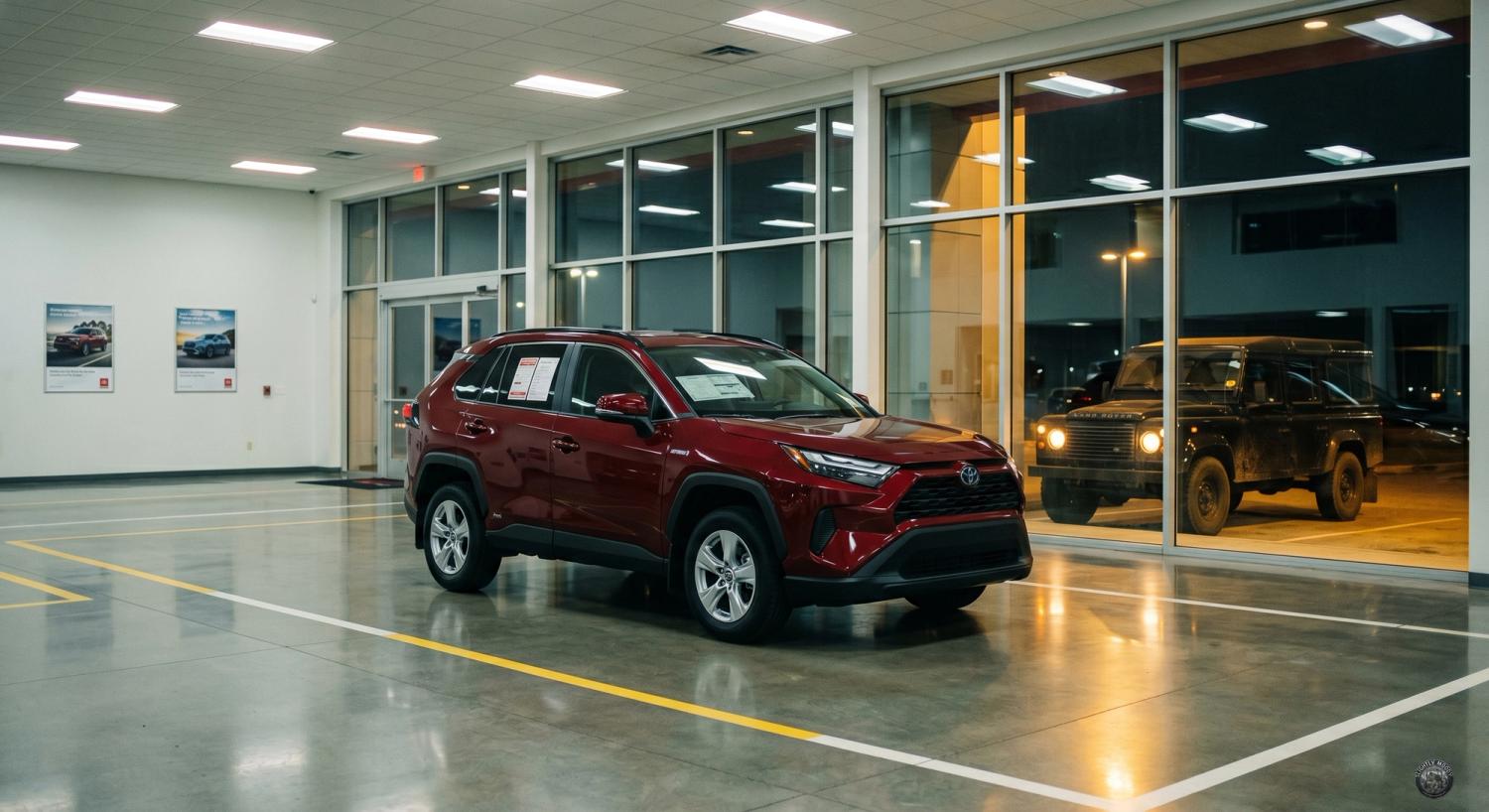
Dixon drove the RAV4 home that night. The seats did not massage. The headlights did not turn on automatically. The car had, and this was the detail that would haunt him for the next few months, an actual key, a metal one, that you put into a slot on the steering column and turned. He had not driven a car with a key in fifteen years. He sat in the driveway and turned the key off and turned the key on again. He did this three times. He laughed at himself. He thought, what have I done? He thought, this feels right. He thought both of these at once.
Two nights later he picked Taylor up for their second date. He pulled up to her front door in the RAV4. She came out of the house, beautiful in the same way as before, the perfume floating ahead of her, and she stopped at the curb and looked at the car, and she said, “Is this a rental?”
“No,” Dixon said quietly proudly. “I traded the Land Rover in,” he declared with the triumphant nature of someone that had slayed a great foe in battle. “I’m trying something new.”
Taylor looked at the RAV4. She looked at Dixon. She did not get in. She just closed the door that she had begun to open.
“Oh,” she said through the opened window. She said it quietly, with kindness, but with a deeper thought in the undertones. “Wow. Okay.”
There was a long pause.
“You know what,” Taylor said, “I think I’m going to try something new too. I’m sorry, Dixon. I had a really lovely time the other day. I just. I can’t.”
She turned around and walked back up the path to her front door. She closed it behind her. The porch light went off about thirty seconds later.
Dixon sat in his new RAV4 in front of her house for a full minute before he turned the metal key in the metal slot and drove home, and he did not know whether to feel devastated or relieved, and so he was both. In a sense he was shaken that this choice, that he had made for himself, would be met with such derision. But then, maybe this was yet another sign. A sign that the people here in this place were going to take issue with the choices he was going to make, and that he was going to have to get used to that.
The fourth parade entrant, Brooklyn was pleased to report, was, in her words “a real catch.”
“Her name is Jackie. She’s the chief marketing officer of a huge company that we all know. She lives in Buckhead. She is fifty-two. She is, on paper, exactly what we discussed.”
“On paper?” Dixon said.
“OK not paper. Electronically. Her profile is stellar. She sounds amazing. I sent her a message from your account. She responded.”
“Brooklyn,” Dixon said with some level of disapproval.
“You said I could.”
“I did say that.”
The exchange that followed was conducted, Dixon began to suspect within four messages, by a person who was not entirely Jackie. The replies came quickly during business hours and a bit more slowly at night. The replies were more polished than the way people correspond on dating apps, which is to say with a level of concise communication that often does not indicate a level of interest. These messages were well composed. They contained no typos. They made occasional reference to “my schedule” in a way that suggested the schedule was also a part of the conversation. He suggested a brunch the following Sunday. There was a pause of four hours. Then he received the following reply:
Hi Dixon, this is Monika from Jackie’s office.
Dixon, on his couch, said the word “what?” out loud.
Jackie has asked me to handle her social calendar while she’s in the middle of a product launch. She loved your photos and is excited to meet you. Sunday won’t work. She’s in Geneva this week. The first availability she has is three Sundays from now at 11:00 a.m. at — and a restaurant Dixon recognized as the kind of place where people did business they did not want to discuss in their offices. Does that work?
He stared at the message.
He typed: Yes.
He thought: I am being slotted into a CMO’s calendar by her secretary three weeks out for a first date and I have just said yes to it without thinking.
He thought: Brooklyn is going to win this round.
He arrived ten minutes early. Jackie arrived at 11:04, which was somehow exactly the right amount of late. It was the amount of late that suggests she had to squeeze in one more quick telephone call before a meeting and that she knew the meeting couldn’t start without her.
She was, in person, more striking than her photos. She had the particular smooth confidence of a woman who had spent thirty years being the most prepared person in every meeting and had stopped finding this remarkable. She wore light gray. She wore the right light gray. She floated through the dining room toward him and the maître d’ said good morning, Jackie, and the bartender said good morning, Jackie, and a man at a corner table stood up and said Jackie, and she gave each of them a single warm word and arrived at Dixon’s table without breaking stride.
“You must be Dixon,” she said.
He stood and said, “I must be.”
“I’ve been looking forward to this.” They both sat. “Tell me everything,” she said.
He told her some things. She listened. She asked the kinds of questions that good marketers ask, which were the kinds of questions that returned the conversation to the topic she found interesting. She liked his work. She had attended an event he had designed a few years back at the Sundance Film Festival in Park City. She did not name-drop, but she noted a conversation with ‘Bob’ that Dixon knew to mean Robert Redford, because he’d worked at the Sundance Film Festival and that’s what someone means when they say Bob in that context. She mentioned, in passing, the names of three or four people whose names people would recognize from news headlines. The names simply walked through her sentences the way names walk through the sentences of people who use them every day. She wasn’t bragging. She was just talking about the people in her circle. Dixon was familiar with this set of people, as they were often his clients. He knew that she had probably been brought to Sundance because she was important and important people are brought there to be around other important people.
Halfway through the eggs Benedict her phone vibrated.
She looked at the screen. She looked at Dixon.
“I’m so sorry,” she said. “I have to take this. It’s Mikey.”
“Mikey?”
“The Senator,” said to Dixon. “Hold on Dix. Mikey, hi… I’m with someone, can I… sure. Sure, of course. Yes. Yes. Tell him I said yes. Okay. Bye, honey.”
She put down the phone.
“Sorry. Where were we.” Dixon ignored the shortening of his name.
They finished brunch. She told him about her house, which was twelve thousand square feet on a huge wooded parcel in Buckhead, and her staff, and her trainer, and her travel schedule, which involved Geneva twice a quarter and Singapore three times a year, and Dixon listened to all of this and tried to imagine himself adjacent to it, the way he had imagined himself adjacent to it in the abstract when he had filled out the dating profile. He found, in the actual presence of an actual life like that, that the adjacency was harder to picture than he had expected. There was a chair here on offer. It was next to a very nice pool. He could sit on it. But he wasn’t sure this was the chair for him.
She paid the check before he could reach for it. She did this with the absent-minded reflex of a person who had paid a great many checks. They walked to the valet.
“I’d love to do this again,” Jackie said, with what seemed like real warmth.
“I’d love that too.”
“I’ll have Monika reach out.”
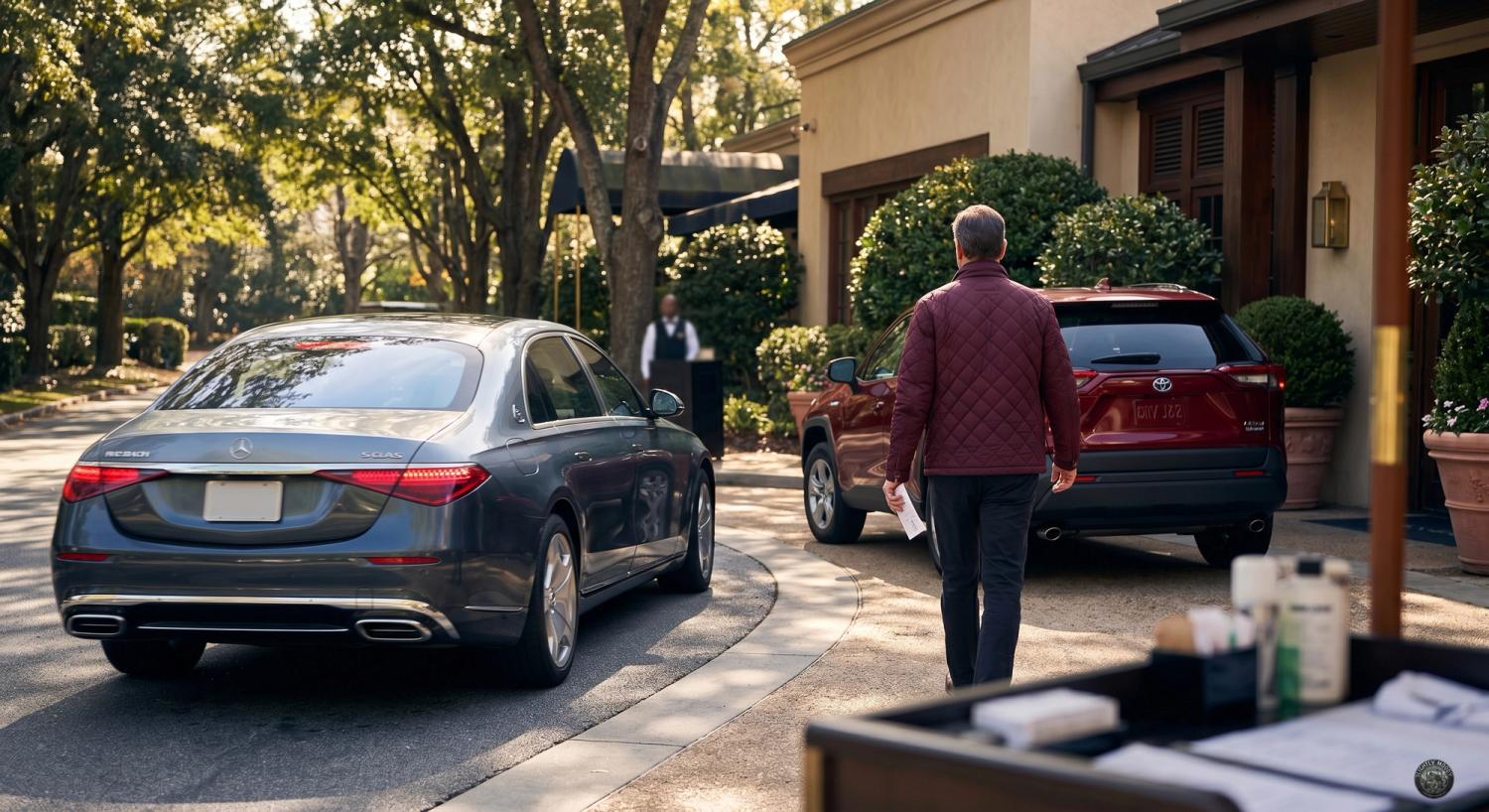
The valet brought her car around. It was a Maybach, which cost more than Dixon made in a couple of years, in a color that Dixon, owner of the big Pantone color book, could not name. The valet, who was approximately twenty-three, beamed at her. Here you go, Jackie. He winked. She kissed his cheek. She got in. She drove away.
A second valet, a different one, walked toward Dixon with a slip of paper in his hand.
“Ticket 3-2-9?”
“That’s me.”
“The dark red one?”
“That’s me.”
He brought the RAV4 around and put it gently in front of Dixon, who tipped him five dollars and got in, and turned the metal key in the metal slot, and sat there for a moment in the driver’s seat of the most popular model of the most popular brand. The RAV4 hummed at him pleasantly, as if to say, yes, hello, I am ready when you are, I will not let you down.
He thought of the Land Rover. He thought of the massaging seats. He thought of Taylor’s porch light going off.
He pulled out of the valet line. He turned onto Peachtree. The Maybach was no longer in sight. Dixon drove home in the small dark red hybrid that nobody at the restaurant had nodded to, and he did not know yet that this little vehicle was going to carry him sixty-five thousand miles in the next two years, and essentially become his home. He did not know that one day he would sigh and feel happy when he got back to this car after flying away and leaving it somewhere. He did not know yet that those miles he was going to travel were going to be the best miles of his life. And he also did not know yet that Jackie’s office was going to email him on Wednesday to say that her schedule had become unexpectedly complicated and that she would be in touch when things settled.
He had a feeling he wouldn’t hear from her again. And he knew that Bobby was up next again. The parade would continue on without Jackie.
Published April 26, 2026 from the road in Utah.
Enjoying the story? Support the work →
All text, images and music copyright (2026), Slightly Moody Creative LLC and Joe English.