The Sit Boy
Many Little Heartbreaks (Part I)

The thing about being recently single in Atlanta was the calendar of social obligations. Atlanta is a very society-friendly city. There were friends with shows, friends with openings, friends with daughters in plays. Twelve weeks had passed with Bobby and Brooklyn still engaged with gusto into the project of finding someone to brighten Dixon’s life. Dixon had been to four gallery openings, two very interesting pop-up restaurant concepts, and a public reading by a former colleague who was, even charitably speaking, not as good at either writing or interpretive dance as he pictured himself. Dixon had begun saying yes to things on principle. Showing up was the principle. Getting out was the principle. Dixon was also starting to get horny, but he was sticking to his intentional dating scheme and was proud of himself for bucking the typical male conventions.
That Saturday night, he had been invited to a gallery show by an artist that he did not know. This would be an important detail. The gallery was small, very small. And gritty. Very gritty. The designer in Dixon wanted to have a word with the owner. The artist was a friend of a friend whose work involved photographs of mailboxes blown up to wallpaper scale. That was the entire premise. Full stop. The artist was giving a talk. The talk was, and Dixon was choosing the kindest sentiment here between designers and artists, intentional.
Three minutes in he was losing interest. He looked across the room.
She was standing by a six-foot mailbox doing the exact thing he was doing. She was biting the inside of her cheek to suppress a face you do not want your face to make and have someone see. She had long dark hair, which was pulled up in what Dixon thought was a perfectly done up-do. Her long olive coat had a tinge of beige suede on the edges. She was wearing tight blue jeans that showed off the sculpted shape of her hips in a way that Dixon’s restrained state of sexual intention enjoyed seeing. Her tall leather boots had notes of cowgirl. His initial impression was that she might be from Nashville and also be from money. She was elegant. She was sexy. She was holding a glass of red wine, but didn’t seem to be drinking it. Her eyes met his, noticed that he was doing the thing with his cheek too, and they both broke out into wide smiles.
Dixon walked over and stood next to her, but he stood facing the giant mailbox and spoke to her while looking at the art.
“I have an experiment to propose,” he said quietly, when he had reached her side. “If you’re up for it.”
She looked at him, waiting for him to turn, but he kept his gaze focused on the mailbox. “OK. I’m always up for an experiment. Especially with a complete stranger.”
“How ‘bout tonight, we don’t use our real names. We can be anyone we like, but not our real selves. It will just be tonight. Whatever happens, happens. We see what we’re like when we don’t have to be ourselves.”
She considered him for a beat. Then it was two beats.
She reached her hand out toward him, offering to shake his hand. “I’m Margaret.”
“I am Anders and I have recently moved here from Sweden,” Dixon said with no trace of an accent.
“Anders is unconvincing,” she said with an unsuppressed grimace.
“Well, Margaret is worse.”
“Perhaps. But Margaret was my doll when I was a girl so Margaret stays. And don’t even think of calling me Maggie.”
Dixon (or Anders for tonight) finally turned toward her. He smiled the biggest smile he’d smiled in a long time and shook her hand warmly. It was actually more that he held her hand for a long while, feeling the warmth of her soft skin. He thought he could feel her pulse beating gently, but that he might have imagined.
What followed was the most engaged Dixon had been at a gallery opening in approximately seven years, not that he had been counting. He was just enjoying the moments as the evening unfolded.
They moved through the show together as a team. Margaret began. She stopped in front of an enormous photograph of a mailbox in front of a Waffle House and said, with the gravity of someone delivering serious art critique, “Late period.” Dixon nodded solemnly in agreement. “The composition references Eggleston, obviously, but the choice of subject feels like a rebuttal.” A man in a black turtleneck nearby paused. He had not been paying them attention until that moment.
“You’re art critics?” he said.
“Independent,” Margaret said gravely.
“Scandinavian school,” Dixon added.
The turtleneck man wanted to know what they thought of the next piece, which was a mailbox in a snowstorm. Margaret said it was, regrettably, derivative. Dixon said the snowstorm was clearly metaphorical and the artist had been writing in his recent interviews about his mother. Neither of them had read any interview by this artist or any artist for that matter. The turtleneck man asked about the price. Dixon and Margaret exchanged a look that meant we have gone too far, abort. Dixon motioned across the room and said, “Regina is the expert on pricing for items under ten million dollars.” He looped his arm through Margaret’s and pulled her away toward another group of unsuspecting patrons. Margaret said over her shoulder as they floated away: “we’ll let you sit with it.”
When they reached the back of the gallery, three different groups had asked their opinions of various mailboxes. Dixon had become, over the course of forty minutes, an authority on the sublime subtlety of the mailbox. When they slipped out the side door onto the sidewalk, Margaret was laughing in a way that suggested she had not laughed like that in some time.
“I think,” she said, “we have a moral obligation to leave before someone actually buys something on our advice.”
“Yes,” Dixon agreed heartily, “we have many more obligations tonight. We must push on into the night.” He pointed down the street toward. . . something. . . and then turned the other way. . . “This isn’t my neighborhood. So, let’s go this way!”
Before they could take a step, she stopped him. She reached into her bag. She pulled out a disposable camera. She handed it to him. “You are going to take the pictures tonight.”
It was one of those yellow disposable cameras, the kind with the clear plastic wheel and the wind lever and the analog click. The kind that are mostly on tables at weddings these days.
“Oh shit, I love these!” Dixon said. And he did, in fact, love them. He loved the grittiness of the pictures. He liked the simplicity. He considered them “old school.”
“Of course you do,” she said, and in doing so looked deeply into his eyes. She was considering this man that seemed to be radiating a very non-Scandinavian energy and she wanted to know him.
“Why do you have one of these?” he asked.
“Because I have a deep desire to remember the things I see in the world. And I often lose my phone,” with no hint of irony.
He held the camera up and said, “I’m taking your picture first.” He composed a nice shot of her with the gritty art gallery behind her. Dixon thought the light fell in a lovely way across her cheek bones. She smiled with all of herself.
“Here, I’m taking yours back,” she said, practically grabbing the camera out of Dixon’s hand with a swipe.
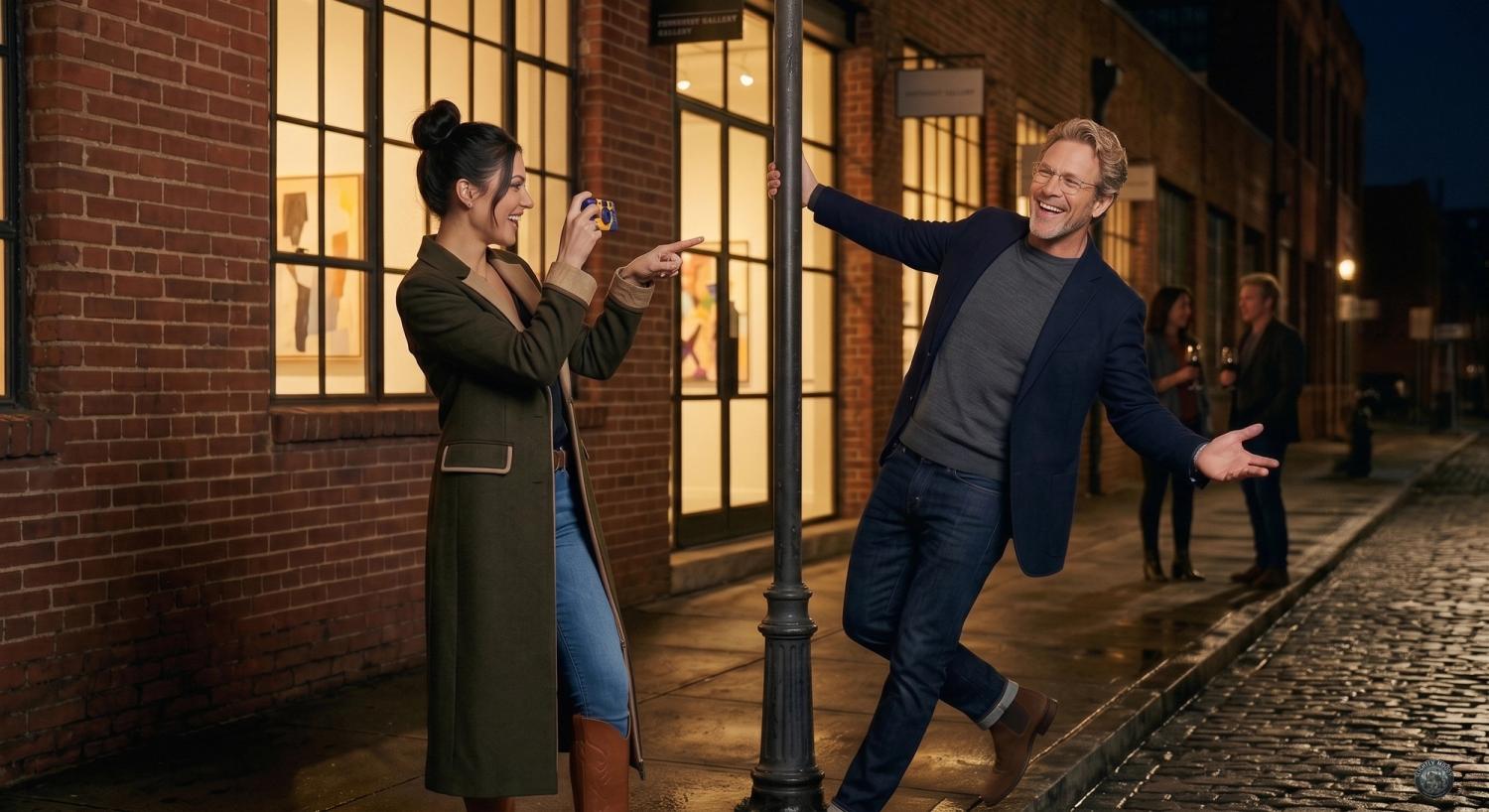
“I don’t usually allow that. . .” he started to say, but then caught himself. He wasn’t Dixon tonight. “I mean, in Scandinavia, men pose boldly for pictures!” He wrapped himself around a lamppost and did his best Gene Kelly impression in Singing in the Rain. after taking his picture, there were twenty-two exposures left on the camera.
They walked. Dixon actually danced along a little. He might have had ‘Singing in the Rain’ in his head now. It was one of those perfect Atlanta October nights when the city is at its best, an evening that asked for nothing except that you keep moving and notice things.
They stopped at a bar with a large pink neon Martini glass in the window that Dixon likely would have never gone into on his own. It was the kind of place that did not feel a need to advertise. Inside, two sofas, low light, a bartender who appeared to know everyone except them.
There was a young man sitting alone at the bar with a yellow legal pad in front of him and the apparent agony of a person preparing to do something big in his life. He was scrawling a bit too harshly on the page. He had crossed out three lines. He was muttering. He looked like he was struggling.
Margaret made eye contact with Dixon. Dixon made eye contact back. They sat on either side of the young man without discussing it.
“Are you proposing,” Margaret asked, “or breaking up?”
The young man, who was named Nathan, was startled. He looked at her. He turned and looked at Dixon, or Anders as it were tonight. He looked at his legal pad.
“Proposing,” he said into the pad.
“Tonight?” Margaret asked.
“In about an hour. She’s meeting me here,” Nathan said suddenly, wild-eyed.
“Would you like to read it to us?” Anders cut in.
Nathan said yes the way drowning men say yes to ropes. He read his proposal. It was earnest and verbose and he had used the word partnership eight times in two paragraphs. Margaret, with extreme tenderness, asked him to consider the possibility that partnership was a word people said when they had been to too many corporate retreats. Dixon suggested a complete re-write. The creative director in him took over: start with one specific memory, then go to emotions. “Tell her how you FEEL,” he commanded with a flourish, and a tinge of a Scandinavian accent. Together they helped him cut three paragraphs, rewrite the closing, and come to something of which even a Swede would be proud.
He rehearsed the new version. He got teary. They got teary. The bartender, who had been listening, high-fived them each one after another. The regulars looked on in wonder.
“Wait,” Dixon said, somewhere in the middle of the second rehearsal. “I should mention. I’m an ordained minister.” All of them gaped at him.
“You’re what?” asked Margaret, and this she really wanted to hear.
“It’s a long story. I married my friends a few years ago. I never let the certification lapse,” he said hurriedly to Margaret. He didn’t want to lose this opportunity, so he turned his attention back to Nathan. “I think we should marry you two tonight. It wouldn’t be a religious thing, of course, it’s more of a secular . . .ok an Internet thing, but legal I assure you.”
The young man’s face was painted in absolute puzzlement.
“Tonight?” Nathan said. “You could actually do this tonight?”
Nathan’s girlfriend, Maya, arrived twenty minutes later. There was a small private negotiation Dixon and Margaret could not hear. The girlfriend cried. The girlfriend nodded. The bartender cleared a corner of the bar and produced, unexpectedly, from a drawer beneath the register, what appeared to be a marriage certificate that had been waiting in that drawer for exactly this kind of evening.
Just a few minutes later, in front of seven strangers and one very enthusiastic bartender, Dixon/Anders from Scandanavia, performed a wedding ceremony in the back of the bar for two people whose names he had only learned a few minutes earlier and whose marriage would, by the bartender’s testimony and Dixon’s signature, become legally binding once filed at the courthouse on Monday morning.
Margaret signed the certificate first as the witness.
She wrote Margaret in clean, clear, penmanship. She handed it to Dixon who looked at it carefully for a moment. He noted that she had signed it Margaret. He still didn’t know her name. He signed the certificate and handed it to Maya.
They all hugged, even the bartender. Dixon/Anders bought a round for the bar. And then he and Margaret slipped outside.
Outside, on the sidewalk, Margaret looked at Dixon for a long moment.
“That is the strangest thing that has ever happened to me,” she said, “and I have SEEN SOME THINGS,” she said with emphasis, gesturing broadly in a sing-song manner along with the words.
“I have officially,” Dixon said, beaming broadly, “had a better night than I expected to have when I left home this evening.”
Margaret lifted the camera. She took his picture. Along with the wedding photos and some others Dixon had taken, there were now only a few more shots left on the twenty-four shot roll.
Together they walked east. They walked because neither of them was ready for the night to be over and walking gave the night more time to be itself.
They walked all the way to Ponce. The Krispy Kreme had its ‘hot light’ on, which was Atlanta speak for ‘the time is now! The doughnuts are coming off the conveyor belt at this exact moment and you would be a fool to walk past.’ They were not fools. They got two glazed each, fresh and warm enough to deform under their own heat, and they sat on the curb in front of the building eating them like teenagers.
There was a long quiet that was not at all awkward. Dixon was emitting his calm energy. Margaret was gladly soaking it up. She looked at him again and wondered, really wondered, who this man was beside her.
“This is the best date I have ever been on,” Margaret said. “And I do not even know your name.”
“Uh, yeah you do. I am Anders,” he protested.
“Well, I am not proposing we exchange them,” she said, but she did really want to know.
“Neither am I,” and he really wanted to know too.
She finished her doughnut. She reached into her bag.
“Take it,” she said, handing him the camera. “I have more at home. I think you have a unique eye. I watched you in the gallery. You actually looked at those dumb mailboxes. People don’t see the details. Here, you should have it.”
Dixon thought about his Virgo tendencies, which were all about details. “I haven’t taken a picture for myself in fifteen years.”
“That sounds like a good reason to start.”
He took the camera. He looked at it and thought about what it felt like to take pictures for art instead of work. He had a pang of longing.
He thought, sitting on the curb in front of the Krispy Kreme on Ponce, at one in the morning with sugar on his fingers, and a yellow plastic camera in his hand, that something felt different inside of him. He couldn’t have said what. The camera suddenly felt heavier than it had any reason to be.
“One more place,” she said. “I know a bar.” She took his hand and dragged him on-ward into the night.
The bar she knew was on Edgewood, dim and narrow and the kind of place that was almost certainly violating the fire code in any number of ways. It was the kind of place you had to know someone to get in. Margaret knew the right people. They got a small table in the back. They talked about nothing the way people talk about nothing when they are quietly aware that they just want to be with that person, no matter what is being discussed.
Around two-thirty, Dixon said he had to go to the bathroom. He didn’t ask where it was. Before he left the table, he turned and gave Margaret a long look.
“What?” she asked.
“I don’t know, nothing. Let’s talk when I get back. I really need to pee.” He turned and looked around in the dim light. He headed toward the back of the space, where bathrooms usually live, at least according to every architect that Dixon had ever studied.
The bathroom was at the end of a hallway that bent ninety degrees. There was a back door straight at the end of the hallway with a sign on it that, had Dixon read it, would have said something close to: “DO NOT EXIT - DOOR LOCKS BEHIND YOU.” He did not read it. He was a little lost thinking about Margaret’s dreamy face in the streetlight in front of the Krispy Kreme. He pushed the bar of the door because the door was directly in front of him, and the door swung open easily. Dixon stepped out into a small concrete loading dock behind the bar, and the door clicked shut behind him with the small precise sound of a lock closing very securely.
He turned around. He pushed. The door did not move.
He pulled. The door did not move.
He pounded. He pounded for ninety seconds before it occurred to him that there was music inside loud enough that no one would hear it. He felt warmth rush to his face and neck. He panicked a little.
He started running to the other side of the building, but he had to go all the way down the block. At the end of the street, he found construction blocking the road. He kept going another block and then finally circled back. He didn’t recognize anything. He finally found the bar’s door, but there was no longer a bouncer outside. It was almost 3:00AM. Too late to let new people in.
Dixon knocked hard on the door. After a few minutes, a large man finally opened it. He was not the bouncer from before. He did not recognize Dixon. Dixon tried to explain in the rushed voice of a man making a worse and worse impression that he had just been inside, that he had a friend at a back table, that he had stepped out the wrong door, and the man looked at him with the expression of a person who hears this story approximately once a weekend.
“What’s your friend’s name?” he asked.
Dixon opened his mouth. In what was a critical mistake, he waited too long and started to say, “I don’t actually. . .” He should have said ‘Margaret’ with confidence.
The door closed.
Dixon waited. Twenty minutes passed. Then it was thirty. He paced around. He looked at his watch a lot. No one came out.
Finally after nearly an hour, the door opened and a group of employees were making their way out to go home. Dixon explained in a panicked voice that he had gotten locked out. He explained that he had been on a date and that she must have thought he bailed. “Was there anyone left inside?” He asked.
“No, sorry. When it’s this late people leave from the entrance at the end of the building. We’re not supposed to be open this late, so we send people out through the apartment lobby,” said a very earnest young woman.
“Can I just go look?” he asked softly. She said yes and took him into the bar.
The table was empty.
One of the other bartenders was still cleaning glasses. Dixon described Margaret. The bartender remembered her. She stayed about twenty minutes. She had asked, twice, if he had seen where Dixon had gone. She looked upset.
Dixon walked over to the table. He looked on the floor and saw a folded cocktail napkin. It had something written on it. Dixon opened it.
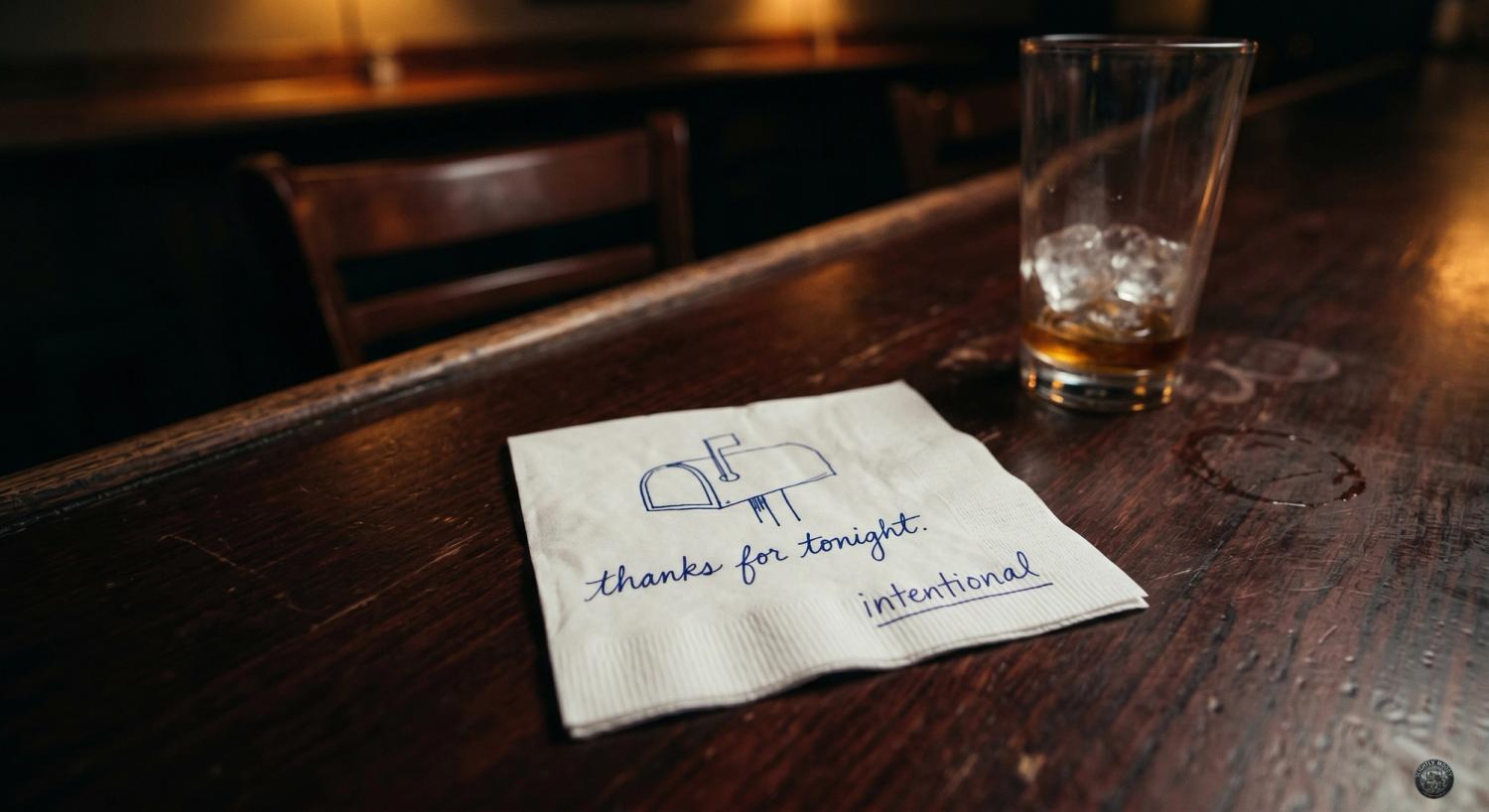
It was a small ink drawing of a mailbox with the word “intentional” below it. Underneath the drawing, in her perfect script with a small flourish, she had written:
Thanks for tonight.
That was all.
He turned the napkin over. He held it to the light. He flipped it again. There was no number. There was no clue where she had gone, or where she had come from, or how to find her.

Lyrics
[Intro]

[Verse 1]
I read the signs, I did the math, I thought we had a spark
Two strangers tipping toward each other in the dark
You were charming, you were funny, had me laughing at your jokes
But I guess some guys are mirrors — just reflections and some smoke
You said you'd be right back, and I waited there a while
Then I waited longer, sitting like a fool inside my smile

[Pre-Chorus]
It was electric, but I should have known
A man who's running disappears alone
You don't need a reason, you don't need to say
You can be a ghost in the middle of the day

[Chorus]
We met on a Saturday night
I thought you liked me but I guess that wasn't right
Tight jeans and my hair just right
I wanted your hands on me all night
But you slipped right out the door without a sound
You picked the night I cared and you walked away from me
I thought you liked me, but that wasn't right
And the worst part is I never got a goodbye
But hey — your loss, I'm moving on

[Verse 2]
It's Monday now, the sun is up, and I'm just sipping tea
Analyzing why you'd run from something good as me
Maybe I'm a little too much, or maybe you're just less
But I won't spend my afternoon cleaning up your mess
If you thought you'd find a girl who'd write your story for you
You picked the wrong direction — I've got my own things to do

[Pre-Chorus]
It was electric, but I should have known
A man who's running disappears alone
You don't need a reason, you don't need to say
You can be a ghost in the middle of the day

[Chorus]
We met on a Saturday night
I thought you liked me but I guess that wasn't right
Tight jeans and my hair just right
I wanted your hands on me all night
But you slipped right out the door without a sound
You picked the night I cared and you walked away from me
I thought you liked me, but that wasn't right
And the worst part is I never got a goodbye
But hey — your loss, I'm moving on

[Bridge]
I'm not the type to cry over a man who couldn't stay
I've got too much rhythm to be wasting on your way
You're a chapter I am closing, just a detour on the road
I'm dropping off your silence, yeah, I'm lightening the load
Lightening the load
Lightening the load

[Final Chorus]
We met on a Saturday night
I thought you liked me but I guess that wasn't right
Tight jeans and my hair just right
I wanted your hands on me all night
But you slipped right out the door without a sound
You picked the night I cared and you walked away from me
I thought you liked me, but that wasn't right
And the worst part is I never got a goodbye
But hey — your loss, I'm moving on
Yeah, your loss, I'm moving on

[Outro]
I'm too smart for the disappearing game
And I've already forgotten your name
Yeah, your loss
I'm moving on
He left the bar and walked back to the RAV4, which was a long way away. He sat in the driver’s seat for a while before turning the key. He reached in his pocket and pulled out the yellow disposable camera. On the camera roll were twenty exposures of a night that had briefly taken him away from his troubles. The photos were the only evidence of the night that would exist.
He drove through the quiet Atlanta streets back toward the freeway.
He thought, somewhere on the way home: she thinks I left her there.
He did not, for a long time afterward, know what to do with that thought.
Published May 8th, 2026 from the road in Utah.
Enjoying the story? Support the work →
All text, images and music copyright (2026), Slightly Moody Creative LLC and Joe English.