The Sit Boy
Prologue: The Shack

The little wood building had been in the process of dying for longer than Dixon had been alive.
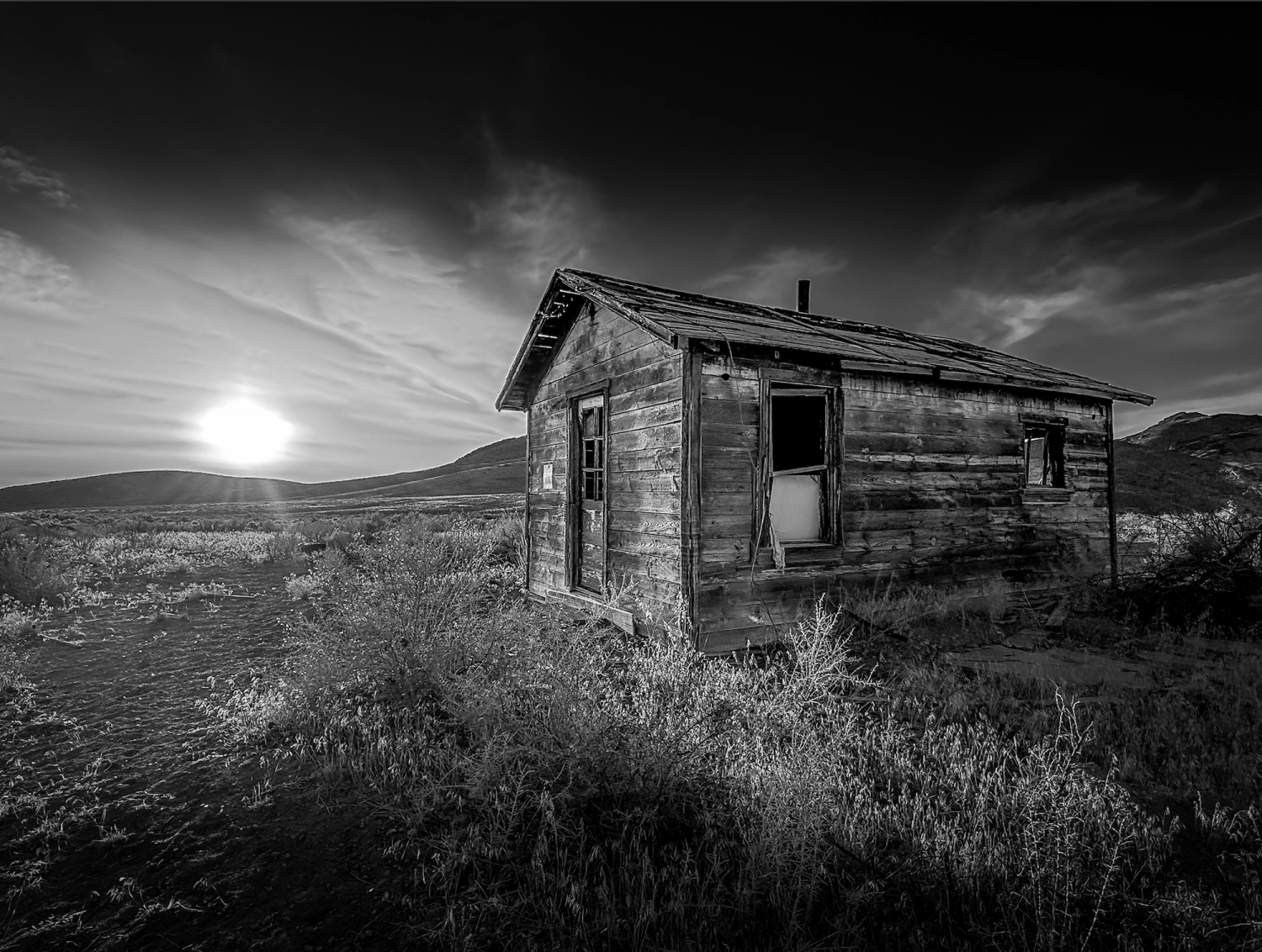
He could see that from the road, even at seventy-five miles an hour, but what caught him was that it was still standing. Still upright, still peaked, the roofline intact enough to hold its original shape against the sky. It was a small thing, maybe ten feet by twelve, the kind of wood structure a single person builds with their own hands when they’ve decided that this particular patch of sagebrush is where they’re going to make a go of it. The horizontal planks had gone silver-gold. Not grey, not brown, but something richer, as if the decades of wind and frost and the indifferent sun had burnished the wood into something finer than what the original ingredients would have made when put together. A stovepipe jutted from one side of the roof, rusted but still pointing upward, still committed to the idea of smoke and warmth even though no one had lit a fire in there for half a century. And on the front wall, next to the door that had lost the glass in its windows, but still hung solidly in its frame, someone had nailed a sign: NO TRESPASSING.
This caught Dixon’s attention. Someone still claimed this place. Someone, somewhere, still thought of this ten-by-twelve box of decaying wood in the middle of the Great Basin as theirs — enough to post a legal warning to whomever might venture into the sagebrush to get close enough for it to matter. Perhaps they were putting a padlock on a memory.
He drove on past as he thought about this. He drove maybe another quarter mile. Then he pulled the wine-red hybrid SUV onto the shoulder, which was not so much a shoulder as a suggestion of where the road ended and the limitless expanse of the Great Basin began.
The engine ticked in the silence and then shut itself off. That was the first thing you noticed about this place. The absolute, aggressive silence of central Nevada in December, the kind that doesn’t just mean the absence of sound but the presence of something larger: a quiet so vast it had texture, had weight, pressed against the windows of the car like water in a deep ocean.
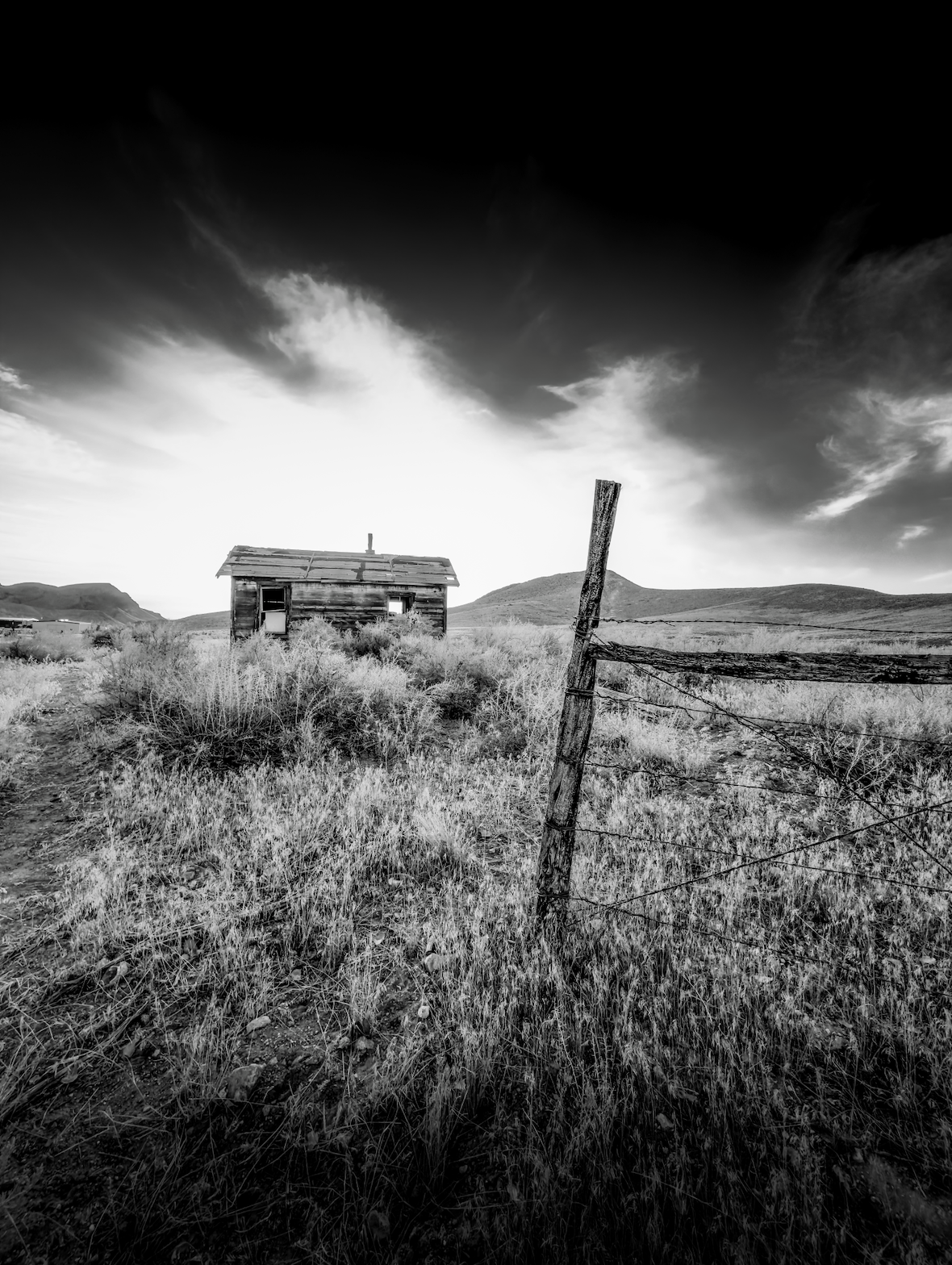
Dixon sat with his hands on the wheel and looked in the rearview mirror at the little building in the distance. Two hundred yards back, maybe less. Just a shape against the sky now, a dark interruption in the sagebrush. Beyond it, one just one side, he could see fence posts. They were the hand-cut type, leaning, connected by barbed wire that sagged between them. Someone had drawn a property line out here once. The land didn’t seem to have noticed.
Dixon knew he should keep driving. He still had five hours to Park City, the light was thinning, and this day had already been too long. He’d left Mammoth Lakes before dawn, chaining up the little SUV that contained his entire life in the dark to get off the mountain through two feet of fresh snow. The chain up process itself had taken forty-five minutes and involved a YouTube tutorial watched by headlamp, fingers so cold he’d had to close the phone protector with his nose. That had been at eight thousand feet and twelve degrees. This was lower, warmer in theory, but the wind on the basin floor was doing something that cold alone doesn’t do. It was finding every seam in his clothing, every gap between collar and neck, and delivering a personal message about the difference between a man who had not long ago lived in the very warm city of Atlanta and a landscape that didn’t care where he’d most recently called home.
He hadn’t learned how to dress for this yet. He would. But not today.
He had a pair of dogs to meet tonight: Windi, a German Shorthaired Pointer with an anxiety pronounced enough it could be considered a disorder, and Dylan, a grand-old mixed breed who had been rescued from a Utah road-side in a cardboard box as a puppy. Normally he would meet the owners and dogs in person, but due to the coordination of all of the parties’ complex schedules, a substitute sitter was covering for him today and he would not actually meet the owners before they flew out of the country. The owners, owing to the lack of an in-person meeting, had sent about fourteen texts in the last two days, each one more detailed than the last. The final one had include a hand-drawn map of Windi’s preferred walking route with arrows indicating where she liked to stop and sniff and where she absolutely must not be allowed to stop and sniff. Dylan could basically do as he pleased, because that’s what old good-boys are allowed to do.
The prep material had been extensive, but the detail that had stayed with Dixon was Windi’s backstory. Windi was a purebred hunting dog who was terrified of loud noises. The irony of this was not subtle — a pointing breed, built across generations to hold steady at the sound of a shotgun, who came apart at a car door slamming. She hadn’t made the cut. Guns were loud. So instead of spending her life flushing pheasants in rural Utah, she now lived in a very large and comfortable home right at the top of Park City’s Bear Hollow Drive, which in yet more irony was not more than 100 yards from a ski resort where the trigger-happy avalanche control team set off explosives every winter morning and she had to be driven miles from her own home just to go outside without shaking.
Dixon understood her. Not metaphorically of course. He literally understood the experience of being a creature designed for one life who had ended up in a completely different one and was trying to figure out how to stop flinching.
The last text from her owner had read: Thanks so much Dix! They’re going to LOVE you!!!
‘Dix.’ Everyone did this. Everyone took his name,Dixon, a name he liked, a name with weight and specificity and shaved it down to something that sounded like a fraternity nickname at best and an anatomical insult at worst. He had never once introduced himself as Dix. He introduced himself as Dixon, always, clearly, with both syllables, and within forty-eight hours every new person in his life had decided that was one syllable too many. People he worked with called him Dix. His clients called him Dix. Women he dated called him Dix. Homeowners whose dogs he cared for called him Dix. His Trusted Housesitters profile said ‘Dixon Davie’ and people still messaged him: Hey Dix, we’d love to have you watch our Labradoodle in Cincinati! He had considered, more than once, that this was a small and petty thing to be bothered by, and he had decided, more than once, that he didn’t care. His name was Dixon.
He should keep driving.
Instead, he got out of the car.
The wind hit him immediately. This was not the cold of Mammoth, which had been still and heavy and white with snow, but something leaner and meaner. The basin wind comes off a hundred miles of nothing and arrives with purpose. It went through his jacket like the jacket was more a garment in theory than in practice. This was not the worst cold he’d experienced, maybe not even today, but it certainly was the most personal. Where Mammoth had been indifferent, this wind was specific. It knew exactly where his collar gaped.
He walked along the highway toward the building anyway.
When he reached the closest part of the road to the little homestead. there was no fence, no driveway, no property line. There was no indication that the land between the highway and the homestead belonged to anyone who might object to a man in insufficient clothing trespassing on their century-old ruin. The sagebrush came up to his shins, stiff and grey-green, crackling like static as he pushed through it. The smell was immediate. It was a sharp, medicinal, ancient smell that the Great Basin gives off when the cold releases something in the brush, something that has been sitting in the plant’s chemistry for ten thousand years waiting for exactly this temperature to make itself known.
Lyrics
[Intro]

[Verse 1]
There's a tremor underneath me
That I cannot really name
A small unsteady kind of feeling
Like the ground is not the same
I have been the steady one
The man who held the line
But the line has started moving
And the moving feels like mine

[Pre-Chorus]
And the careful man inside me
Tries to tell me it's the road
But the road is just a pathway
And whatever's out there knows

[Chorus - BIG]
Tiny earthquakes on the highway
Tiny earthquakes in my chest
Something shaking something open
Something asking for the rest
I don't know what it's telling me
I don't know where it goes
But every mile of shaking
Tells me something in me knows
Something in me knows

[Verse 2]
There is a country I am crossing
That is also crossing me
Every mile undoes a little
Of the man I used to be
I do not feel the loss of him
I feel the room that he made
Like a house with all the windows open
Letting in the air for days

[Pre-Chorus]
And the careful man inside me
Tries to call it just a phase
But whatever's been awakened
Has been waiting all my days

[Chorus - BIG]
Tiny earthquakes on the highway
Tiny earthquakes in my chest
Something shaking something open
Something asking for the rest
I don't know what it's telling me
I don't know where it goes
But every mile of shaking
Tells me something in me knows
Something in me knows

[Bridge]
It's not fate
It's not luck
It's not something I can plan
It's a hand beneath the surface
Pulling levers on the man
I'm headed where I'm going
And I know I'm not there yet
But the shaking is the compass
And the compass won't forget
This is not a thought
This is not a choice
This is something underneath me
Speaking in my voice
And I would not have heard it
If I had not been lost
And I do not want it to stop
I do not want it to stop

[Final Chorus - BIG]
Tiny earthquakes on the highway
Tiny earthquakes in my chest
Something shaking something open
Something asking for the rest
I don't know what it's telling me
I don't know where it goes
But every mile of shaking
Tells me something in me knows
Something in me knows
Something in me knows

[Outro]
Something in me knows
Listen to the song that goes along with this chapter above.
Dixon breathed it in. He had not known this smell existed six months ago. Six months ago he had known the smell of suburban Atlanta in summer: cut grass, hot asphalt, the jasmine along the back fence that someone had planted and he had maintained and that was probably dead now because he wasn’t there to maintain it anymore. The house was in the process of becoming someone else’s now, and the jasmine would soon be someone else’s problem, and his lawn mower that he had used to cut the grass had been sold at an estate sale for forty dollars, which seemed like too little for a machine that had demanded so much of his Saturday mornings.
He started thinking about the lawn mower. He stopped himself.
This was a thing he was still trying to learn in his travels. He was trying to be more present in the moment. And the desert didn’t care about his lawn mower anyway. The basin didn’t need his backstory. The sagebrush and the rocks existed on a timeline that made his turbulent life look like just a blip in time. The homestead he was walking toward had outlasted whoever built it by many decades. This place was a reminder of the huge difference between the timescales of human life and the longevity of natural landscapes. Time was long out here.
He reached the building.
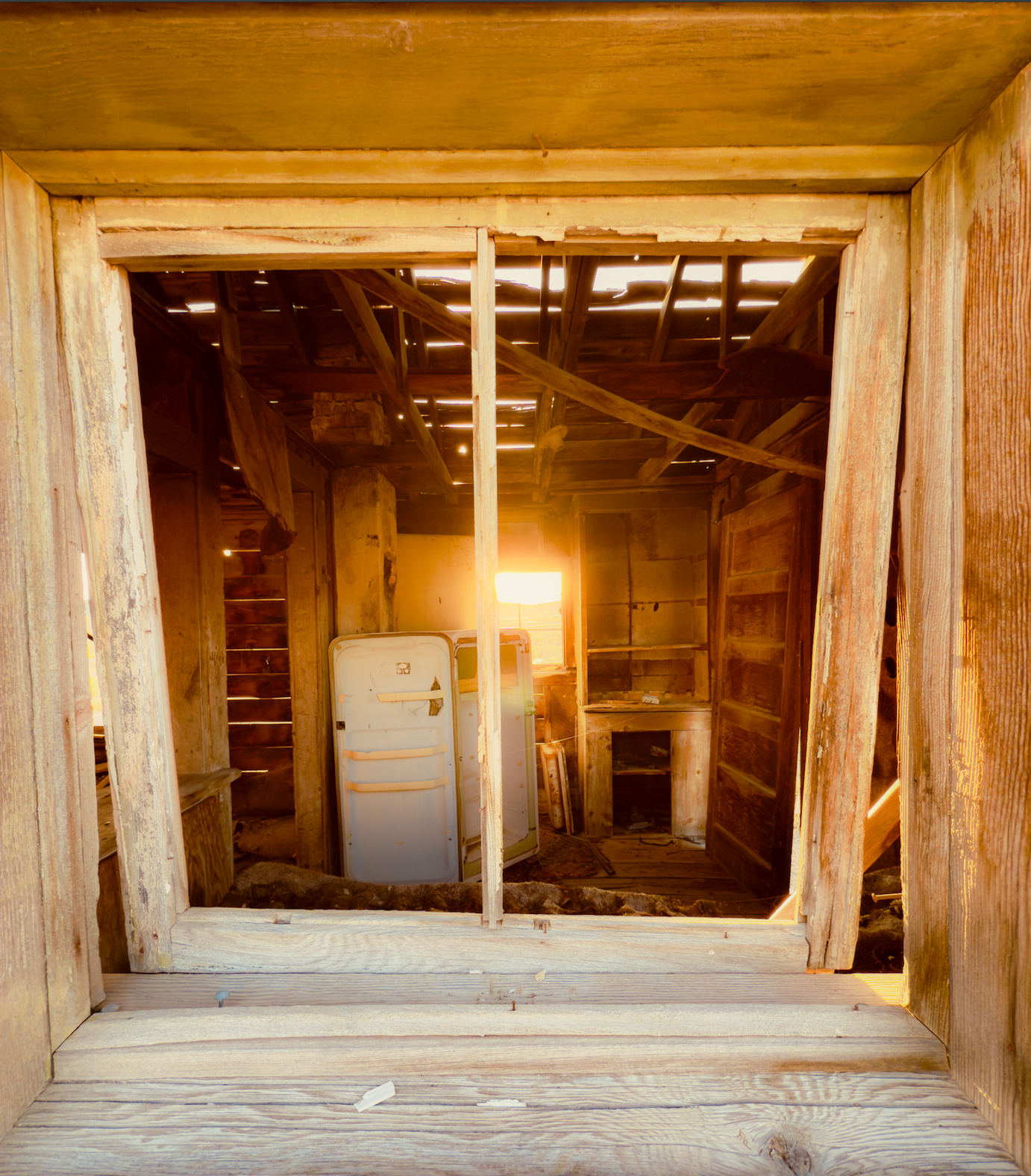
Up close it was even smaller than it had looked from the road. It was barely a room. The glass in the windows was gone but through the frames he could see the interior lit by the low sun pouring through gaps in the roof. Slats of gold light fell across the wreckage like a church nobody attended anymore. And there, in the middle of it, standing upright, door hanging open, inexplicably present, was a sturdy old refrigerator. Rounded at the corners, white enamel gone to cream and rust. It was still there. Everything else had been taken or fallen apart. The furniture, the fixtures, whatever had made this a home, but the refrigerator had stayed, too heavy to carry out, too solid to collapse, standing in the ruins of someone’s kitchen keeping nothing cold for no one.
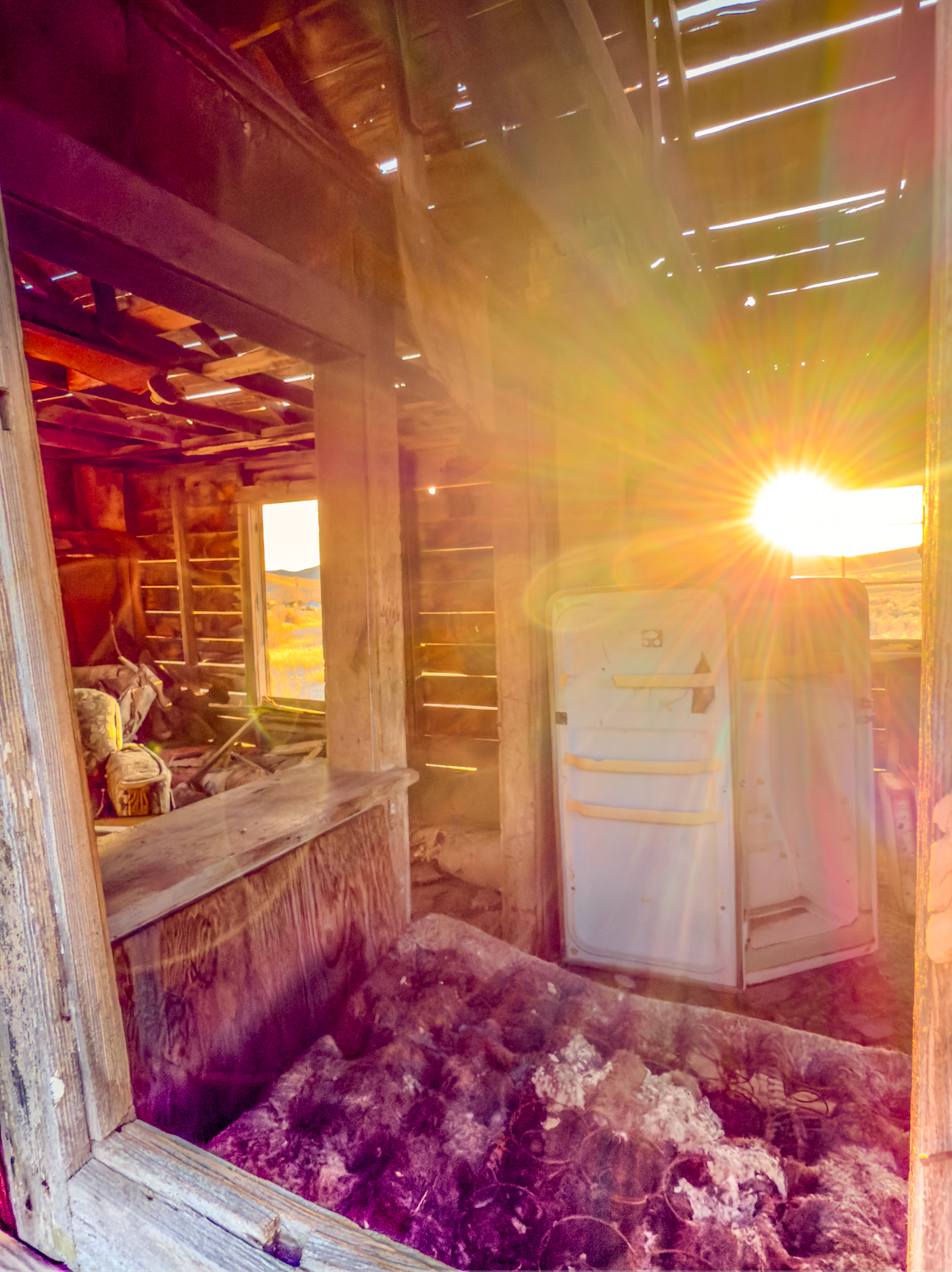
Dixon stared at it through the window frame and felt something move in his chest that he didn’t have a name for.
Someone had opened that refrigerator every morning. Someone had reached in for milk, for eggs, for whatever people kept in their kitchens in the middle of the Nevada desert in 1940 or 1950 or whenever this place had been alive. There had been shelves on the back wall. He could see their shadows, the brackets still bolted to the studs. Someone had organized things on those shelves. Someone had swept the floor that was now dirt and splinter. Someone had hauled wood and nails and a refrigerator out here. An appliance that required electricity, which meant a generator and gasoline, and also meant regular trips to whatever town existed within range to get that gas. To Dixon this all meant a commitment to this place that was almost incomprehensible standing here now. They had decided that this exact spot in the Great Basin, with all its hardships, was where they would make a life.
And then they had left. Or died. Or both. And the refrigerator had stayed. And the building had stayed. And the land and the sky had stayed. The only things that hadn’t lasted were the people.
It occurred to Dixon, with a clarity that the cold sharpened rather than dulled, that his house in Atlanta had contained a refrigerator that cost more than some people’s cars, and it was someone else’s now, and it didn’t mean even one single thing to him. But this one, this rusted relic in a ruin on Nevada Highway 6, this one he understood. This one had been carried out here by someone who believed in the life they were building. The one in Atlanta had been chosen from a catalog to match the countertops.
He would later learn that there was always a refrigerator. Every homestead, every shack, every abandoned ranch house from Nevada to Idaho to Oregon seemed to have its refrigerator still there. You could strip out the furniture, pull the copper, salvage the glass, but the refrigerator stayed. Sometimes it was inside. Often it was outside, lying on its side in the yard, with its door opened to the sky like a mouth that had forgotten how to close. The refrigerator, after all, was the heaviest thing in the house. It was the last thing standing. It was the answer to the question: what was too heavy to take with you when you left?
It was a question Dixon was beginning to have some thoughts about.
He pulled out his camera phone. His good camera was in the backseat, in its bag, under a second bag, which was the dog bag. The dog bag contained three leashes of varying lengths, a collapsible water bowl, a pouch of training treats (grain-free, because dogs like Windi and Dylan don’t deserve grain in their treats), a bright orange pet first-aid kit that had already been used more than once, two different brushes, a bottle of lavender oil for dogs with anxiety, a salve for helping with dry dog noses, and a large box of plastic bags for purposes that did not require further description. He had started assembling this bag three months ago. It had started as a Ziploc baggie with some treats in it and had evolved, through a process he could not entirely explain, into something that a very organized veterinary Mary Poppins might carry into battle.
The good camera was under all of that. The phone would do.
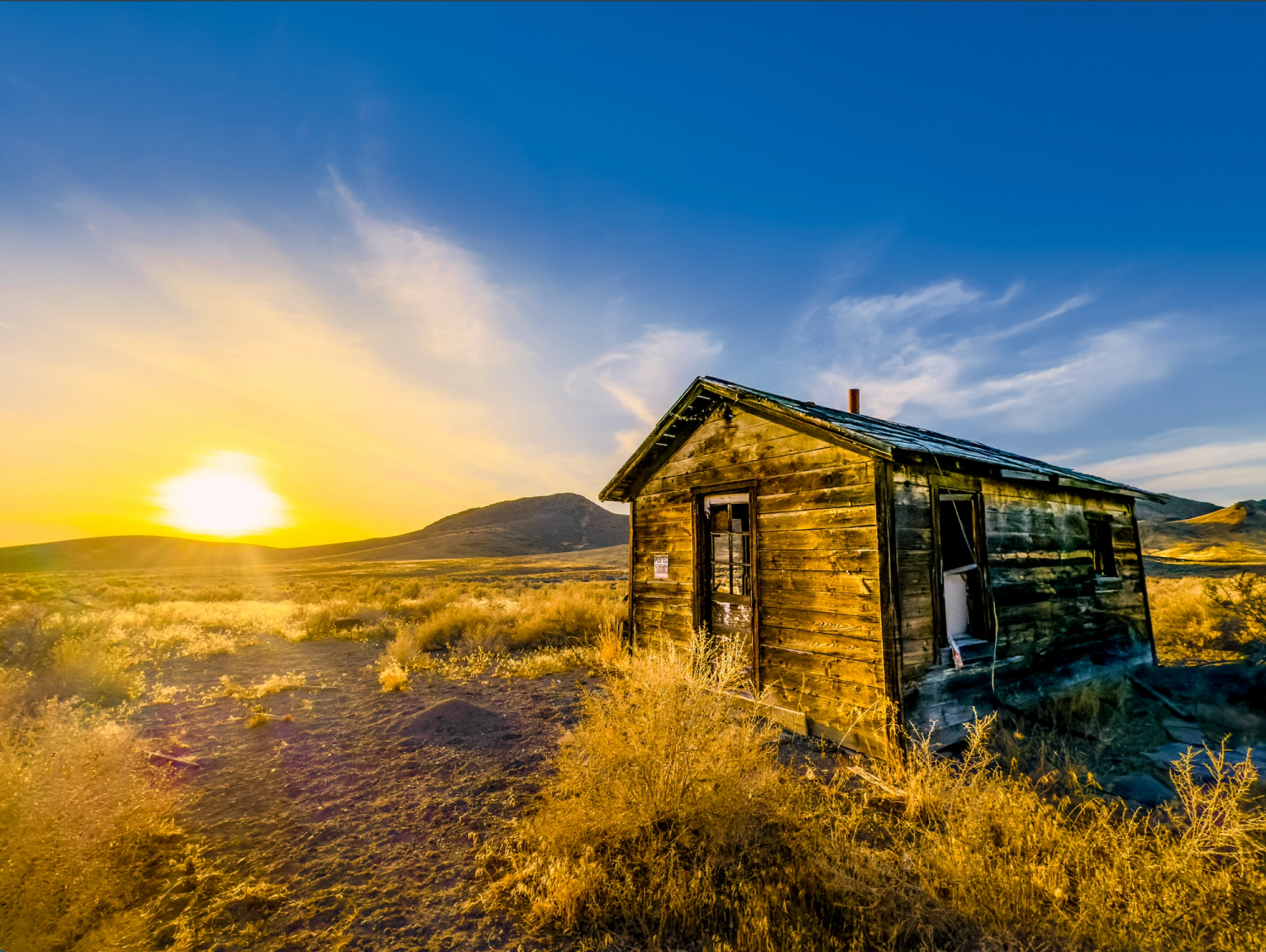
He walked the perimeter. He shot the building from the east with the setting sun behind it, the sagebrush turning copper in the last light, the whole scene drenched in a golden warmth that made the ruin look less sadness and more like a long, dignified sleep. He shot it head-on in the flat grey light from the north, the peaked roof centered in the frame, the ‘No Trespassing’ sign legible, the wood grain so sharp and detailed that you could count the decades in the silver lines. He shot the hand cut fence posts, the barbed wire sagging between them, the building small and alone in the background. He shot the interior through the window, with the refrigerator, the slats of light, and the shelves. This was the one. He knew it before he lowered the phone. Something about framing a life through a window, looking in from the outside at what remained.
They photos were good. All of them. He could see that immediately, even on the phone’s screen with his fingers going numb and the wind trying to take the device out of his hands. The compositions were nice with the building grounded and stubborn, the sky soaring and indifferent. But they captured a feeling he couldn’t name in words. He recognized it instantly in the images. It was loneliness, maybe. But not the desperate kind. The kind that had space around it. The kind of loneliness that he might see someone choosing. He felt something in this place that he had not felt before. Within the loneliness, and around it, he felt an ache of truly belonging to a place.
Dixon did not know, standing there, losing feeling in his fingers, that these photographs would be the seed of something in him and mean something to many others. He didn’t know that within a year, he would have shot hundreds of buildings like this one across the Great Basin of Nevada, Utah, Idaho, and Oregon in search of the elusive feeling that he first felt here. He didn’t know the collection would become a thing he called ‘Slightly Moody’, because he felt like pictures of aging and abandoned things was pretty fucking moody, and that thousands of people would eventually follow them. He didn’t know so many people would also be looking for the ache of belonging that he would capture in these places. And the people would construct from those images a version of him that was romantic and solitary and deep. The would impose on him that he was the desert poet, the wandering artist, the man whom had left everything behind to find himself in the silence of the American West.
But these particular photographs, the Highway 6 set, the first ones, the ones being taken right now with numb fingers in fading light, he would keep private. For a year. He would shoot and publish hundreds of other homesteads, establish the style, build the following, and never once post the images that started it all. They were too close to him. Too raw. Too much his. They would eventually surface as the three-hundredth post, slipped into the feed as if they were just another set of ruins, and only he would know that they were the origin. That this was the shack that had stopped a man on a highway and made him reach for the camera instead of driving past.
The followers would not know this. They would not be wrong about him, exactly. The picture of him would just be incomplete.
The origin story, the one the followers would eventually tell themselves, did not include the part where he designed big pop culture moments and events that people would know the names of. It did not include the part where he was far from destitute and was doing all of this, the wandering, the dog sitting, the carrying what he owned in a little SUV, the sleeping in strangers’ houses, entirely by choice. It did not include the part where he spoke a few languages, most of them badly, or could read an astrological birth chart with the precision of an accountant. Or that he had once been very good at a sport that most of his followers had never heard of. It did not include the part where a woman had recently spilled candle wax on a small dog during an evening that had started with excellent cooking and ended with Dixon trying to figure out knot work he had no business attempting, and the answer to the evening’s most pressing question turned out to be: how do you get candle wax out of dog fur? And they certainly didn’t know that Dixon had the care and patience to spend four days getting wax out of this fur attached to a dog who seriously did not want to be rubbed with olive oil and warm compresses. There was a lot more to the story than they knew.
They would see the photographs and feel something. The would see the loneliness, the beauty, the stripped-down simplicity of a life lived close to the land, and they would think: I know this man. I understand him.
He looked at the photographs one more time, scrolling through them with a numb thumb. The golden one. The stark one. The empty fence posts. The refrigerator through the window. Then he put the phone in his pocket and looked at the actual building, which was still there, still silver, still not caring whether he photographed it or not.
“You’re doing a great job,” he said to it. It was a thing he usually said to animals, but it felt appropriate here. The building had been doing its job, standing, sheltering, being a place, for a very long time, with no one to thank it.
The wind picked up. The sagebrush rattled. Somewhere to the northeast, very far away, a set of headlights appeared on the highway and eventually passed without slowing. The first car he’d seen in hours.
Dixon turned and walked back through the sagebrush toward the SUV with the “Tell your dog I said ‘Hi’” bumper-sticker. His fingers were stiff. His nose was running in a way that was not dignified but was, at this point, his body’s honest response to conditions he had not yet learned to prepare for. He was fifty-two years old, though people reliably told him he looked forty, and his body was just adjusting to a new environmental reality that was harsher, more extreme and far colder than suburban Atlanta. The sturdy boots, lined guide pants, heavy coats, and gloves with built-in heaters would come later, and they would definitely help.
He got in the car. He turned the heater to maximum. He sat for a moment, looking through the windshield at the nothing. He looked at the sagebrush, the foothills, the last ember of light along the ridge line, and he thought about how he had gotten here. Not the driving route, though that was its own kind of story. He had left Mammoth in the dark and trusted his phone to get him to the highway, and his phone had repaid that trust by sending him down a forest road that hadn’t been plowed, possibly ever, toward a turn that existed only in the imagination of a computer. He had sat in the RAV4, chains still on, staring at a wall of untracked snow across what his screen cheerfully insisted was a road, and had his first real lesson in not letting a GPS make decisions for a human. He’d turned around, found the actual highway, and promised himself he’d figure out how to download maps before the next time he drove into the middle of nowhere without cell service.
That had been this morning. It felt like a week ago.
Before this morning, there had been a different set of dogs to look after in another town, where he’d temporarily moved his life of temporaryness. Before that were other houses and other towns and other dogs that weren’t his. And the countless miles spent driving between them: the mountain homes, the lakefront estates with elevators, the straight up no doubt about it mansions with sprawling wings he didn’t go in, the gourmet kitchens, the occasional climbing walls and the hot tubs overlooking expansive valleys. Before all of that there had been one house that was his, and it had contained a life that fit on paper but didn’t fit in his chest, and then that house had contained nothing, and it would eventually contain someone else.
He was not sad about this. That was the thing that surprised him most, standing in the chronological wreckage of the last sixteen months. He was not sad. He was not angry. He was cold, and he was alone, and he was driving a car that nobody respected toward a pair of dogs he hadn’t met yet, in a state he hadn’t planned to be in, living a life that no one who thought they knew him would recognize.
And he was, for reasons he could not quite articulate and did not need to, okay.
More than okay. Something that didn’t have a word yet. Something that had to do with the building, and the sky, and the dog supplies in the backseat, and the fact that he had pulled over on a highway in the middle of nowhere to take a picture of a ruin because something in it spoke to something in him, and that he had said “you’re doing a great job” to a pile of silver wood, and that he had meant it.
He put the car in drive. The heater was finally doing its job. The highway stretched northeast, straight and empty and certain in a way that very few things in his life were, and that certainty, the road’s certainty, not his, was enough.
He drove toward Park City. Toward Windi and her fear of explosions and her sweet aging companion. Toward the big house at the top of Bear Hollow Drive where elk wandered through the yard and moose stood in the road like they held the mortgage. Toward a life that would have been unrecognizable to the man he’d been eighteen months ago; the one in Atlanta, the one with the lawn mower and the matching refrigerator and the clear idea of who he thought he was.
The photographs sat in his phone, unseen by anyone but him.
They would not stay that way.
He drove northeast into the gathering dark, and the homestead shrank in the mirror until it was just another shape in the Great Basin, just another thing that someone had built and left behind.
Like all of them. Like all of us.
The highway hummed. The heater blew. Somewhere in the backseat, the dog bag shifted as the car took a curve, and a single grain-free treat rolled out of its pouch and came to rest against the good camera, which was still in its case, which was still under the bag, which was still everything he needed and nothing he didn’t.
Somewhere west of him, or around him, or right exactly here, a life was waiting that he hadn’t built yet.
He just didn’t know its shape.
Published from the road in Twin Falls, Idaho.
Enjoying the story? Support the work →
All text, images and music copyright (2026), Slightly Moody Creative LLC and Joe English.